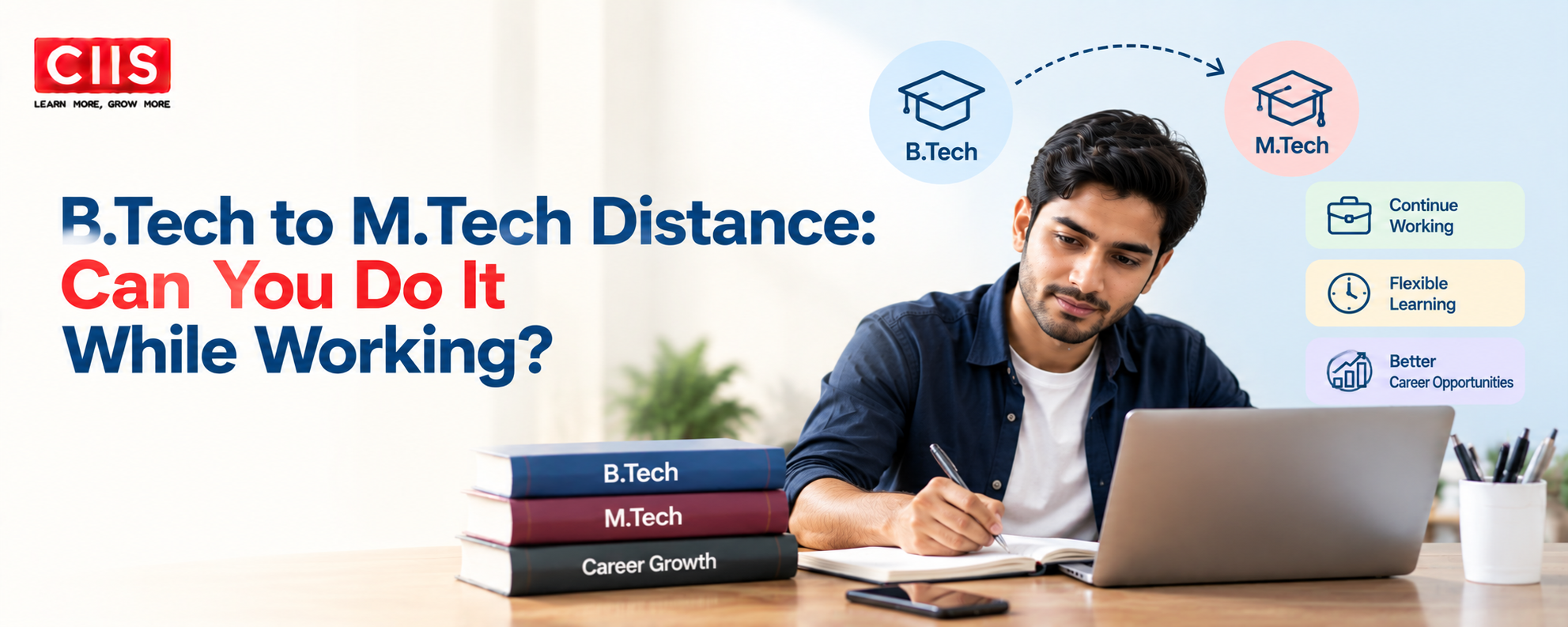
If you are a Bachelor of Technology (B.Tech) graduate trying to decide what to do next, the M.Tech vs MBA debate is one of the most important career crossroads you will face. Both are respected postgraduate qualifications. Both can significantly increase your salary. But they take your career in completely different directions and choosing the wrong one can cost you years of misdirected effort.
This complete 2026 guide compares M.Tech and MBA across every dimension that matters to an engineer: salary, career direction, eligibility, fees, duration, government job eligibility, and which option is available through distance and online mode for working professionals.
⚡ Quick Answer – M.Tech vs MBA: Which Is Better for Engineers in 2026?
- Choose M.Tech if you want to deepen technical expertise, pursue R&D, become an engineering lecturer, or advance in core engineering roles
- Choose MBA if you want to move into management, business leadership, consulting, or switch from a purely technical role to a business-facing career
- Salary after M.Tech: ₹6.0 – ₹14.0 LPA (specialization and employer dependent)
- Salary after MBA: ₹7.0 – ₹18.0 LPA (specialization and institution dependent)
- Both available in distance mode for working engineers no need to leave your job
- GATE required? For M.Tech at IIT/NIT – yes. For distance M.Tech – no. For MBA – no.
Not Sure Whether M.Tech or MBA Is Right for You?
Get free 1-on-1 counselling from CIIS India Mumbai’s most trusted education consultancy with 9+ years of experience and 50,000+ students enrolled.
1. M.Tech vs MBA – The Fundamental Difference
Before comparing salary, fees, and eligibility, you need to understand what each qualification fundamentally does to your career trajectory:
| Parameter | M.Tech | MBA (Master of Business Administration) |
|---|---|---|
| Core purpose | Deepens technical expertise in your engineering discipline | Develops business, management, and leadership skills |
| Career direction | Senior engineer, R&D specialist, engineering lecturer, technical lead | Project manager, business analyst, product manager, operations head, C-suite |
| Who should choose it | Engineers who love their technical domain and want to go deeper | Engineers who want to lead teams, manage businesses, or pivot to consulting |
| Salary ceiling (India) | ₹8 – ₹25 LPA (IIT M.Tech graduates in premium roles) | ₹10 – ₹35 LPA (IIM MBA graduates in top management roles) |
| International recognition | Strong in engineering-heavy countries (Germany, Japan, South Korea) | Strong globally especially in business, consulting, and BFSI sectors |
| Available in distance mode | Yes AICTE approved M.Tech distance programs exist | Yes UGC-DEB approved MBA distance and online programs available |
2. M.Tech vs MBA – Eligibility Comparison
| Eligibility Parameter | M.Tech | MBA |
|---|---|---|
| Minimum qualification | B.Tech / B.E. / BSc Engineering with 50–60% marks | Any bachelor’s degree with 50% marks — B.Tech, BA, BCom, BSc all accepted |
| Entrance exam (regular mode) | GATE (mandatory for IITs, NITs, and top government institutes) | CAT, XAT, GMAT, MAT, CMAT (for top B-schools); not required for distance MBA |
| Entrance exam (distance mode) | Not required at most AICTE-approved distance universities | Not required at most UGC-DEB approved distance MBA programs |
| Work experience required | Not mandatory for most; some distance programs prefer working engineers | Not mandatory for distance MBA; 2–5 years preferred for premium 1-year MBA programs |
| Can non-engineers apply? | Generally no — B.Tech / B.E. required | Yes — MBA is open to all graduates regardless of discipline |
Long tail insight: “Can I do MBA after B.Tech?” Yes, absolutely. MBA after B.Tech is one of the most common career transitions in India. A B.Tech degree qualifies you for MBA admission at all levels — from IIMs (via CAT) to distance MBA programs (via direct merit-based admission). Many top MBA graduates in India come from an engineering background, and a B.Tech + MBA combination is particularly valued in consulting, fintech, and product management roles.
3. M.Tech vs MBA – Salary Comparison 2026
This is the comparison most engineers care about most. Here is a realistic salary breakdown by experience level and institution:
| Stage | M.Tech Salary (India) | MBA Salary (India) |
|---|---|---|
| Fresher / Entry-level (0–2 years post-PG) | ₹5.0 – ₹8.5 LPA | ₹6.0 – ₹10.0 LPA |
| Mid-level (3–6 years post-PG) | ₹8.0 – ₹14.0 LPA | ₹10.0 – ₹18.0 LPA |
| Senior level (7+ years post-PG) | ₹12.0 – ₹22.0 LPA | ₹15.0 – ₹30.0 LPA+ |
| IIT M.Tech / IIM MBA (top institute) | ₹14.0 – ₹25.0 LPA (campus placement) | ₹18.0 – ₹35.0 LPA (campus placement) |
| Distance / online mode (working professional) | 20%–35% salary increase via promotion after completion | 25%–45% salary increase via lateral hire or promotion after completion |
Long tail insight: “What is the MBA vs M.Tech salary difference for engineers in India?” On average, MBA graduates from top institutions earn 15–30% more than M.Tech graduates at the same experience level, because MBA opens access to management and business roles that typically carry higher pay bands than specialist engineering roles. However, M.Tech from IIT or NIT in a high-demand specialization (AI/ML, Data Science, VLSI) can match or exceed MBA salaries in the right sector.
4. M.Tech vs MBA – Fees Comparison 2026
| Mode / Institution Type | M.Tech Fees | MBA Course Fees |
|---|---|---|
| Government university (regular mode) | ₹50,000 – ₹2,00,000 (IITs/NITs) | ₹1,00,000 – ₹3,00,000 (state govt. B-schools) |
| Premium private regular (IIMs, top B-schools) | ₹3,00,000 – ₹8,00,000 (top private tech universities) | ₹15,00,000 – ₹25,00,000+ (IIMs, XLRI, ISB) |
| Distance / online mode (state open university) | ₹40,000 – ₹75,000 | ₹30,000 – ₹55,000 |
| Distance / online mode (NAAC A+ private university) | ₹90,000 – ₹1,40,000 | ₹80,000 – ₹1,60,000 |
| Online MBA fees (leading online platforms) | N/A | ₹1,00,000 – ₹1,80,000 (Chandigarh, LPU, Amity Online) |
For a complete M.Tech distance fee breakdown by branch and university, read: M.Tech Distance Education Fees 2026 – University wise List
For a complete MBA distance fee breakdown, read: MBA Distance Education Fees 2026 – University wise Comparison
5. M.Tech vs MBA – Career Paths Compared
| Career Path | M.Tech Opens This Door | MBA Opens This Door |
|---|---|---|
| Senior / Principal Engineer | Strong | Limited |
| R&D Scientist / Research Engineer | Very Strong | Not typical |
| Engineering College Lecturer / Assistant Professor | M.Tech is mandatory for this role | Not accepted for engineering faculty |
| Project Manager / Programme Manager | Partial with PMP or experience | Strong |
| Product Manager | Partial with B.Tech + experience | Very Strong (B.Tech + MBA is ideal combo) |
| Management Consultant | Rarely | Very Strong |
| Business Analyst | Partial technical BA roles | Strong for business-side BA roles |
| PSU / Government Management Trainee | For technical MT posts | For management MT posts |
| Entrepreneur / Business Founder | Partial technical product founders | MBA provides business framework for founders |
| C-Suite / Director level (COO, CTO, CEO) | Partial CTO track | Strong MBA is the standard pathway |
6. M.Tech for Engineers – When It Is the Right Choice
Choose M.Tech if your career priorities align with any of the following:
| Situation | Why M.Tech Is the Better Choice |
|---|---|
| You want to become an engineering lecturer or professor | M.Tech is mandatory for assistant professor eligibility in engineering colleges; MBA does not qualify |
| You work in a core engineering role and want a promotion | M.Tech signals advanced technical expertise to engineering employers and PSU grade committees |
| You want to qualify for GATE-based PSU recruitment or IIT/NIT admissions | GATE score is primarily relevant for M.Tech track; MBA track uses CAT/XAT |
| You are in R&D, product development, or a specialised technical domain | M.Tech provides domain depth that MBA cannot offer for technical research roles |
| You want to migrate to Germany, Japan, or South Korea for engineering work | M.Tech is highly recognised in manufacturing-heavy economies; MBA is less valued for technical visas |
For details on which M.Tech specialization has the most demand in 2026, read: M.Tech Specializations List: Which Branch Has Most Demand?
For complete eligibility, validity, and AICTE approval details for the M.Tech distance route, read: M.Tech Distance Education: Is It Valid & AICTE Approved? Complete Guide 2026
7. MBA for Engineers – When It Is the Right Choice
Choose an MBA if your career priorities align with any of the following:
| Situation | Why MBA Is the Better Choice |
|---|---|
| You are tired of purely technical work and want to lead teams or manage projects | MBA shifts you from individual contributor to team leader and decision-maker |
| You want to work in consulting, fintech, e-commerce, or FMCG | These sectors actively prefer B.Tech + MBA combination for business-facing roles |
| You want to become a product manager at a tech company | Product management is increasingly MBA-preferred; B.Tech + MBA is the gold standard combination |
| You are planning to start your own business | MBA provides the business, finance, operations, and marketing framework for founders |
| You want to work in banking, NBFC, or financial services | MBA Finance from a recognised university opens banking, investment, and treasury roles |
| You want higher salary faster through lateral hire into a management role | MBA opens management-band salary scales; M.Tech stays in technical salary bands |
For a complete guide on the MBA distance education program eligibility, admission, and universities read: MBA Distance Education: Everything You Need to Know in 2026
Still not sure which is right for you? Our counsellors assess your current role, salary, career goal, and budget and give you a clear recommendation in 15 minutes. Get free guidance →
8. M.Tech vs MBA For Government Jobs
| Government Job Type | M.Tech Advantage | MBA Advantage |
|---|---|---|
| PSU Technical MT (ONGC, BHEL, SAIL) | Strong M.Tech preferred for technical stream MT posts | Partial MBA accepted for management stream MT posts |
| PSU Management MT (NTPC, Coal India) | B.Tech alone sufficient for technical track | Strong MBA specifically recruited for management trainee track |
| Engineering Services Examination (IES/ESE) | B.Tech qualifies; M.Tech strengthens candidacy | Not applicable ESE is for engineers only |
| UPSC Civil Services (IAS/IPS) | Either qualifies graduation is the minimum | Either qualifies graduation is the minimum |
| DRDO / ISRO Scientist posts | Strong M.Tech preferred; some posts require it | Not applicable for scientific posts |
| Defence (Commissioned Officer via SSB) | B.Tech qualifies; M.Tech adds to profile | MBA strengthens candidacy for service support roles |
| IBPS / Bank Officer posts | Not preferred banking sector favours management PG | Strong MBA Finance specifically valued in banking |
9. M.Tech vs MBA – Distance Mode for Working Engineers
One of the most practically important aspects of this comparison for working engineers is that both programs are available through distance and online mode — with no requirement to leave your job:
| Parameter | M.Tech Distance Mode | MBA Distance Mode |
|---|---|---|
| Regulatory approval | AICTE + UGC-DEB | UGC-DEB (AICTE not required for MBA) |
| GATE required | No for distance M.Tech | No for distance MBA |
| Daily attendance | No | No |
| Duration | 2 years (4 semesters) | 2 years (4 semesters) |
| Fees (distance mode) | ₹40,000 – ₹1,40,000 | ₹30,000 – ₹1,60,000 |
| EMI available at CIIS India | Yes Eduvanz, Jodo, Early Salary | Yes Eduvanz, Jodo, Early Salary |
| Validity for govt. and private jobs | Yes AICTE-approved programs valid for all | Yes UGC-DEB approved programs valid for all |
For a complete guide on whether MBA distance education is accepted by government and private employers, read: Is MBA Distance Education Valid for Government & Private Jobs?
10. M.Tech vs MBA – Which Should You Choose? Decision Framework
| Your Priority | Choose |
|---|---|
| I want to teach in an engineering college | M.Tech — mandatory for engineering faculty post |
| I want to lead a team and manage a business unit | MBA |
| I want the highest possible salary ceiling long-term | MBA — management roles carry higher pay bands than technical roles at most companies |
| I want to work in R&D or deep technical research | M.Tech |
| I want to transition from engineering to consulting or product management | MBA |
| I want a PSU grade promotion as a technical engineer | M.Tech — technical grade upgrades require technical PG |
| I want to start a business | MBA — gives business, finance, and operations foundation |
| I want to migrate internationally for engineering work | M.Tech — stronger for engineering visa categories in Europe and East Asia |
| I cannot afford high fees and want the best ROI | Distance MBA — fees start at ₹30,000; salary impact is faster |
| I want to explore multiple MBA tracks before deciding | Read: MBA Specializations List: Which Should You Choose? |
11. M.Tech vs MBA – CIIS India Mumbai
If you are in Mumbai and weighing the M.Tech vs MBA decision, CIIS India offers free 1-on-1 counselling to help you make the right choice based on your specific engineering background, salary goals, and career direction. Located at Sej Plaza, Marve Road, Malad (West), Mumbai, CIIS India is a UGC-recognised education consultancy with 9+ years of experience and 50,000+ students enrolled across M.Tech distance education and MBA distance learning programs for working engineers.
- Free 1-on-1 M.Tech vs MBA decision counselling based on your B.Tech branch, current role, and target career
- Admission support for AICTE-approved M.Tech distance programs and UGC-DEB approved MBA distance programs
- Fee comparison across 10+ universities for both programs
- AICTE, UGC, and UGC-DEB verification before you pay any fees
- Zero-interest EMI through Eduvanz, Jodo, and Early Salary
- Walk-in available at Sej Plaza, Marve Road, Malad (West), Mumbai
Frequently Asked Questions (FAQs)
It depends entirely on your career goal. M.Tech is better if you want to deepen your technical expertise, become an engineering lecturer, work in R&D, or advance in core engineering roles. MBA is better if you want to move into management, consulting, product management, or business leadership. Both are valid the question is which direction you want your career to go.
Yes. MBA after B.Tech is one of the most popular postgraduate pathways in India. A Bachelor of Technology (B.Tech) degree fully qualifies you for MBA admission at all universities from IIMs via CAT to distance MBA programs via direct merit-based admission. The B.Tech + MBA combination is actively sought after in consulting, product management, fintech, and e-commerce sectors.
At the mid-level (3–6 years post-PG), MBA graduates typically earn ₹10–18 LPA while M.Tech graduates earn ₹8–14 LPA. At senior levels (7+ years), MBA graduates in management roles often earn more ₹15–30 LPA vs ₹12–22 LPA for M.Tech in technical roles. However, M.Tech graduates in high-demand specializations like AI/ML at premium companies can match or exceed these figures.
Yes. M.Tech is mandatory for the Assistant Professor post in engineering colleges under AICTE norms. An MBA does not qualify you for an engineering faculty position. If becoming an engineering lecturer or professor is your goal, M.Tech is the only valid pathway. A distance M.Tech from an AICTE-approved university is fully valid for this purpose.
Yes. An MBA from a UGC-recognised, UGC-DEB approved university in distance or online mode is fully valid for government jobs (PSU Management Trainee, bank officer posts, SSC, UPSC) and private sector jobs (MNCs, IT companies, FMCG, banking).
Both are comparably priced in distance mode. Distance MBA fees start from ₹30,000 (IGNOU) and go up to ₹1,60,000 (NAAC A+ online universities). M.Tech distance fees start from ₹40,000 (state open universities) and go up to ₹1,40,000 (NAAC A+ online universities). Zero-interest EMI is available at CIIS India for both programs through Eduvanz, Jodo, and Early Salary.
No. GATE is not required for distance M.Tech programs. Most AICTE-approved distance and online M.Tech universities admit candidates based on B.Tech marks and work experience. GATE is only mandatory for M.Tech admission at IITs, NITs, and GATE-based government stipend programs.
For startup roles, MBA is the stronger choice particularly for product, business development, operations, or growth roles. However, if you are targeting a deep tech startup (AI, robotics, semiconductors, biotech), an M.Tech in the relevant specialization may be equally or more valuable. A B.Tech + MBA combination is the most versatile profile for startups that need both technical understanding and business acumen in the same person.