If you have just completed your 12th and are deciding between BSc and BCA, or if you are a working professional trying to choose the right undergraduate degree through distance or online mode, this is the most important decision you will make for your next three years and potentially for the rest of your career.
BSc and BCA are both popular 3-year undergraduate degrees available through distance and online mode in India. Both are valid for government jobs, private sector employment, and higher studies. But they are designed for fundamentally different kinds of careers, and choosing without understanding the difference can result in years of study in the wrong direction.
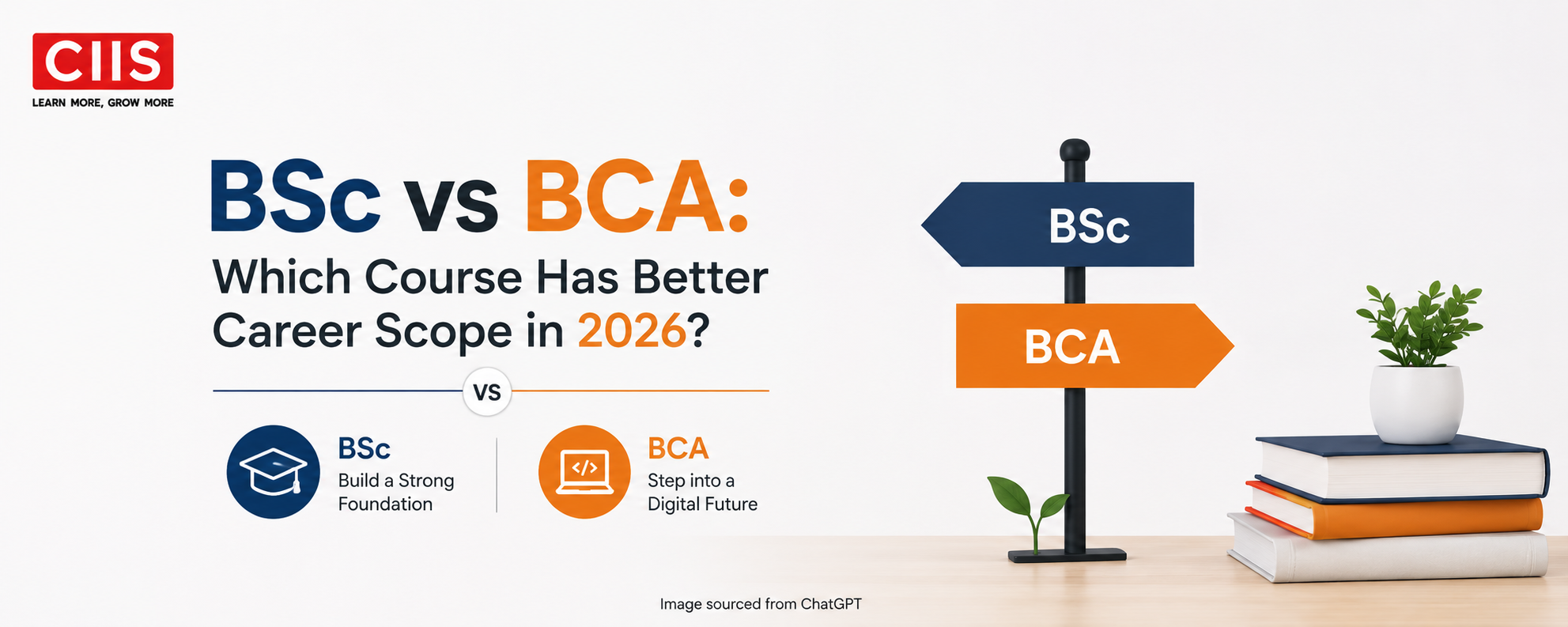
This complete 2026 guide compares BSc and BCA across career scope, salary, fees, admission, job opportunities, and which one is right for your specific background and goals.
Quick Answer — BSc vs BCA: Which Is Better?
- Choose BCA if your goal is software development, web development, programming, IT, or a direct tech career
- Choose BSc Computer Science if you want a blend of science fundamentals and computing, or plan to pursue MSc / MTech
- Choose BSc (other specialization) if you want a career in healthcare, agriculture, research, teaching, or government science posts
- Salary after BCA: ₹2.5 – ₹6.0 LPA entry-level; ₹6.0 – ₹14.0 LPA with MCA or 3–5 years experience
- Salary after BSc: ₹2.0 – ₹5.0 LPA entry-level; varies widely by specialization
- Both available in distance mode — no daily attendance required
- Fees: BSc from ₹28,000; BCA from ₹35,000 (full 3-year distance program)
BSc or BCA — Not Sure Which Fits Your Goals?
Get free 1-on-1 counselling from CIIS India — Mumbai’s most trusted education consultancy with 9+ years of experience and 50,000+ students enrolled.
1. BSc vs BCA — The Fundamental Difference
Before comparing salary, fees, and career scope, you need to understand what each degree fundamentally prepares you for:
| Parameter | Bachelor of Science (BSc) | Bachelor of Computer Applications (BCA) |
|---|---|---|
| Core focus | Science education Physics, Chemistry, Biology, Mathematics, Computer Science, Agriculture, Psychology and more | Computer education Programming, Software Development, Database Management, Web Development, Computer Networks |
| Degree type | Undergraduate science degree (broad 15+ specializations) | Undergraduate computer applications degree (tech-focused) |
| Who it is for | Students with varied science interests; teaching aspirants; healthcare; research; government science posts | Students specifically targeting IT, software, and technology careers |
| Postgraduate pathway | MSc (science specialization), MTech (for BSc CS/IT), MBA | MCA (Master of Computer Applications) most natural progression |
| Industry pathway | Healthcare, pharma, agriculture, research, teaching, IT (for BSc CS/IT) | IT, software development, web development, data science, software engineering |
| Eligibility (12th) | 10+2 Science with PCM / PCB / PCMB (stream depends on specialization) | 10+2 with Mathematics from any stream Science, Commerce, or Arts |
| Available in distance mode | Yes 15+ specializations available | Yes UGC-DEB approved BCA distance programs available |
2. BSc vs BCA — Eligibility and Admission
| Eligibility Parameter | BSc Admission | BCA Admission |
|---|---|---|
| Minimum 12th requirement | Science stream (PCM or PCB depending on specialization); 45–50% marks | 10+2 with Mathematics as a subject from any stream Science, Commerce, or Arts |
| Commerce or Arts background | Only eligible for BSc Psychology or BSc Statistics at some universities | Yes BCA accepts students from all streams as long as Mathematics was studied |
| Entrance exam | Not required at most distance and online universities | Not required at most distance and online universities |
| Minimum marks at 12th | 45–50% aggregate (varies by university and specialization) | 45–50% aggregate (Mathematics minimum marks may be specified separately) |
| Age limit | No upper age limit at distance programs | No upper age limit at distance programs |
| Working professionals | Yes — distance BSc designed for working professionals | Yes distance BCA fully flexible for working professionals |
Long tail insight: “Can I do BCA after 12th Commerce without PCM?” Yes. BCA is one of the few technology degrees that accepts students from Commerce and Arts backgrounds at the 12th level as long as Mathematics was one of the subjects studied. This makes BCA after 12th a popular choice for non-science students who want to enter the IT and software sector.
3. BSc vs BCA Subjects and Curriculum
| Subject Category | BSc Computer Science (for comparison) | BCA |
|---|---|---|
| Mathematics | Calculus, Discrete Mathematics, Statistics — strong theoretical focus | Mathematics for Computing, Business Mathematics application-oriented |
| Programming | C, C++, Python foundational; less application-depth | C, C++, Java, Python, PHP more languages; more project work |
| Database Management | DBMS as one paper | SQL, Oracle, DBMS greater coverage and project integration |
| Web Development | Limited — 1–2 papers maximum | HTML, CSS, JavaScript, PHP dedicated web development track |
| Software Engineering | 1 paper typically | Software development lifecycle, project management, testing — greater depth |
| Computer Networks | Covered as elective or optional paper | Core paper networking, protocols, cybersecurity fundamentals |
| Science subjects | Physics, Chemistry or Electronic Science (depending on university) | None purely computing curriculum |
| Data Science | BSc Statistics or BSc CS at select universities | Data analytics and data science subjects at modern BCA programs |
BSc CS or BCA — still deciding? Our counsellors compare your 12th background, career goal, and budget to give you a clear recommendation in 15 minutes free. Get free guidance →
4. BSc vs BCA — Career Scope and Job Opportunities 2026
BCA Career Options and Job Opportunities
BCA graduates are directly employable in the IT and software sector. Key BCA job opportunities in 2026:
| Job Role | Industry | Average Salary |
|---|---|---|
| Junior Software Developer | IT, Product, Startup | ₹3.0 – ₹5.5 LPA |
| Web Developer (Frontend / Full Stack) | IT Services, Digital Agencies | ₹3.5 – ₹6.0 LPA |
| Database Administrator (Junior) | BFSI, Healthcare, IT | ₹3.0 – ₹5.0 LPA |
| System Analyst | IT, Consulting | ₹3.5 – ₹6.5 LPA |
| Network Administrator (Junior) | Telecom, IT Infrastructure | ₹3.0 – ₹5.0 LPA |
| Data Analyst (entry level) | E-commerce, FMCG, IT | ₹3.5 – ₹6.0 LPA |
| IT Support Engineer | Any sector | ₹2.5 – ₹4.5 LPA |
| Software Tester / QA Analyst | IT, Product | ₹3.0 – ₹5.0 LPA |
BSc Career Options and Jobs
BSc career options vary significantly by specialization. Here is a cross-specialization overview:
| BSc Specialization | Top Job Roles | Average Entry Salary |
|---|---|---|
| BSc Computer Science | Software Developer, IT Analyst, Web Developer, Data Analyst | ₹3.0 – ₹5.5 LPA |
| BSc Mathematics | Data Analyst, Actuary, Statistician, SSC/banking posts | ₹2.5 – ₹4.5 LPA |
| BSc Physics | Lab Technician, Quality Control, Research Assistant, teaching | ₹2.5 – ₹4.0 LPA |
| BSc Agriculture | Agricultural Officer, IBPS Agri Officer, Agri-business, horticulture | ₹3.0 – ₹5.0 LPA |
| BSc Psychology | Counsellor, HR Executive, Research Associate, MSc Psychology pathway | ₹2.5 – ₹4.5 LPA |
| BSc MLT | Lab Technician, Pathology Assistant, Hospital Diagnostic | ₹2.5 – ₹4.5 LPA |
| BSc Biotechnology | Research Assistant, QC in Pharma, Biotech industry | ₹3.0 – ₹5.0 LPA |
Long tail insight: “Which has better job opportunities after 3 years — BSc or BCA?” — For IT and software-specific jobs, BCA graduates have a slight edge because the curriculum is entirely focused on practical computing skills that employers in the tech sector directly map to job roles. However, BSc Computer Science graduates with strong programming skills are equally hireable in software development roles. For non-IT careers — healthcare, agriculture, government science posts, and research — BSc is the only relevant qualification.
5. BSc vs BCA — Postgraduate Pathway Comparison
| PG Pathway | After BSc | After BCA |
|---|---|---|
| Master of Computer Applications (MCA) | Eligible (BSc with Mathematics or CS) | Most natural progression MCA after BCA is the standard tech career ladder |
| MSc (science specialization) | Yes direct pathway for all BSc graduates | Not applicable for most MSc science programs (no science base) |
| MBA | Yes any graduation qualifies for MBA | Yes BCA graduates eligible for MBA; BTech + MBA track not applicable |
| MTech (via GATE) | Yes for BSc CS/IT GATE eligibility with BSc from AICTE-affiliated institutions | Typically not eligible BCA is not a technical engineering degree |
| UGC NET | Eligible with MSc for Assistant Professor posts | Not directly eligible MCA or MSc CS required for NET Computer Science |
| Data Science PG program | Yes BSc Mathematics / Statistics / CS all eligible | Yes BCA graduates widely accepted for data science PG programs |
6. BSc vs BCA – Government Job Scope
| Government Job Category | BSc Eligible? | BCA Eligible? |
|---|---|---|
| SSC CGL (Graduate posts) | Yes | Yes |
| IBPS Bank Clerk / PO | Yes | Yes |
| IBPS Agriculture Officer | Yes (BSc Agriculture) | No |
| Government Lab Technician / Scientist | Yes (BSc in relevant science) | No |
| Forest Guard / Wildlife Department | Yes (BSc Botany / Zoology) | No |
| Government IT Programmer / Data Entry posts | Yes (BSc CS / IT) | Yes |
| TGT Science Teacher (after B.Ed) | Yes — BSc is prerequisite for B.Ed science teaching | No — BCA is not accepted for science teacher eligibility |
| State PSC general posts | Yes | Yes |
| UPSC Civil Services | Yes | Yes |
Long tail insight: “Is BSc or BCA better for government jobs?” — Both BSc and BCA qualify you for general graduate-level government posts (SSC CGL, IBPS bank posts, state PSC, UPSC). However, BSc opens significantly more domain-specific government posts — agriculture officer, forest services, laboratory assistant, science teacher — that BCA cannot access. For government IT posts, both are equally eligible.
7. BSc vs BCA — Fees Comparison 2026
BSc Distance Education Fees
| University Tier | BSc Fees in India (Full 3 Years) | Examples |
|---|---|---|
| Government open university | ₹28,000 – ₹55,000 | IGNOU, YCMOU, KSOU, VMOU |
| NAAC B++ private university | ₹55,000 – ₹85,000 | Mangalayatan University, SMU Distance |
| NAAC A+ online university | ₹85,000 – ₹1,40,000 | LPU Online, Chandigarh University Online |
BCA Distance Education Fees
| University Tier | BCA Fees in India (Full 3 Years) | Examples |
|---|---|---|
| Government open university | ₹35,000 – ₹60,000 | IGNOU, YCMOU, KSOU |
| NAAC B++ private university | ₹60,000 – ₹90,000 | Mangalayatan University, SMU Distance |
| NAAC A+ online university | ₹90,000 – ₹1,50,000 | LPU Online, Chandigarh University Online, Jain University Online |
Long tail insight: “What are the online BCA fees vs online BSc fees in India?” — Online BCA fees are typically ₹5,000 – ₹15,000 higher than online BSc fees at equivalent university tiers, because BCA programs generally require more digital lab infrastructure, coding platforms, and industry-integrated projects. Both are available at CIIS India Mumbai with zero-interest EMI through Eduvanz, Jodo, and Early Salary.
For a complete BSc fee breakdown across all 15 specializations and universities, read our detailed fee guide: BSc Distance Education Fees 2026 — University wise Comparison
8. Online BSc Degree vs Online BCA Degree For Working Professionals
| Parameter | Online BSc Degree | Online BCA Degree |
|---|---|---|
| Who benefits most | Working professionals in healthcare, education, or science-adjacent roles who need a formal degree | Working professionals in IT support, data entry, or tech-adjacent roles targeting formal software/IT qualification |
| Coding knowledge required before admission | No — for non-CS specializations | No — but interest in programming is essential |
| Time commitment per week | 6–10 hours (self-paced) | 8–12 hours (project and programming practice adds load) |
| Career pivot potential | Moderate — strengthens current field; limited pivot to IT (except BSc CS) | High — BCA can pivot a non-tech professional into software and IT roles |
| Recognised by online education platforms | Yes — all UGC-DEB approved online BSc degrees are recognised | Yes — all UGC-DEB approved online BCA degrees are recognised |
9. BSc Computer Science vs BCA — Which Is Better for IT Careers?
Since the most common point of comparison is specifically BSc CS vs BCA for tech careers, here is a dedicated breakdown:
| Parameter | BSc Computer Science | BCA |
|---|---|---|
| Theoretical depth | Stronger — covers mathematics, physics, and computing theory in depth | Moderate — computing-focused with business and application emphasis |
| Programming practice | Good — covers multiple languages but fewer projects | Better — more project-based; real-world application focus |
| MCA eligibility | Yes | Yes — MCA is the most natural BCA progression |
| MTech eligibility via GATE | Yes — at select universities with AICTE affiliation | Generally no — BCA not treated as technical engineering degree |
| Teaching (TGT Computer Science) | Yes — with B.Ed | Not for science teacher posts; BCA not accepted for TGT CS at most boards |
| Industry recognition for software jobs | Equal — both accepted by IT companies for lateral hiring | Equal — both accepted; BCA may have slight edge for application development roles |
| Data Science pathway | Strong — Mathematics background adds statistical depth | Good — BCA with data analytics modules is increasingly data science relevant |
10. BSc and BCA in Mumbai — Distance and Online Options
For Mumbai students, both BSc distance education and BCA distance education are available through a wide range of UGC-DEB approved institutions. CIIS India at Malad (West), Mumbai supports admission for both programs across all partner universities.
For a complete guide to BSc distance education options available in Mumbai — including all 15 specializations, open university study centres, and fees read: BSc Distance Education in Mumbai: Top Colleges & Fees
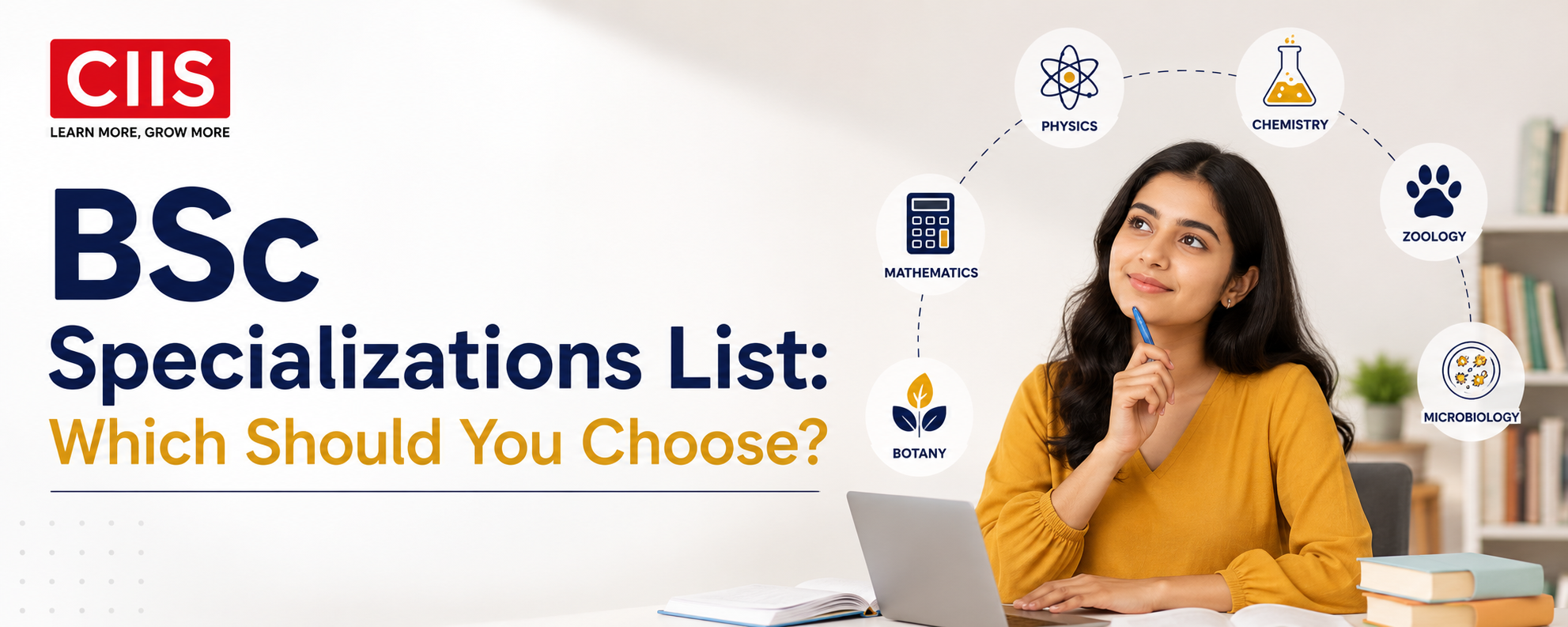
For a complete guide on all BSc specialization options and which one is right for your background, read: BSc Specializations List: Which Should You Choose?
For the complete eligibility, admission, and university guide for BSc distance education across India, read: BSc Distance Education: Everything You Need to Know in 2026
11. BSc vs BCA — Decision Framework
| Your Situation | Choose |
|---|---|
| I want to become a software developer or web developer | BCA — curriculum directly aligned to software and web roles |
| I want to work in healthcare, agriculture, or government science | BSc — relevant specialization (MLT, Agriculture, Chemistry, Botany) |
| I am from Commerce or Arts at 12th and want to enter IT | BCA — accepts non-science background with Mathematics |
| I want to pursue MSc after graduation | BSc — direct MSc pathway; BCA does not lead to MSc science |
| I want to become a government science teacher (TGT) | BSc — B.Ed requires a BSc in the relevant subject |
| I want MCA as my postgraduate degree | BCA — the most natural and direct MCA feeder degree |
| I want the highest salary ceiling in IT | BCA + MCA or BSc CS + MTech — both strong depending on specialization |
| I am a working professional in IT support wanting a formal tech degree | BCA distance education — directly relevant to your current role |
| I want to pursue data science | BSc Mathematics / Statistics for statistical depth, or BCA with data analytics track |
12. BSc vs BCA — CIIS India Mumbai
If you are in Mumbai and want expert guidance on whether to pursue BSc or BCA through distance or online mode, CIIS India at Sej Plaza, Marve Road, Malad (West), Mumbai offers free, unbiased counselling based on your 12th background, career goal, and budget. With 9+ years of experience and 50,000+ students enrolled, our counsellors give you a clear answer without a sales pitch.
- Free 1-on-1 BSc vs BCA career counselling based on your exact profile
- Admission support for BSc (all 15 specializations) and BCA through UGC-DEB approved partner universities
- UGC, UGC-DEB, and NAAC verification before you pay any fees
- Guidance for working professionals on which program suits their current role and target career
- Zero-interest EMI through Eduvanz, Jodo, and Early Salary
- Walk-in available at Sej Plaza, Marve Road, Malad (West), Mumbai
Frequently Asked Questions (FAQs)
For a career directly in software development, web development, and application-level IT roles, BCA is marginally better suited because its curriculum is entirely focused on computing, programming, and software applications. However, BSc Computer Science is equally respected by IT employers for lateral hires and entry-level software roles. The choice between the two should be based on whether you want a pure tech degree (BCA) or a science-rooted computing degree with broader postgraduate options (BSc CS).
Yes. BCA is one of the few technology undergraduate degrees that accepts students from all 12th streams — Science, Commerce, and Arts — as long as Mathematics was one of the subjects studied at 12th level. This makes BCA after 12th accessible to Commerce and Arts students who want to enter the IT and software sector without having taken PCM.
BSc distance education fees start from ₹28,000 for the full 3-year program at government open universities. BCA distance education fees start from ₹35,000 for the full 3-year program at government open universities — slightly higher due to programming infrastructure and project delivery requirements. At NAAC A+ online universities, both programs range from ₹85,000 to ₹1,50,000. Zero-interest EMI is available at CIIS India for both.
Both qualify for general graduate-level government posts including SSC CGL, IBPS bank officer posts, state PSC exams, and UPSC. However, BSc opens additional domain-specific government posts — IBPS Agriculture Officer (BSc Agriculture), Government Lab posts (BSc Chemistry/Biology), Forest Services (BSc Botany/Zoology), and Government Science Teacher posts (BSc with B.Ed) — that BCA is not eligible for.
After 5 years, salary depends heavily on postgraduate qualification and career track rather than the BSc vs BCA distinction at undergraduate level. A BCA + MCA graduate working in software engineering typically earns ₹8–14 LPA after 5 years. A BSc CS + MSc graduate in data science can earn similarly. For non-IT BSc tracks (Agriculture, Biology, Psychology), salaries are typically ₹4–8 LPA after 5 years in government or healthcare roles.
Yes — BSc graduates with Mathematics as a subject are eligible for MCA admission at most universities. However, BSc graduates without Mathematics may face restrictions at certain institutions. BCA is the most natural MCA feeder degree, but BSc CS and BSc IT graduates are equally eligible and commonly pursue MCA as their postgraduate qualification.
Yes. A BCA from a UGC-recognised, UGC-DEB approved university in distance or online mode is fully valid for IT and software sector jobs in India. Most Indian IT companies, MNCs, and tech employers accept distance BCA degrees for lateral hire and experience-based recruitment. The critical requirement is that the university is UGC-recognised and the program is UGC-DEB approved verify at deb.ugc.ac.in before enrolling.
Absolutely. Both BSc distance education and BCA distance education are specifically structured for working professionals — no daily attendance is required, study materials are delivered digitally, and exams are held at regional centres or online. Higher education through distance mode is one of the most practical upskilling routes for working professionals in India in 2026, with no income disruption during the degree program.