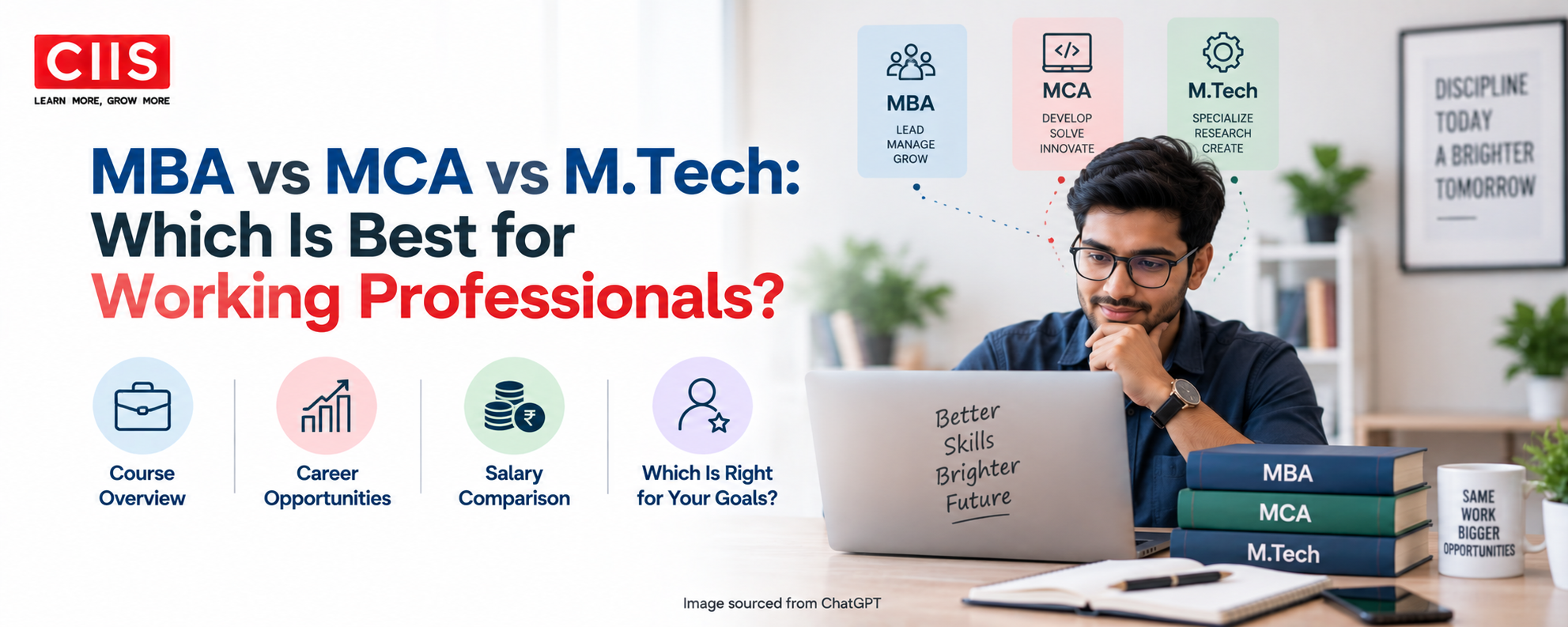
If you are a working professional deciding between an MBA, MCA, and M.Tech for your postgraduate degree, you are facing one of the most consequential career decisions you will make, and the right answer is genuinely different for different people.
All three are credible, widely recognised postgraduate qualifications available through distance and online mode. But they take your career in fundamentally different directions, suit completely different professional profiles, and deliver different salary outcomes depending on your current background and target role.
This complete 2026 guide gives you an honest, data-grounded comparison of MBA vs MCA vs M.Tech across every parameter that matters: career direction, salary, government job suitability, fees, difficulty level, and a clear recommendation based on your specific profile.
⚡ Quick Answer — MBA vs MCA vs M.Tech: Which Is Best?
- Choose MBA if: You want to move into business management, leadership, finance, marketing, or operations across any industry
- Choose MCA if: You are a BCA / BSc CS / BA / BCom graduate who wants to enter or advance in software development, IT, and tech careers
- Choose M.Tech if: You are a B.Tech / BE graduate who wants to deepen technical engineering expertise, qualify for GATE-based PSU roles, or enter engineering lectureship
- Salary ceiling: All three can reach ₹20–40 LPA+ at senior levels; M.Tech and MCA lead in tech; MBA leads in corporate management
- Government jobs: M.Tech is strongest for engineering PSUs and lectureship; MBA for management trainee posts; MCA for government IT roles
- Working professionals: All three are available through distance/online mode at UGC-DEB approved universities no career break required
Not Sure Whether MBA, MCA, or M.Tech Is Right for Your Career?
Get free 1-on-1 career counselling from CIIS India Mumbai’s most trusted education consultancy with 9+ years of experience and 50,000+ students enrolled.
1. MBA vs MCA vs M.Tech – The Fundamental Difference
| Parameter | MBA (Master of Business Administration) | MCA (Master of Computer Applications) | M.Tech (Master of Technology) |
|---|---|---|---|
| Core focus | Business management, strategy, leadership, finance, marketing, operations | Computer applications, software development, programming, IT systems | Advanced engineering and technology — deepens B.Tech domain expertise |
| Regulated by | UGC + UGC-DEB (distance); AICTE (full-time PGDM) | UGC + UGC-DEB (distance); AICTE (full-time) | AICTE + UGC-DEB (distance); mandatory AICTE approval for all M.Tech |
| Ideal prior degree | Any graduation — BA, BCom, BSc, B.Tech all eligible | BCA, BSc CS / IT, B.Tech CSE, BCom, BA (Math) — varies by university | B.Tech / BE in the relevant engineering branch |
| Career direction | Management, business, consulting, banking, entrepreneurship | Software development, IT, data science, programming, system design | Engineering research, PSU technical posts, engineering lectureship |
| Duration | 2 years | 2 years (3 years for some universities that still follow old norms) | 2 years |
2. MBA vs MCA vs M.Tech Salary – Complete 2026 Comparison
| Career Stage | MBA Salary | MCA Salary | M.Tech Salary |
|---|---|---|---|
| Entry level (0–3 years post-PG) | ₹5.0 – ₹12.0 LPA | ₹4.5 – ₹9.0 LPA | ₹5.0 – ₹10.0 LPA |
| Mid-level (4–8 years post-PG) | ₹10.0 – ₹22.0 LPA | ₹9.0 – ₹18.0 LPA | ₹9.0 – ₹18.0 LPA |
| Senior level (8+ years) | ₹18.0 – ₹40.0 LPA+ | ₹15.0 – ₹35.0 LPA (tech lead, architect) | ₹14.0 – ₹30.0 LPA (specialist, PSU senior) |
| Government post salary | ₹7.0 – ₹14.0 LPA (PSU management trainee, banking) | ₹5.0 – ₹10.0 LPA (NIC, government IT roles) | ₹7.0 – ₹14.0 LPA (DRDO, ISRO, PSU engineer) |
| Salary ceiling (top track) | ₹40.0 – ₹60.0 LPA+ (IIM / consulting / C-suite) | ₹30.0 – ₹50.0 LPA+ (FAANG, product companies) | ₹25.0 – ₹45.0 LPA+ (AI/ML, VLSI, research lead) |
Long tail insight: “Which pays more — MBA, MCA, or M.Tech in India in 2026?” — None is definitively the highest across all contexts. At the senior level in corporate management and consulting, MBA from top institutes commands the highest salaries. For software architecture and product development roles, MCA and M.Tech CSE professionals at tech giants can match or exceed MBA salaries. For PSU and government engineering posts, M.Tech has the strongest salary advantage. The right comparison is within your specific career track not across all three in aggregate.
3. MBA Career Options – What You Can Do After MBA
| MBA Career Path | Best Specialisation | Salary Range |
|---|---|---|
| Finance Manager / Investment Analyst | MBA Finance | ₹8.0 – ₹28.0 LPA |
| Marketing Manager / Brand Lead | MBA Marketing | ₹7.0 – ₹20.0 LPA |
| HR Business Partner / CHRO Track | MBA Human Resources | ₹6.0 – ₹18.0 LPA |
| Operations / Supply Chain Manager | MBA Operations | ₹7.0 – ₹18.0 LPA |
| PSU Management Trainee | Any MBA specialisation | ₹8.0 – ₹14.0 LPA + full perks |
| Bank PO / Banking Officer | MBA Finance or any MBA | ₹6.0 – ₹12.0 LPA |
| Business Consultant / Strategy Analyst | MBA General or Strategy | ₹9.0 – ₹25.0 LPA |
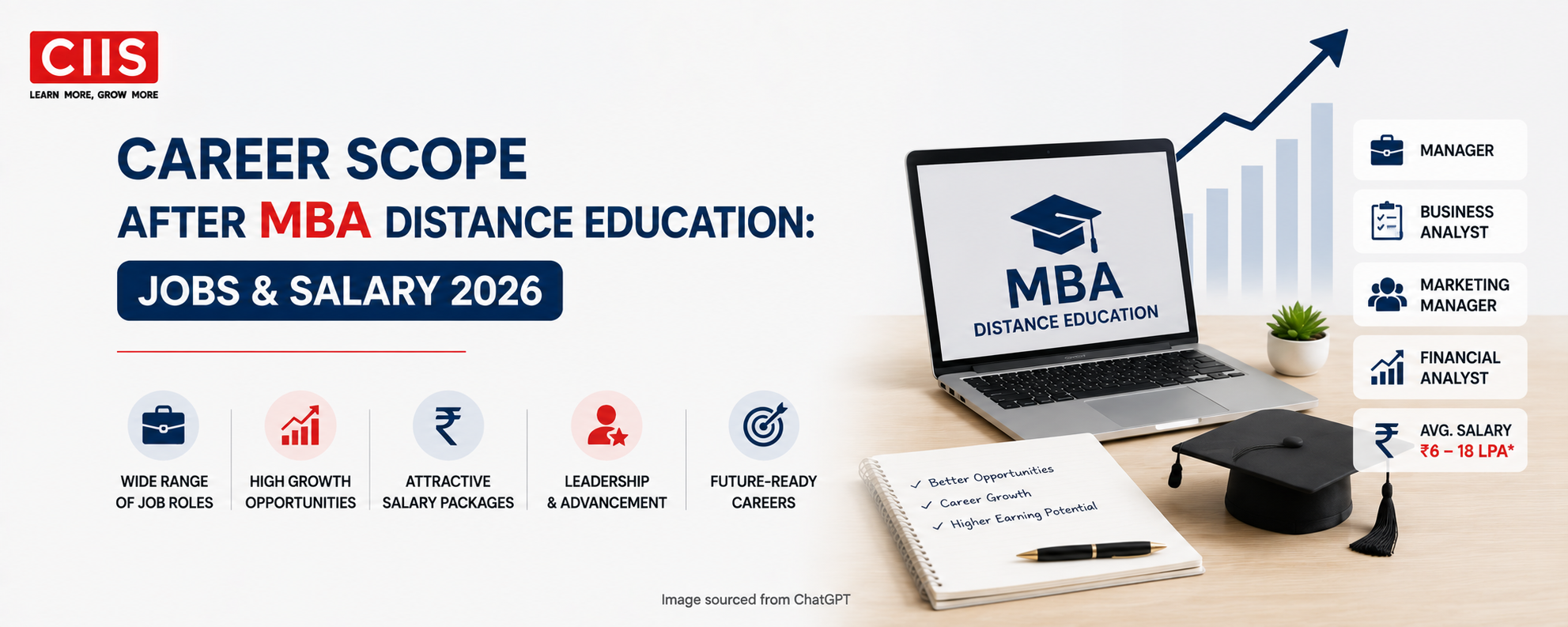
For the complete MBA career scope guide including government job salaries and employer-wise breakdowns, read: Career Scope After MBA Distance Education: Jobs & Salary 2026
4. MCA Career Options – What You Can Do After MCA
| MCA Career Path | Key Skills Used | Salary Range |
|---|---|---|
| Software Developer / Senior Developer | Programming, system design, frameworks | ₹5.0 – ₹18.0 LPA |
| Data Scientist / ML Engineer | Python, statistics, ML frameworks | ₹7.0 – ₹22.0 LPA |
| System / Network Administrator | OS, networking, cloud infrastructure | ₹4.5 – ₹10.0 LPA |
| Cyber Security Analyst | Security protocols, ethical hacking, SIEM | ₹6.0 – ₹16.0 LPA |
| Government IT Officer (NIC, MeitY, SSC) | Programming, database management | ₹5.0 – ₹10.0 LPA |
| Database Administrator (DBA) | SQL, Oracle, NoSQL databases | ₹5.0 – ₹12.0 LPA |
| College Lecturer — Computer Science (with NET) | MCA + UGC NET qualification | ₹5.0 – ₹9.5 LPA (government) |
5. M.Tech Job Opportunities – What You Can Do After M.Tech
| M.Tech Career Path | Best Specialisation | Salary Range |
|---|---|---|
| Senior Software / AI Engineer | M.Tech CSE / AI / Data Science | ₹9.0 – ₹30.0 LPA |
| VLSI Design / Semiconductor Engineer | M.Tech VLSI / ECE | ₹10.0 – ₹28.0 LPA |
| DRDO / ISRO Scientist | M.Tech in relevant engineering branch | ₹7.0 – ₹14.0 LPA + perks |
| PSU Senior Engineer / Technical Officer | Mechanical, Civil, Electrical, ECE | ₹8.0 – ₹14.0 LPA + benefits |
| Engineering Lecturer / Assistant Professor | Any AICTE-approved M.Tech branch | ₹5.5 – ₹9.5 LPA (government) |
| R&D Engineer | Any core engineering branch | ₹6.0 – ₹14.0 LPA |
Confused between MBA, MCA, and M.Tech for your profile? Our counsellors give you a clear, personalised recommendation based on your degree background and career goal completely free. Get free guidance →
6. Government Jobs – MBA vs MCA vs M.Tech
| Government Job Category | MBA | MCA | M.Tech |
|---|---|---|---|
| PSU Management Trainee (ONGC, NTPC, BHEL) | Strong — MBA is the standard qualification | Not applicable for management track | Not applicable for management track |
| DRDO / ISRO Scientist / Engineer | Not applicable for technical scientist posts | Eligible for IT/CS roles (NIC, MeitY) | Strong M.Tech is the preferred qualification |
| Government IT Officer (NIC, MeitY, SSC CGL) | Eligible as graduate-level entry | Strong MCA specifically preferred for IT officer roles | Eligible; CSE specialisation preferred |
| Banking (IBPS PO, SBI PO, RBI) | Strong MBA Finance preferred for specialist banking posts | Eligible as any graduate | Eligible as any graduate |
| College Lecturer / Assistant Professor | MBA + NET qualifies for management / commerce lectureship | MCA + NET qualifies for computer science / applications lectureship | Strong M.Tech is mandatory for engineering lectureship (AICTE) |
| UPSC Civil Services | Any graduation qualifies; MBA optional paper advantage for management | Any graduation qualifies | Any graduation qualifies; technical paper advantage |
| PSU Engineer (GATE route) | Not applicable | Not applicable for core engineering | Strong M.Tech + GATE score is the primary route for PSU engineer posts |
For the complete guide on MBA distance education validity for government and private sector posts, read: Is MBA Distance Education Valid for Government & Private Jobs?
7. MBA vs MCA vs M.Tech for Working Professionals – Key Differences
| Parameter | MBA for Working Professionals | MCA for Working Professionals | M.Tech for Working Professionals |
|---|---|---|---|
| Available through distance/online? | Yes — widely available at UGC-DEB approved universities | Yes — UGC-DEB approved MCA distance programs available | Yes — AICTE + UGC-DEB approved M.Tech distance programs |
| Prior degree required | Any graduation with 45%–50% marks | BCA / BSc CS / B.Tech CSE / BCom + Math (varies by university); 45%–50% marks | B.Tech / BE in relevant branch (mandatory) |
| Career pivot potential | Strongest — enables domain change from technical / science / arts to management | Strong for non-CS graduates wanting IT career; limited management pivot | Narrow — deepens existing B.Tech domain; limited cross-domain pivot (except CSE/AI) |
| Ease of study while working | High — theory-heavy; no lab requirements; fully self-paced online | Moderate — programming assignments and project work require dedicated time | Moderate — technical depth requires focused study; some practical components |
| Best suited for | Any graduate wanting management, business, or leadership roles | Non-engineering graduates wanting tech careers; BCA / BSc CS graduates | B.Tech engineers wanting specialist depth, PSU grade upgrade, or lectureship |
Long tail insight: “Is MBA easier than MCA or M.Tech while working?” Generally yes. MBA coursework is management and business theory — manageable alongside a full-time job with weekend and evening study. MCA requires active programming practice and project submissions, which demand more hands-on time. M.Tech has the highest technical depth of the three and typically requires the most dedicated study time. However, “easier” should never be the primary reason to choose a postgraduate degree — fit to your career goal matters far more.
8. MBA vs MCA – Which Is Better for Non-Engineering Graduates?
| Profile | Recommended | Why |
|---|---|---|
| BCom / BA graduate wanting business / finance career | MBA | Natural progression; unlocks management, banking, and corporate leadership roles |
| BCA / BSc CS graduate wanting advanced tech career | MCA | Technical depth in software development; bridges BCA into senior IT roles |
| BSc / BA graduate wanting IT career switch | MCA | MCA is specifically designed for science and arts graduates entering IT; no B.Tech required |
| BCom / BA graduate wanting tech + management hybrid | MBA (Business Analytics or IT Management) | Combines business and technology; no programming depth required; wider employer base |
| Any graduate targeting government management trainee posts | MBA | MBA is the standard qualification for PSU management trainee posts; MCA and M.Tech are not applicable |
9. MBA vs M.Tech – Which Is Better for Engineers?
For B.Tech engineers, this is the most common dilemma. The comprehensive career-focused answer is covered in our dedicated guide read: M.Tech vs MBA for Engineers: Which Is Better in 2026?
The quick summary:
| If You Are a B.Tech Engineer Who Wants… | Choose |
|---|---|
| Deeper technical expertise in your engineering branch | M.Tech |
| A move into management, business, or leadership roles | MBA |
| PSU grade upgrade or DRDO / ISRO scientist track | M.Tech |
| Engineering lectureship / Assistant Professor post | M.Tech (mandatory) |
| Product management, business development, or consulting | MBA |
| Advanced AI/ML or Data Science specialisation | M.Tech CSE / AI or MCA Data Science (either) |
10. MBA vs MCA vs M.Tech – Fees Comparison (Distance Mode, 2026)
| Institution Type | MBA Distance Fees (2-year total) | MCA Distance Fees (2-year total) | M.Tech Distance Fees (2-year total) |
|---|---|---|---|
| IGNOU / state open universities | ₹32,000 – ₹45,000 | ₹18,000 – ₹32,000 | ₹50,000 – ₹75,000 |
| Private NAAC A / A+ universities | ₹55,000 – ₹1,20,000 | ₹40,000 – ₹80,000 | ₹80,000 – ₹1,40,000 |
| Premium NAAC A++ online universities | ₹80,000 – ₹1,50,000 | ₹60,000 – ₹1,00,000 | ₹1,00,000 – ₹1,60,000 |
For the complete university-wise MBA fee breakdown, read: MBA Distance Education Fees 2026 — University-wise Comparison
11. MBA vs MCA vs M.Tech – Which Is Best: Decision Framework
| Your Profile | Best Choice | Why |
|---|---|---|
| B.Tech engineer; wants senior tech role or PSU grade upgrade | M.Tech | Deepens domain; PSU grade upgrade; DRDO/ISRO eligibility; lectureship |
| B.Tech engineer; wants management / leadership role | MBA | Tech + management combination; product management; business leadership |
| BCA / BSc CS graduate; wants advanced software career | MCA | Bridges BCA/BSc CS into senior developer or architect roles |
| BCom / BA graduate; wants corporate management career | MBA | Only MBA of the three opens corporate management, banking, and PSU MT roles |
| Any graduate; wants government IT officer roles (NIC, SSC) | MCA | MCA is specifically preferred for government IT technical recruitment |
| Science graduate; wants data science / AI career | MCA (Data Science) or M.Tech CSE/AI | Both valid; M.Tech if you have B.Tech; MCA if you have BSc / BCA |
| Working professional; wants fastest path to salary increase | MBA | Widest applicability across industries; strong lateral hire ROI for most profiles |
12. Admission Overview – MBA vs MCA vs M.Tech for Working Professionals
| Admission Parameter | MBA Distance | MCA Distance | M.Tech Distance |
|---|---|---|---|
| Minimum qualification | Any graduation with 45%–50% marks | BCA / BSc CS / B.Tech / BA or BCom with Math — varies by university | B.Tech / BE in relevant branch with 55% marks |
| Entrance exam required? | Not required for distance MBA at most universities | Not required for distance MCA at most universities | Not required for distance M.Tech at most universities; GATE preferred at some |
| Work experience required? | Not required for distance MBA; required for Executive MBA only | Not required | Not required; preferred by some universities for working professional track |
| Admission cycle | January and July sessions; rolling at private universities | January and July sessions; rolling at private universities | January and July sessions; AICTE-governed academic calendar |
For the complete MBA distance education admission and program overview, read: MBA Distance Education: Everything You Need to Know in 2026
For a breakdown of all MBA specialisations and which one suits your career goal, read: MBA Specialisations List: Which Should You Choose?
13. MBA vs MCA vs M.Tech – CIIS India Mumbai
If you are in Mumbai and need expert, unbiased guidance on whether MBA, MCA, or M.Tech is the right postgraduate degree for your career based on your specific degree, job profile, and target role, CIIS India at Sej Plaza, Marve Road, Malad (West), Mumbai provides free 1-on-1 counselling with 9+ years of experience and 50,000+ students enrolled.
- Free personalised career assessment we map your degree background, current role, and target outcome to the right program
- Specialisation guidance for MBA, MCA, and M.Tech which branch delivers the strongest ROI for your profile
- UGC, UGC-DEB, and AICTE verification before you pay any fees to any institution
- Admission support for all major approved distance and online programs
- Zero-interest EMI through Eduvanz, Jodo, and Early Salary
- Walk-in available at Sej Plaza, Marve Road, Malad (West), Mumbai
Frequently Asked Questions (FAQs)
It depends entirely on your background and career goal. MBA is best for working professionals who want to move into management, business leadership, banking, or corporate functions it works for any graduation background. MCA is best for BCA or BSc CS graduates who want advanced IT and software development careers without a B.Tech. M.Tech is best for B.Tech engineers who want to deepen technical expertise, qualify for PSU grade upgrades, or enter engineering lectureship. All three are available through distance mode no career break required.
At senior levels, all three can reach ₹25–40 LPA+ in their respective tracks. MBA leads in corporate management and consulting roles. MCA and M.Tech CSE graduates at FAANG or product companies can match or exceed MBA salaries in tech roles. For government posts, M.Tech has a salary advantage through PSU grade upgrades and DRDO/ISRO scientist positions. The salary outcome depends far more on specialisation, employer, and work experience than on which degree you hold.
Yes at many universities, BCom or BA graduates with Mathematics as a subject at 10+2 or graduation level are eligible for MCA. The specific eligibility varies by institution; some require a science background or mathematics in graduation. MBA is a more universally accessible postgraduate option for BCom and BA graduates with no subject restrictions. CIIS India verifies your specific eligibility for MCA before recommending it for your profile.
Generally yes. MBA coursework is business theory, case studies, and management concepts manageable with weekend and evening study. MCA involves active programming practice, algorithm study, and project work that requires more hands-on time. M.Tech has the highest technical depth of the three. That said, the right choice should always be driven by your career goal, not perceived difficulty a degree you complete but don’t use is a poor investment regardless of how easy it was.
It depends on which government role you are targeting. For PSU Management Trainee posts (ONGC, NTPC, BHEL), MBA is the standard qualification. For government IT officer roles (NIC, MeitY, SSC), MCA is specifically preferred. For DRDO / ISRO scientist posts and PSU engineer grade upgrades, M.Tech is the strongest qualification. For banking (IBPS PO, SBI PO), MBA Finance is preferred but any graduation including MCA or M.Tech qualifies.
Yes. MBA after MCA is a popular combination — it adds business management skills to a strong technical base, often enabling transitions into product management, IT consulting, or business leadership roles. MBA after M.Tech is similarly valued, especially for engineers targeting management-track PSU roles or corporate leadership. For distance mode, MBA eligibility requires any graduation your MCA or M.Tech is more than sufficient.
For software development roles, MCA and M.Tech CSE are both strong the distinction matters more for the path you came from. M.Tech is available only to B.Tech / BE graduates; MCA is the route for BCA and BSc CS graduates who want equivalent depth in software careers. At the job market level, a skilled MCA graduate and an M.Tech CSE graduate compete for the same software developer and senior engineer roles at most IT companies.
MBA has the broadest industry scope applicable across every sector, from FMCG and banking to tech, pharma, and government PSUs. MCA has strong and growing scope specifically in IT, software, and government tech roles. M.Tech has deep scope in engineering, PSU, defence R&D, and academic roles — but is narrower in cross-industry applicability than MBA. For maximum scope across industries, MBA is the most versatile choice in 2026.