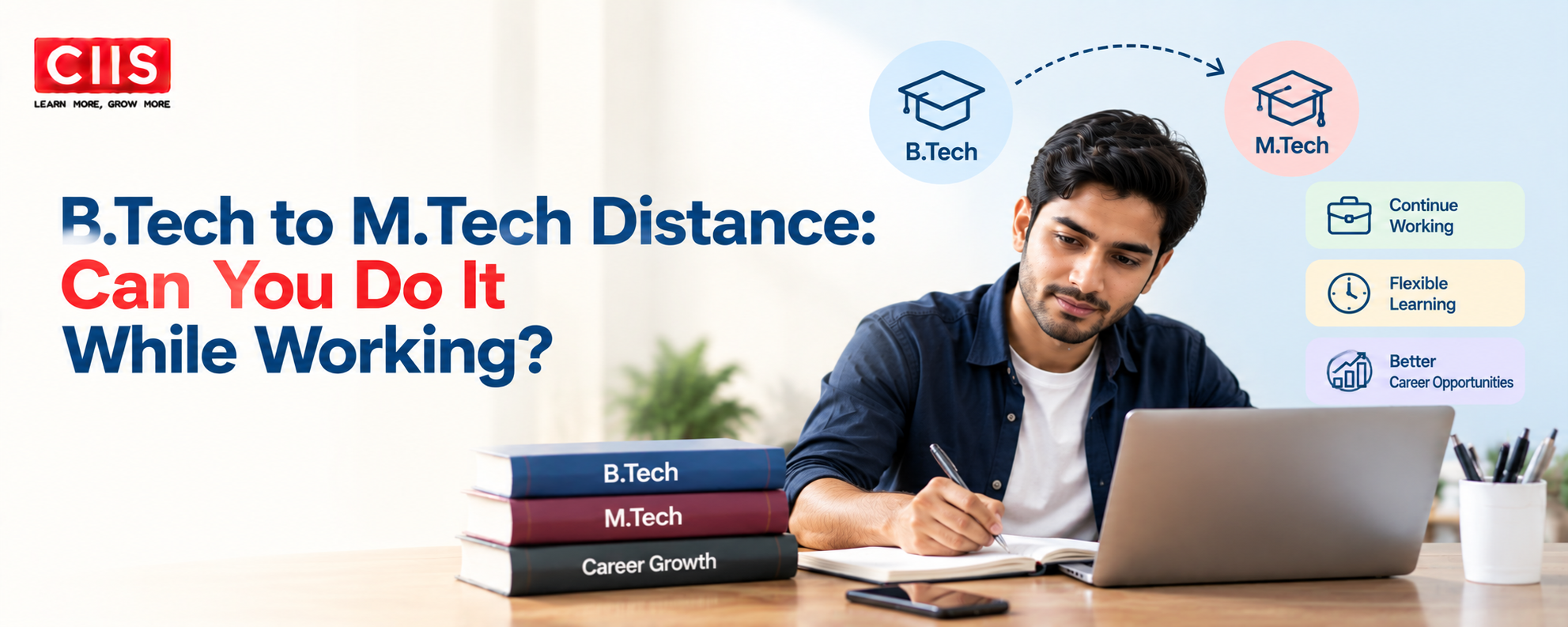
If you completed your B.Tech and are now working as an engineer, whether in IT, core manufacturing, a government PSU, or any other sector, an M.Tech through distance education is one of the most impactful career upgrades available to you. The most important practical question is: can you do it while keeping your job?
The answer is yes—and this guide explains exactly how, for whom it makes the most sense, what the process looks like, and what you realistically gain in salary, government job eligibility, and career advancement.
⚡ Quick Answer — B.Tech to M.Tech Distance While Working
- Can you do M.Tech while working? Yes — distance and online M.Tech programs require no daily attendance
- Eligibility: B.Tech / BE with 55% aggregate marks (50% for SC/ST at most universities)
- Duration: 2 years; flexible pace at most distance universities
- GATE required? Not for distance M.Tech merit-based admission on B.Tech percentage
- Salary impact: 20%–40% increase within 12–24 months for most working engineers
- Key condition: University must be AICTE-approved + UGC-DEB listed verify before enrolling
Want to Know If M.Tech Distance Is the Right Move for Your Engineering Career?
Get free 1-on-1 career and admission guidance from CIIS India — Mumbai’s most trusted education consultancy with 9+ years of experience and 50,000+ students enrolled.
1. Why B.Tech Engineers Choose M.Tech Through Distance Education
| Reason | What It Means Practically |
|---|---|
| Cannot afford to leave job for a full-time M.Tech | Distance M.Tech removes the career break entirely — you study in evenings and weekends without losing income or work continuity |
| PSU grade upgrade requirement | Many PSU grade structures (ONGC, BHEL, NTPC, SAIL) allow grade upgrade on completion of M.Tech — ₹1.5 – ₹3.0 LPA additional salary |
| Engineering lectureship eligibility | M.Tech is mandatory for the Assistant Professor post at AICTE-approved engineering colleges — no M.Tech means no lectureship, regardless of experience |
| Government scientist post eligibility | DRDO, ISRO, and CSIR Scientist posts prefer or specifically require M.Tech in the relevant branch |
| GATE score for PSU recruitment | M.Tech (even through distance mode) qualifies you for GATE — GATE score opens PSU recruitment doors at salary packages of ₹8–14 LPA |
| Senior engineering designation | Many private engineering employers require M.Tech for Senior Engineer, Technical Lead, or Architect designations |
2. How M.Tech Distance Learning Works for Working Engineers
| Aspect | How It Works in Practice |
|---|---|
| Study schedule | Fully self-paced — no fixed class time; study after work hours, on weekends, or early mornings |
| Content delivery | Pre-recorded lectures on LMS platform at private universities; printed self-learning material dispatched by post at open universities like IGNOU |
| Attendance requirement | Zero daily attendance — you are never required to visit a college campus during working hours |
| Assignments and projects | Submitted online; project work often based on your current engineering role — which actually strengthens the assignment quality |
| Examinations | Held twice a year (semester-wise or term-end); appear at a designated centre near your workplace or home |
| Practical / lab components | Some specialisations require condensed practical sessions — typically 1–2 days per semester at a study centre; many universities offer virtual labs |
| Duration flexibility | IGNOU and most open universities allow up to 4–5 years to complete a 2-year M.Tech — no penalty for slower pace due to work demands |
| Employer disclosure | Not required — no law or standard employer policy prevents an engineer from pursuing a distance postgraduate degree simultaneously |
Long tail insight: “Can a working engineer complete M.Tech through distance education in 2 years?” Yes. Most working engineers who dedicate 1–2 hours of study per day, and 4–6 hours on weekends, complete the distance M.Tech within the standard 2-year window. The self-paced format makes this achievable even during demanding work periods if one semester is particularly busy, the extended completion window (up to 4–5 years at most open universities) removes any penalty for slowing down temporarily.
3. M.Tech Eligibility After B.Tech — What You Need
| Eligibility Condition | Standard Requirement | Notes |
|---|---|---|
| Minimum qualification | B.Tech / BE from an AICTE-approved institution | Both government and private AICTE-approved B.Tech degrees qualify |
| Minimum marks | 55% aggregate in B.Tech / BE | 50% for SC/ST/PwD at most universities; some private universities accept 50% for working professionals |
| Branch alignment | B.Tech branch should be relevant to M.Tech specialisation | CSE M.Tech is the most flexible — many universities admit all engineering branches |
| GATE score | Not required for distance M.Tech | GATE only required for IIT / NIT / CCMT admission; distance programs are merit-based on B.Tech percentage |
| Work experience | Not required; working professionals are specifically welcomed | Some universities give preference to engineers with work experience for their working professional track |
| Age limit | No upper age limit as per AICTE norms | Engineers completing M.Tech at 35, 40, or beyond is common and fully acceptable |
4. M.Tech Course Duration — What to Expect While Working
| Mode | Standard Duration | Maximum Duration Allowed | Practical Completion for Working Professionals |
|---|---|---|---|
| Distance M.Tech — IGNOU / open universities | 2 years | 4–5 years | Most engineers complete in 2–3 years |
| Distance M.Tech — Private online universities | 2 years | 3–4 years | 2–3 years with consistent study |
| BITS Pilani WILP (Work Integrated Learning) | 3 years | 5 years | 3–4 years; weekend campus sessions required |
| Regular M.Tech (full-time campus) | 2 years | 2 years (fixed) | Requires full-time; working simultaneously is typically not possible |
5. M.Tech Distance Courses — Best Specialisations for Working Engineers
| M.Tech Specialisation | Best For (B.Tech Background) | Career / Salary Outcome | Available Through Distance? |
|---|---|---|---|
| M.Tech CSE / AI / Machine Learning | CSE, IT, ECE, EEE engineers | ₹10.0 – ₹30.0 LPA at senior level | Yes — most widely available |
| M.Tech Data Science | Any engineering branch with programming interest | ₹8.0 – ₹22.0 LPA | Yes |
| M.Tech VLSI Design | ECE, EEE engineers | ₹10.0 – ₹25.0 LPA | Yes — select universities |
| M.Tech Cyber Security | CSE, IT, ECE engineers | ₹9.0 – ₹20.0 LPA | Yes |
| M.Tech Mechanical (CAD/CAM / Robotics) | Mechanical, Production, Automobile engineers | ₹8.0 – ₹18.0 LPA | Yes — select universities |
| M.Tech Civil / Structural Engineering | Civil engineers in construction / infrastructure | ₹7.0 – ₹15.0 LPA | Yes |
| M.Tech Electrical / Power Systems | EEE, Electrical engineers; PSU engineers | ₹7.0 – ₹14.0 LPA | Yes — select universities |
For the complete branch-wise demand analysis and career scope for each M.Tech specialisation, read: M.Tech Specialisations List: Which Branch Has Most Demand?
6. M.Tech Admission Process for Working Professionals
| Step | What You Do | Timeline |
|---|---|---|
| 1. Verify AICTE and UGC-DEB approval | Confirm the university holds AICTE approval for the M.Tech program AND is listed on ugcdeb.gov.in | Before applying |
| 2. Choose specialisation | Select the M.Tech branch aligned to your B.Tech background and career goal | Before applying |
| 3. Apply online | Fill application at official university portal; enter B.Tech marks and branch accurately | Application window: Jan–Feb or July–Aug |
| 4. Upload documents | All B.Tech semester marksheets, degree certificate, ID proof, photographs | At application stage |
| 5. Pay fees | First-year or semester fee; EMI available through CIIS India | At enrollment |
| 6. Receive enrollment and begin | Enrollment number, LMS access, and study materials within 2–4 weeks | After payment confirmation |
For the complete M.Tech admission guide including documents checklist, GATE vs non-GATE routes, and 2026 admission dates, read: M.Tech Admission 2026: Eligibility, Process & Documents
Not sure which M.Tech specialisation aligns with your B.Tech branch and career goal? CIIS India maps your current role, B.Tech branch, and employer type to the right M.Tech specialisation — completely free. Get free guidance →
7. Is Distance M.Tech Valid for Career Advancement?
| Career Goal | Is AICTE-Approved Distance M.Tech Valid? | What the Degree Unlocks |
|---|---|---|
| PSU grade upgrade (ONGC, BHEL, NTPC, SAIL) | Yes | Grade upgrade eligibility; ₹1.5 – ₹3.0 LPA additional annual CTC |
| Engineering lectureship (Assistant Professor) | Yes — M.Tech is mandatory; no alternative qualification accepted | Full new salary: ₹5.5 – ₹9.5 LPA government; ₹4.0 – ₹7.5 LPA private |
| DRDO / ISRO Scientist posts | Yes | M.Tech preferred for Scientist-B and above grade recruitment |
| Senior Engineer / Technical Lead designation | Yes — for lateral hire at private companies | Designation upgrade; 20%–40% salary increase through lateral hire |
| GATE examination eligibility | Yes — AICTE-approved distance M.Tech qualifies for GATE | GATE score opens PSU recruitment and IIT/NIT M.Tech admission tracks |
| PhD admission | Yes — at most universities | M.Tech is the standard entry qualification for PhD in engineering |
For the complete validity guide covering AICTE approval, UGC-DEB listing, and employer acceptance contexts, read: M.Tech Distance Education: Is It Valid & AICTE Approved? Complete Guide 2026
8. M.Tech vs MBA — Which Should You Choose After B.Tech?
Many working engineers use the career pause of considering M.Tech to also evaluate whether MBA would serve their goals better. For the complete side-by-side comparison covering salary, government job suitability, career direction, and decision framework for engineers, read: M.Tech vs MBA for Engineers: Which Is Better in 2026?
| Choose M.Tech After B.Tech If… | Choose MBA After B.Tech If… |
|---|---|
| You want deeper technical expertise in your engineering branch | You want to move into management, business, or leadership roles |
| You are targeting PSU grade upgrades or DRDO/ISRO roles | You are targeting PSU Management Trainee posts or corporate management |
| You want engineering lectureship eligibility | You want product management, consulting, or entrepreneurship |
| Your career growth is in the technical depth track | Your career growth is in the cross-functional leadership track |
9. M.Tech Distance Education Fees — What Working Engineers Pay
| Institution Type | Total 2-Year M.Tech Fee | Best For |
|---|---|---|
| IGNOU (government open university) | ₹50,000 – ₹75,000 | Budget-conscious engineers; PSU and government post targets |
| Private NAAC A universities (distance) | ₹80,000 – ₹1,20,000 | Digital delivery; strong technical support; moderate budget |
| BITS Pilani WILP (premium) | ₹2,70,000 – ₹3,30,000 | Engineers targeting premium brand recognition; MNC lateral hire |
For the complete university-wise M.Tech fee breakdown with semester-level detail, read: M.Tech Distance Education Fees 2026 — University-wise List
10. Salary After M.Tech Distance — The Realistic Picture for Working Engineers
| Working Engineer Profile | Salary Before M.Tech | Salary After M.Tech (12–24 months) | How Increase Happens |
|---|---|---|---|
| PSU engineer (ONGC / BHEL / NTPC) | Grade X salary | Grade Y salary — ₹1.5 – ₹3.0 LPA additional | Internal grade upgrade post-M.Tech |
| IT / software engineer (2–5 years) | ₹5.0 – ₹9.0 LPA | ₹9.0 – ₹15.0 LPA | Lateral hire into senior role; technical lead promotion |
| Engineering faculty aspirant | Not eligible for lecturer post without M.Tech | ₹5.5 – ₹9.5 LPA (government college) | M.Tech unlocks the role entirely |
| Core engineering company (Mechanical / Civil) | ₹4.0 – ₹7.0 LPA | ₹7.0 – ₹12.0 LPA | Senior Engineer / Project Engineer designation upgrade |
For the complete salary guide covering all specialisations, employer types, and experience levels, read: Salary After M.Tech Distance Education: Reality Check 2026
11. Which B.Tech Graduates Should Do M.Tech Through Distance — and Which Should Not
| Profile | Should You Do Distance M.Tech? | Why |
|---|---|---|
| PSU engineer targeting grade upgrade | Yes — strongly recommended | Direct, predictable ROI within 12–18 months of completion |
| IT engineer wanting to specialise in AI/ML or VLSI | Yes — strong fit | Technical depth unlocks higher-salary senior roles and product company lateral hire |
| B.Tech graduate wanting to teach in engineering college | Yes — mandatory | M.Tech is the only qualification accepted for engineering lectureship; no alternative |
| B.Tech engineer targeting management roles | No — MBA is better | MBA opens management track more effectively than M.Tech for business-facing roles |
| Engineer already doing well in technical track; wants PhD | Yes | M.Tech is the standard gateway to engineering PhD programs |
| Engineer with 10+ years experience targeting IIT M.Tech brand | BITS WILP over standard distance | BITS Pilani WILP delivers stronger brand recognition for experienced engineers at MNCs |
12. B.Tech to M.Tech Distance — CIIS India Mumbai
If you are a working engineer in Mumbai considering M.Tech through distance education — and want to understand which program is AICTE-approved, which specialisation fits your career goal, and how to enroll without disrupting your job — CIIS India at Sej Plaza, Marve Road, Malad (West), Mumbai provides free, expert guidance with 9+ years of experience and 50,000+ students enrolled.
- Free 1-on-1 career assessment — we map your B.Tech branch, current employer, and target goal to the right M.Tech specialisation and university
- AICTE and UGC-DEB verification for every institution we recommend — before you pay
- Complete M.Tech admission support — application form, document checklist, and enrollment tracking
- Salary impact projection — we estimate your realistic salary gain from M.Tech based on your specific employer and role
- Zero-interest EMI through Eduvanz, Jodo, and Early Salary
- Walk-in available at Sej Plaza, Marve Road, Malad (West), Mumbai
Frequently Asked Questions (FAQs)
Yes distance and online M.Tech programs are specifically designed for working engineers. No daily attendance is required. You study through self-paced online material or printed books outside working hours, submit assignments online, and appear for examinations twice a year at a centre near your home or workplace. Most working engineers complete the 2-year distance M.Tech without a single day’s leave from their job.
No GATE is not required for distance and online M.Tech programs. Admission to distance M.Tech is merit-based on your B.Tech aggregate percentage. GATE is mandatory only for IIT, NIT, and CCMT-based regular M.Tech admission. Working engineers who did not appear for GATE, or who appeared but did not qualify, can still pursue a fully valid AICTE-approved M.Tech through the distance route.
The standard M.Tech eligibility for working professionals is a B.Tech or BE degree from an AICTE-approved institution with 55% aggregate marks (50% for SC/ST/PwD). No GATE score is required for distance programs. No work experience is mandated, though many universities welcome working professionals. The B.Tech branch should be relevant to the M.Tech specialisation you are applying for though CSE and AI-related M.Tech programs are often open to all engineering branches.
The standard M.Tech course duration is 2 years. Most distance universities allow up to 4–5 years for completion so if your work demands slow down your study pace in any semester, you can extend without penalty or losing enrollment. Most working engineers who study consistently outside working hours complete the program within 2–3 years.
For working software engineers, M.Tech CSE with AI/Machine Learning specialisation delivers the strongest salary outcome senior AI/ML roles at product companies command ₹15.0 – ₹35.0 LPA. M.Tech Data Science and Cyber Security are equally strong for software professionals. All three are widely available through distance mode and applicable to CSE, IT, and ECE B.Tech graduates. CIIS India advises on which specialisation best leverages your current work experience.
Yes — most PSUs (ONGC, BHEL, NTPC, SAIL, GAIL) recognise AICTE-approved M.Tech degrees irrespective of delivery mode for internal grade upgrades. Engineers at PSUs who complete an AICTE-approved distance M.Tech typically become eligible for a grade promotion that adds ₹1.5 – ₹3.0 LPA to their annual CTC. Always verify the specific PSU’s HR policy on distance M.Tech before enrolling — most accept it, but individual notification language should be confirmed.
M.Tech distance education fees range from ₹50,000 – ₹75,000 for the full 2-year program at IGNOU, to ₹80,000 – ₹1,20,000 at private NAAC A universities, to ₹2,70,000 – ₹3,30,000 for BITS Pilani WILP. Zero-interest EMI through Eduvanz, Jodo, and Early Salary is available at CIIS India for all private university programs making even mid-range and premium options financially manageable on a working engineer’s salary.
AICTE approval is mandatory for any M.Tech program to be legally valid in India. A university offering M.Tech without AICTE approval produces a degree that is rejected by all employers, government bodies, and examination boards including PSUs and DRDO/ISRO. Additionally, for distance mode, UGC-DEB listing of the specific program is also required. CIIS India verifies both conditions for every institution before recommending it to any engineer completely free.