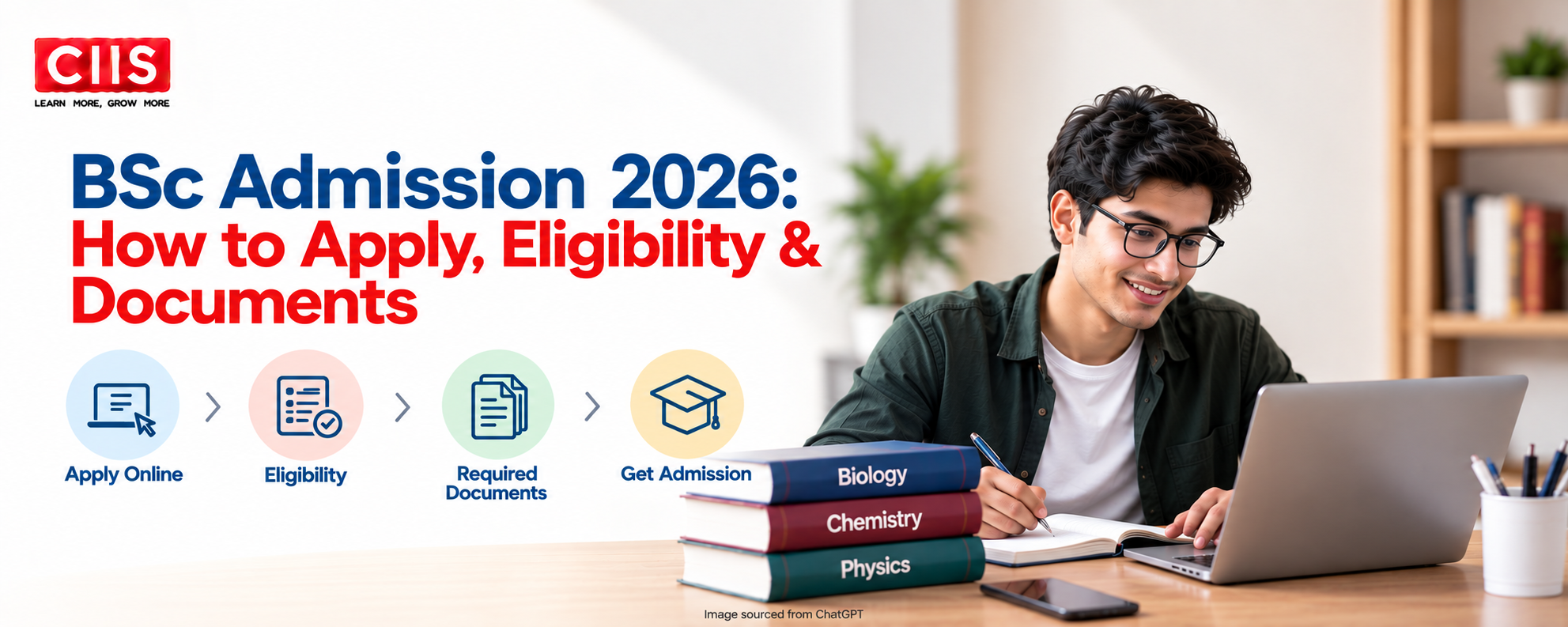
Getting admitted to a BSc program through distance or online mode in 2026 is simpler than most applicants expect: there are no entrance exams at most universities, no campus visits required, and the entire application process can be completed online. But getting it right the first time requires knowing the eligibility criteria, document list, intake deadlines, and the right university to apply to.
This complete guide covers everything you need to know about BSc admission 2026: who is eligible, what documents are required, how the online application process works step by step, when the admission windows open and close, and how CIIS India helps Mumbai students complete their enrollment without errors or delays.
⚡ Quick Answer — BSc Admission 2026
- Minimum eligibility: Class 12 (10+2) pass from a recognised board with relevant science subjects
- Minimum marks: 45%–50% in Class 12 (SC/ST relaxation at most universities)
- Entrance exam: Not required at most distance/online BSc programs — merit-based admission
- Key documents: Class 10 and 12 marksheets, transfer certificate, ID proof, photographs
- Admission intakes 2026: Two windows — July–August 2026 and January–February 2027
- Duration: 3 years (6 semesters or 3 annual examinations)
- Mode: Distance / online — no daily attendance required
Want Free Help Completing Your BSc Distance Admission 2026?
Get free 1-on-1 guidance from CIIS India — Mumbai’s most trusted education consultancy with 9+ years of experience and 50,000+ students enrolled.
1. BSc Distance Education — Who Is This Admission Guide For?
This guide covers BSc admission through the distance and online mode — programs delivered by UGC-DEB approved universities where no daily classroom attendance is required. This is the most common route for:
| Applicant Profile | Why BSc Distance Admission? |
|---|---|
| Class 12 pass — cannot attend full-time college due to location, finances, or family | Complete an accredited BSc at a fraction of the cost of regular college; study from home |
| Working professional with a diploma or Class 12 — wants a degree while employed | No attendance required; study outside working hours; no career break needed |
| Student who missed regular BSc admission due to low marks or late application | Distance BSc has no entrance exam and flexible intake; merit-based on Class 12 percentage |
| Gap year student (1–10+ years after Class 12) | Most distance universities have no upper age limit and no gap year restriction |
| BSc dropout wanting to complete the degree | Credit transfer possible at some open universities; CIIS India advises on transfer eligibility |
For the complete overview of what BSc distance education covers, how exams work, and what the degree unlocks, read: BSc Distance Education: Everything You Need to Know in 2026
2. BSc Eligibility Criteria — Standard Requirements for 2026
| Eligibility Parameter | Standard Requirement | Notes |
|---|---|---|
| Minimum qualification | Class 12 (10+2) or equivalent from a recognised state or central board (CBSE, ICSE, State Board) | Open schooling (NIOS) qualifications are accepted at most distance universities |
| Subject requirement | Science subjects in Class 12 for science-based BSc specialisations (Physics, Chemistry, Biology, Mathematics, Computer Science) | BSc Computer Science and BSc IT are sometimes open to Arts/Commerce students at select universities — check individual university rules |
| Minimum marks | 45%–50% aggregate in Class 12 (varies by university and specialisation) | SC/ST/PwD candidates typically receive 5% relaxation; some open universities have no minimum percentage requirement |
| Age limit | No upper age limit at IGNOU, YCMOU, and most open universities; minimum age 17 years | Working adults and career-returners in their 30s, 40s, and beyond are fully eligible |
| Gap year restriction | No restriction — gap of 1 to 15 years after Class 12 is acceptable at most distance universities | An affidavit or self-declaration may be required by some universities for gaps exceeding 3 years |
| Entrance exam required | Not required at most distance/online universities — admission is merit-based on Class 12 marks | IGNOU conducts an entrance test only for limited-seat programs; standard BSc programs have direct admission |
3. BSc Eligibility Criteria by Specialisation
| BSc Specialisation | Class 12 Subjects Required | Additional Notes |
|---|---|---|
| BSc Physics / Mathematics / Chemistry | PCM (Physics, Chemistry, Mathematics) in Class 12 | Minimum 45%–50% in PCM aggregate |
| BSc Biology / Zoology / Botany / Microbiology | PCB (Physics, Chemistry, Biology) in Class 12 | Minimum 45%–50% in science subjects |
| BSc Biotechnology / Biochemistry | PCB or PCMB in Class 12 | Most universities accept both PCB and PCMB backgrounds |
| BSc Computer Science | Class 12 with Mathematics or Computer Science as a subject | Some universities open to any Class 12 stream if total percentage criteria is met |
| BSc IT (Information Technology) | Class 12 from any stream at most open universities | BSc IT criteria is the most flexible — check specific university norms for BSc IT eligibility |
| BSc Nursing | PCB with minimum 45%–50%; must have passed English as a subject | Nursing programs have additional regulatory requirements; verify with the university’s nursing school |
| BSc Agriculture | PCB or PCM or Agriculture in Class 12 | Some universities accept Agriculture as a main subject in Class 12 |
| BSc Psychology | Any stream in Class 12 at most open universities | Open to Arts, Commerce, and Science graduates; highly flexible eligibility |
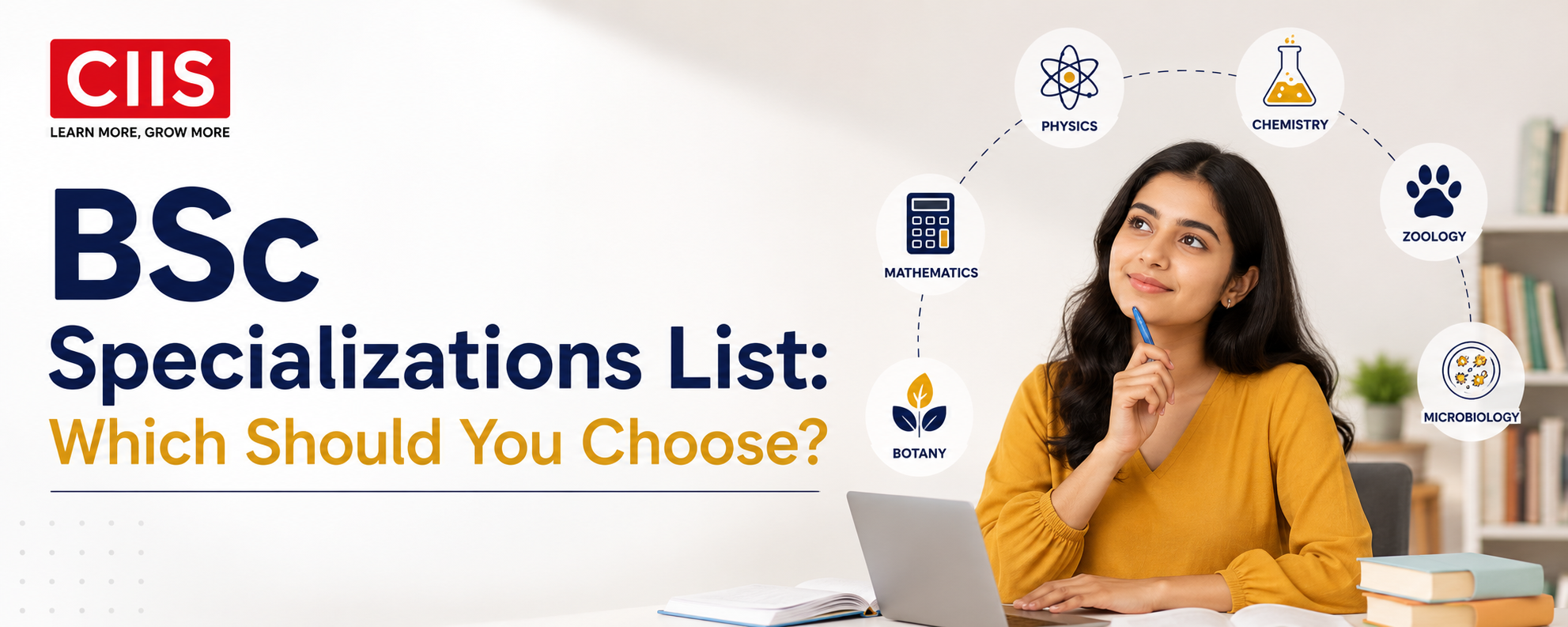
For the complete specialisation comparison with career outcomes for each branch, read: BSc Specialisations List: Which Should You Choose?
4. BSc Admission Documents — Complete Checklist 2026
| Document | Purpose | Notes |
|---|---|---|
| Class 10 marksheet and passing certificate | Date of birth proof; secondary qualification | Required as mandatory supporting document at all universities |
| Class 12 marksheet (all subjects) | Primary eligibility proof; percentage calculation | Final marksheet required; provisional acceptable if results are recent (2025–2026) |
| Class 12 passing / board certificate | Confirms Class 12 completion from a recognised board | If certificate not yet issued, submit provisional certificate or migration certificate |
| Transfer Certificate (TC) | Required by most universities as part of the formal application | Obtained from your Class 12 school; if school is closed, an affidavit may be accepted |
| Migration Certificate (if applicable) | Required if your Class 12 board is outside Maharashtra (for YCMOU) or your state (for state open universities) | Obtained from the State Education Board; takes 2–4 weeks to issue — apply early |
| Government-issued ID proof | Identity verification | Aadhaar card, PAN card, voter ID, or passport — any one |
| Passport-size photographs | Application form and student record | Recent photographs on white background; 4–6 copies in standard size (35mm × 45mm) |
| Caste / category certificate (if applicable) | SC/ST/OBC/PwD fee concession and marks relaxation | State-issued and valid; non-creamy layer certificate required for OBC |
| Gap year declaration / affidavit (if applicable) | Required by some universities for gap exceeding 3 years after Class 12 | Simple notarized affidavit; CIIS India provides the standard format |
| Signature scan | Online application form requirement | White background; clean black ink on white paper; scan or photograph clearly |
Document not ready? Don’t delay your admission. CIIS India helps you identify which documents can be submitted later and which are mandatory at the time of application. We also provide gap-year affidavit formats and migration certificate guidance. Get free document guidance →
5. BSc Online Admission — Step-by-Step Application Process 2026
| Step | What You Do | Notes |
|---|---|---|
| Step 1 — Verify university approval | Confirm the university is listed on ugcdeb.gov.in for distance/online BSc delivery | Both UGC recognition and UGC-DEB listing required; CIIS India verifies this free of charge before you apply |
| Step 2 — Confirm your specialisation eligibility | Verify your Class 12 subjects and percentage qualify for your target BSc specialisation at the chosen university | Use the eligibility matrix in Section 3 above, or call CIIS India for a free check |
| Step 3 — Fill BSc application form online | Visit the university’s official admission portal; create a student account; complete the online application form with personal, academic, and contact details | Ensure name spelling matches exactly across all documents — discrepancies cause enrollment delays |
| Step 4 — Upload BSc admission documents | Upload scanned copies of all required documents per the checklist in Section 4 | File size and format requirements vary by university (typically JPG/PDF under 200KB per file); CIIS India helps with document formatting |
| Step 5 — Pay admission fees online | Pay first-year/first-semester fees via net banking, UPI, or debit/credit card through the university portal | Zero-interest EMI available through Eduvanz, Jodo, and Early Salary for students enrolling via CIIS India |
| Step 6 — Submit and track application | Submit the completed application; note your application number; track status on the student portal | Processing time: 7–21 working days at most universities; enrollment confirmation sent via email and SMS |
| Step 7 — Receive enrollment confirmation | Receive enrollment number, student ID, and access to LMS (Learning Management System) or study material dispatch confirmation | Keep your enrollment number and university ID safe — required for all future exam registrations |
6. BSc Admission Dates 2026 — Intake Windows
| University | Intake 1 (2026) | Intake 2 (2026–27) | Application Mode |
|---|---|---|---|
| IGNOU | January–February 2026 (closed); July–August 2026 (upcoming) | January–February 2027 | Online at ignou.ac.in |
| YCMOU (Maharashtra) | June–August 2026 | December–January 2026–27 | Online at ycmou.ac.in |
| Annamalai University | June–September 2026 | January–February 2027 | Online at annamalaiuniversity.ac.in |
| Madurai Kamaraj University | June–August 2026 | November–January 2026–27 | Online at mkuniversity.ac.in |
| Private online universities (JAIN, Manipal, LPU, Chandigarh) | Rolling admissions — applications accepted throughout the year | Rolling admissions | Online at respective university portals |
Long-tail note: “What is the last date for BSc distance admission 2026?” — Most government open universities close the July–August intake by September 2026. Late fees may apply if applying after the stated deadline. CIIS India tracks all intake windows and alerts students when deadlines approach.
7. BSc Admission Requirements — University-Wise Comparison
| University | Minimum Class 12 % | Entrance Exam | Gap Year Restriction | Annual Fee (Approx.) |
|---|---|---|---|---|
| IGNOU | No minimum % for most programs | No | No restriction | ₹3,000 – ₹8,000 |
| YCMOU | 45% (SC/ST: 40%) | No | No restriction | ₹5,000 – ₹12,000 |
| Annamalai University | 45%–50% | No | No restriction | ₹8,000 – ₹18,000 |
| JAIN Online | 50% | No | No restriction | ₹30,000 – ₹55,000 |
| Manipal University Online | 50% | No | No restriction | ₹35,000 – ₹60,000 |
| LPU (Distance) | 45% | No | No restriction | ₹20,000 – ₹40,000 |
For the complete university-wise fee breakdown with all included and excluded charges, read: BSc Distance Education Fees 2026 — University-Wise Comparison
8. BSc Admission for Working Professionals — Special Considerations
| Concern | How Distance BSc Admission Resolves It |
|---|---|
| Cannot take leave from work to attend classes | No attendance requirement in distance BSc — you study entirely outside working hours |
| Work in shifts; schedule changes weekly | Self-paced learning — no fixed lecture schedule; study material available anytime via LMS or printed books |
| Based outside home city; no college nearby | Examinations at study centres across India; LMS-based coursework requires only internet access |
| Employer wants a degree for promotion / designation change | UGC-DEB approved BSc is accepted by all private and government employers for qualification purposes |
| Cannot afford full-time college fees | Distance BSc fees are 70%–90% lower than regular full-time college; zero-interest EMI available |
For the complete guide to studying BSc online while managing full-time work, read: Can I Do BSc Online While Working? Complete Guide
9. BSc vs BCA — Which Admission to Target in 2026?
If you are choosing between BSc (Computer Science / IT) and BCA, the admission process is similar across both — but the career outcomes and curriculum differ. For the complete comparison to decide which program suits your background and goals, read: BSc vs BCA: Which Course Has Better Career Scope in 2026?
| Parameter | BSc (CS / IT) — Distance | BCA — Distance |
|---|---|---|
| Class 12 requirement | Mathematics or CS as a subject at many universities | Any stream more flexible entry |
| Curriculum focus | Science + Computer Science combination | Pure computer applications and programming |
| Best next step | MSc CS / MSc Data Science / MSc IT | MCA or MBA (IT) for postgraduate options |
| Government job eligibility | Eligible for science + IT posts | Eligible for IT and computer application posts |
10. BSc Distance Education in Mumbai — Admission Help Near You
For students in Mumbai seeking a BSc distance admission, the nearest and most reliable option is CIIS India at Sej Plaza, Marve Road, Malad (West). For university options and college comparisons specific to Mumbai, read: BSc Distance Education in Mumbai: Top Colleges & Fees
11. Jobs After BSc — What Admission Opens for You
The BSc degree unlocks government and private sector employment across science, technology, education, healthcare, and analytics. Understanding the career outcome before choosing your specialisation and university ensures your admission decision is aligned with your employment goals. For the complete job and salary scope, read: Jobs After BSc Distance Education: Salary & Scope in India
| BSc Specialisation | Entry-Level Job After Admission + Degree | Avg. Starting Salary |
|---|---|---|
| BSc Computer Science / IT | Junior Developer, IT Support, Data Entry Supervisor | ₹2.5 – ₹5 LPA |
| BSc Mathematics | Analyst Trainee, Teacher (TGT eligible), Actuarial Trainee | ₹2.5 – ₹5 LPA |
| BSc Chemistry | Lab Technician, Quality Analyst, Pharmaceutical Associate | ₹2 – ₹4.5 LPA |
| BSc Biotechnology | Research Trainee, Lab Assistant, QC Associate | ₹2.5 – ₹4.5 LPA |
| BSc Nursing | Staff Nurse, Clinical Nurse, Ward Assistant | ₹3 – ₹6 LPA |
12. BSc Distance Admission — CIIS India Mumbai
If you are in Mumbai and need free guidance on BSc distance admission 2026 — eligibility check, university selection, document preparation, or the full online application process — CIIS India at Sej Plaza, Marve Road, Malad (West), Mumbai has helped 50,000+ students enroll in the right distance programs over 9+ years.
- Free eligibility check — we assess your Class 12 subjects, percentage, and gap year status for each university before you apply
- UGC-DEB verification — we confirm the university is listed and the BSc program is approved before you pay any fees
- Document checklist and gap-year affidavit format provided free of charge
- Complete online application support — form filling, document upload, payment, and enrollment tracking
- Zero-interest EMI through Eduvanz, Jodo, and Early Salary
- Walk-in available at Sej Plaza, Marve Road, Malad (West), Mumbai
Frequently Asked Questions (FAQs)
The standard eligibility for BSc distance admission is Class 12 (10+2) pass from a recognised board with relevant science subjects, and a minimum aggregate of 45%–50% depending on the university. SC/ST and PwD candidates typically get a 5% marks relaxation. No entrance exam is required at most distance universities — admission is merit-based on Class 12 percentage. Gap years of any length are generally accepted, and there is no upper age limit at open universities like IGNOU and YCMOU.
The documents required for BSc distance admission are: Class 10 marksheet and certificate, Class 12 marksheet and passing certificate, Transfer Certificate (TC) from your Class 12 school, Migration Certificate (if applying to a university outside your board’s state), government-issued ID proof (Aadhaar / PAN / voter ID), recent passport-size photographs, caste certificate if applicable, and a gap-year affidavit if more than 3 years have passed since Class 12. CIIS India provides the affidavit format and document checklist free of charge.
Yes — IGNOU has no minimum percentage requirement for most BSc programs. Students who passed Class 12 with low marks or only a passing grade are eligible to apply at IGNOU. Other open universities like YCMOU require a minimum of 45% (40% for SC/ST). Private online universities generally require 45%–50%. CIIS India recommends the right university based on your actual Class 12 marks to ensure smooth admission.
A migration certificate is required when you studied Class 12 from a board outside the university’s home state. For example, if you studied Class 12 under CBSE or a different state board and are applying to YCMOU (Maharashtra) or a Tamil Nadu open university, a migration certificate from your Class 12 board is typically mandatory. It takes 2–4 weeks to issue, so apply for it early. CIIS India guides you on whether your specific board and university combination requires this document.
The BSc distance admission process involves: (1) verifying the university is UGC-DEB listed, (2) confirming your Class 12 subjects and marks qualify for your target specialisation, (3) filling the online application form at the university portal, (4) uploading all required documents as scanned copies, (5) paying first-semester or first-year fees online, and (6) tracking your application until you receive your enrollment number and LMS access. CIIS India handles steps 3 through 6 on your behalf, free of charge.
The July–August 2026 intake closes between August and September 2026 at most open universities. IGNOU typically closes its July cycle admission by September 30. YCMOU closes its June–August intake by late August. Private online universities accept rolling admissions throughout the year with no strict last date. CIIS India monitors all intake deadlines and alerts students proactively to ensure no one misses the admission window.
Yes — most distance and open universities including IGNOU, YCMOU, Annamalai, and Madurai Kamaraj University have no gap year restriction for BSc distance admission. A gap of 5, 10, or even 15 years after Class 12 does not disqualify you. Some universities require a self-declaration or simple notarized affidavit for gaps exceeding 3 years — CIIS India provides the standard format for this document at no charge. Your Class 12 marks and subjects remain the only eligibility criteria.
Yes — a BSc earned through distance mode from a UGC-DEB listed university is fully valid for government jobs including SSC, Railway RRB, state PSC, and central government recruitment. The degree certificate does not mention distance mode — it shows only the university name, degree, and specialisation. Government recruitment bodies verify UGC recognition of the university, not the mode of delivery. CIIS India confirms UGC-DEB listing of all universities it recommends before any student applies.