B.Tech distance education has two entry routes, and the eligibility conditions for each are distinct. If you completed Class 12 with Physics, Chemistry, and Mathematics, you qualify for the regular 4-year route. If you hold a 3-year engineering diploma, you qualify for the lateral entry route and can enter directly into Year 2, completing B.Tech in 3 years instead of 4. In both cases, no JEE score is required, no entrance exam is mandatory at most distance universities, and no work experience is needed.
This complete guide covers every eligibility condition for B.Tech distance admission, who qualifies under each route, what the minimum marks are, which engineering branches are available for your background, and how CIIS India handles your free eligibility check and admission in Mumbai.
⚡ Quick Answer – B.Tech Distance Education Eligibility
- Route 1 (Regular 4 years): Class 12 (10+2) with Physics, Chemistry, Mathematics minimum 45%–50%; no JEE required
- Route 2 (Lateral Entry 3 years): 3-year engineering diploma in a relevant branch, minimum 45%–50%; no entrance exam
- Work experience required? No; freshers and working professionals are both eligible
- Age limit: No upper age limit at most AICTE-approved distance universities
- Gap year restriction: No restriction at most distance B.Tech universities
- Key regulatory condition unique to B.Tech: University must hold AICTE approval for distance B.Tech delivery, not UGC-DEB alone
Not Sure If You Qualify for Distance B.Tech? Get a Free Eligibility Check at CIIS India
CIIS India assesses your Class 12 or diploma background, verifies AICTE approval, and handles your complete B.Tech admission free, before you pay any fees. 9+ years of experience. 50,000+ students enrolled.
1. B.Tech Eligibility Criteria – Both Routes at a Glance
| Parameter | Regular Route (4 Years) | Lateral Entry Route (3 Years) |
|---|---|---|
| Minimum qualification | Class 12 (10+2) with Physics, Chemistry, and Mathematics from a recognised board | 3-year engineering diploma in a relevant branch from an AICTE-recognised polytechnic or state board of technical education |
| Minimum marks | 45%–50% aggregate in PCM subjects (varies by university; SC/ST: 5% relaxation) | 45%–50% aggregate in diploma (varies by university; SC/ST: 5% relaxation) |
| Entrance exam | No JEE or any entrance exam required merit-based admission on Class 12 percentage | No entrance exam required at most distance universities merit-based on diploma percentage |
| Entry year in B.Tech | Year 1-4 years to complete | Year 2 (direct) 3 years to complete; Year 1 is waived |
| Work experience | Not required | Not required freshers and working diploma engineers both eligible |
| Age limit | No upper age limit at most AICTE-approved distance universities; minimum 17 years | No upper age limit |
| AICTE requirement | University must hold AICTE approval for distance B.Tech delivery | Same AICTE approval for ODL B.Tech mandatory; lateral entry placement confirmed by university |
2. B.Tech Eligibility After 12th – Class 12 Route (Regular 4-Year)
| Eligibility Element | Requirement | Notes |
|---|---|---|
| Mandatory subjects in Class 12 | Physics, Chemistry, and Mathematics (PCM) as main subjects | Biology can substitute for Chemistry or Mathematics at some universities for select B.Tech programs (e.g., Biotechnology B.Tech); PCM is standard for all engineering branches |
| Minimum aggregate | 45%–50% in PCM subjects (university-specific) | IGNOU: may not have a strict minimum; most private online universities: 50%; YCMOU and traditional open universities: 45%; SC/ST: 5% relaxation |
| Board recognition | Class 12 must be from a CBSE, ICSE, state board, or NIOS recognised board | Open school Class 12 (NIOS) is accepted at most distance B.Tech universities |
| JEE score required? | No — distance B.Tech does not require JEE Main or JEE Advanced | This is one of the most significant advantages of distance B.Tech for students who could not qualify in JEE |
| Gap after Class 12 | No restriction — gap of 1–15 years after Class 12 accepted at most distance universities | A simple gap year declaration / affidavit may be required for gaps exceeding 3 years at some private universities; CIIS India provides standard format |
Long-tail note: “What is the B.Tech eligibility after Class 12 for distance education?” Class 12 (10+2) with Physics, Chemistry, and Mathematics from a recognised board, with a minimum of 45%-50% aggregate in PCM. No JEE score required. No entrance exam at most distance B.Tech universities. No work experience requirement. No upper age limit. These are the only conditions for the regular 4-year distance B.Tech route.
3. Lateral B.Tech Eligibility – Diploma Holder Route (3-Year)
| Eligibility Element | Requirement | Notes |
|---|---|---|
| Minimum qualification | 3-year engineering diploma in a relevant branch from an AICTE-recognised polytechnic or state board of technical education | Diploma must be in an engineering branch not a management, arts, or commerce diploma; engineering branch determines B.Tech specialisation for lateral entry |
| Minimum marks in diploma | 45%–50% aggregate across all 6 semesters (varies by university) | Overall diploma aggregate, not individual semester marks; SC/ST get 5% relaxation; some universities have no minimum for distance lateral entry |
| Branch alignment | Diploma branch must match or be closely related to B.Tech specialisation | Diploma in Mechanical → B.Tech Mechanical; Diploma in CS → B.Tech CSE or IT; Diploma in ECE → B.Tech ECE or EEE; Diploma in Civil → B.Tech Civil |
| Entrance exam | No entrance exam at most distance B.Tech universities for lateral entry — merit-based on diploma percentage | For regular campus lateral entry, a state-level LEET or similar is required; for distance mode, direct admission |
| Is Class 12 required for lateral entry? | Not mandatory at most distance universities for lateral entry — diploma is the primary qualifying document | Some state counselling processes may ask for Class 12 as a secondary document; CIIS India clarifies for your specific university |
| Work experience | Not required | Working diploma engineers and freshly graduated diploma holders are both eligible |
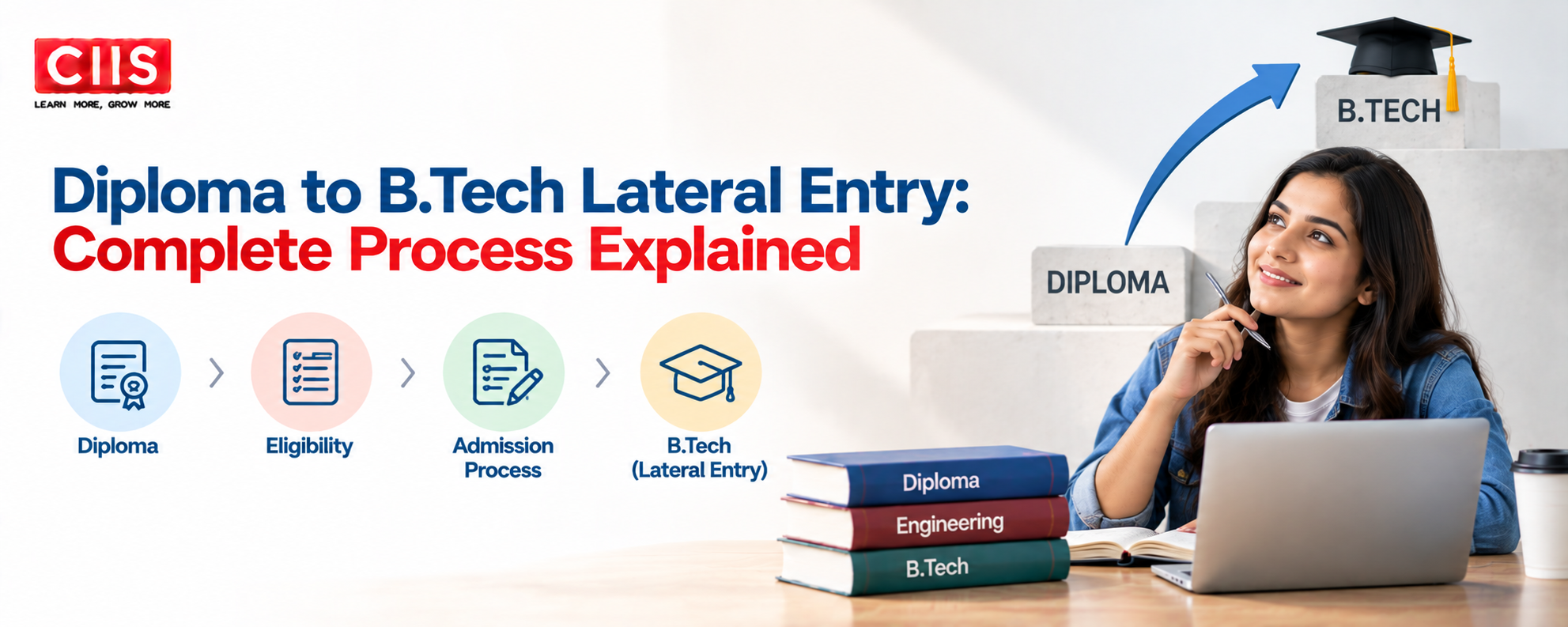
For the complete lateral entry admission process documents, step-by-step enrollment, and which universities accept which diploma branches read: Diploma to B.Tech Lateral Entry: Complete Process Explained
4. B.Tech Course Eligibility – Branch-Wise Subject Requirements
| B.Tech Specialisation | Class 12 Requirements (Regular Route) | Diploma Branch (Lateral Entry Route) |
|---|---|---|
| B.Tech Computer Science (CSE) | PCM or PCM with CS as additional subject | Diploma in CS, IT, ECE (at select universities) |
| B.Tech Information Technology (IT) | PCM or any stream with Maths at some open universities | Diploma in IT, CS, ECE |
| B.Tech Mechanical Engineering | PCM (Physics, Chemistry, Mathematics) | Diploma in Mechanical, Production, Automobile |
| B.Tech Civil Engineering | PCM | Diploma in Civil Engineering |
| B.Tech Electronics (ECE) | PCM | Diploma in ECE, Electronics, EEE |
| B.Tech Electrical Engineering (EEE) | PCM | Diploma in EEE, Electrical Engineering |
| B.Tech Chemical Engineering | PCM with Chemistry as a main subject | Diploma in Chemical Engineering |
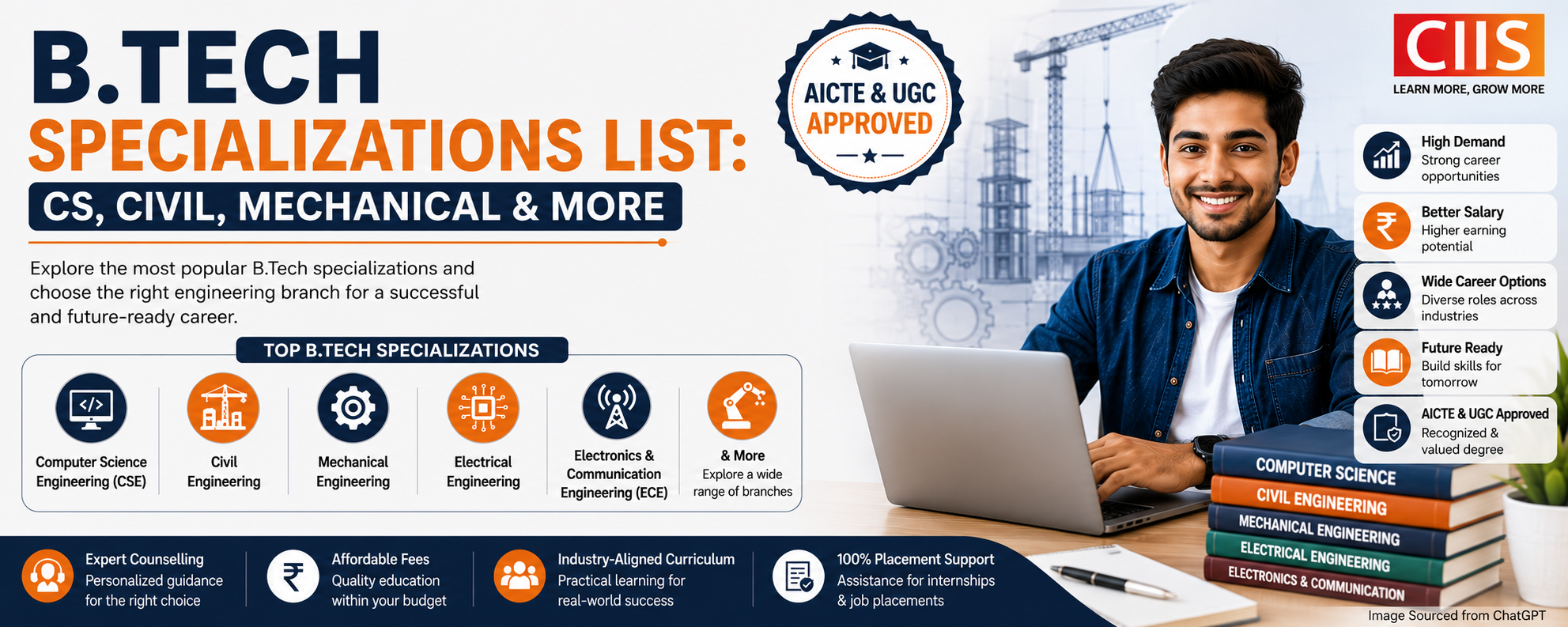
For the complete career scope, demand, and salary analysis for each B.Tech specialisation, read: B.Tech Specialisations List: CS, Civil, Mechanical & More
5. AICTE Eligibility for B.Tech Admission – The Regulatory Condition
Unlike MBA or MSc (where UGC-DEB listing alone is sufficient), B.Tech requires AICTE approval because engineering education is regulated by AICTE under the AICTE Act. This means:
| What You Must Confirm Before Enrolling | How to Verify |
|---|---|
| AICTE has approved the university for distance B.Tech delivery | Check aicte-india.org → Approved institutions → ODL programs list; or ask CIIS India to verify free |
| The B.Tech program is listed on ugcdeb.gov.in | Check ugcdeb.gov.in → Search by university and program; B.Tech must appear for current year |
AICTE approved engineering courses through distance mode are currently available at: BITS Pilani (WILP), JAIN University Online, Manipal University Online, Chandigarh University Online, Amity University Online, IGNOU (select programs). CIIS India verifies both AICTE and UGC-DEB approval before recommending any B.Tech program.
For the complete AICTE approval analysis and validity guide, read: Is B.Tech Distance Education Valid? AICTE Approved? 2026
6. B.Tech for Working Professionals – Eligibility Is the Same; Delivery Is Different
| Working Professional Profile | Eligibility Met? | B.Tech Route |
|---|---|---|
| Diploma engineer, 5 years in manufacturing, wants B.Tech for designation upgrade | ✅ Yes diploma + 45%+ meets lateral entry criteria | Lateral entry (Year 2, 3-year completion) |
| Class 12 PCM pass, working in IT support without a degree, wants formal B.Tech | ✅ Yes PCM + 45%+ meets regular route criteria | Regular route (Year 1, 4-year completion) |
| Diploma in Civil, 8 years in construction, targeting SSC JE degree category | ✅ Yes diploma qualifies for lateral B.Tech Civil | Lateral entry → B.Tech Civil; SSC JE degree category unlocked after completion |
| Class 12 PCM with 38%; general category | ❌ Below 45% threshold at most universities | Check IGNOU for no-minimum-percentage options; CIIS India assesses alternatives |
| Diploma in Computer Science, applying for B.Tech CSE lateral entry | ✅ Yes CS diploma + 45%+ qualifies | Lateral entry into B.Tech CSE Year 2 |
| Diploma in Mechanical wanting B.Tech Computer Science | ❌ Branch mismatch AICTE norms do not permit Mechanical Diploma → CSE B.Tech lateral entry | Must do regular route (Class 12 PCM) for CSE; or pursue B.Tech Mechanical (matching branch) |
7. B.Tech Admission Requirements – University-Wise Eligibility Comparison
| University | Class 12 Minimum % | Diploma Minimum % (Lateral) | JEE / Entrance Exam? | Gap Year Restriction? |
|---|---|---|---|---|
| IGNOU (select B.Tech programs) | No strict minimum for most programs | No strict minimum | No | No restriction |
| JAIN University Online | 50% in PCM | 50% in diploma | No | No restriction |
| Manipal University Online | 50% in PCM | 50% in diploma | No | No restriction |
| Chandigarh University Online | 45%–50% in PCM | 45%–50% in diploma | No | No restriction |
| Amity University Online | 50% in PCM | 50% in diploma | No | No restriction |
| BITS Pilani WILP | 60% in PCM at 12th + B.Tech already completed (WILP is for working engineers) | Not applicable WILP requires a full B.Tech degree, not diploma; employer partnership also required | Own selection test (not JEE) | Employer partnership required |
8. B.Tech Minimum Qualification – What Disqualifies You and What Doesn’t
| Situation | Eligible? | What to Do |
|---|---|---|
| Class 12 PCM with 47%; General category | ✅ Yes at IGNOU, YCMOU, Chandigarh University meets 45% threshold | Apply to universities with 45% minimum; CIIS India identifies best fit |
| Class 12 PCM with 42%; General category | ❌ Below standard threshold at most universities | Check IGNOU for no-minimum options; consider NIOS re-improvement if planning long-term |
| Class 12 with PCB (Biology instead of Mathematics) | ❌ Not eligible for standard B.Tech branches PCM required | Biotechnology B.Tech may be available with PCB at select universities; CIIS India confirms |
| Class 12 Commerce or Arts (no Science / Maths) | ❌ Not eligible for B.Tech — PCM required | Consider BSc CS / IT or BCA instead; CIIS India advises on alternative technology degrees |
| 3-year diploma with 42%; SC category | ✅ Yes SC category needs only 40%–45% at most universities; 42% qualifies | Apply with valid SC certificate; CIIS India confirms specific university threshold for your category |
| 3-year diploma + Class 12 both available (hybrid applicant) | ✅ Yes both routes available; lateral entry is faster and cheaper | CIIS India recommends lateral entry (3-year) over regular route (4-year) for diploma holders |
9. B.Tech Education Qualification – Eligible Profiles for Government Job Aspirants
Engineers targeting government jobs (SSC JE, RRB JE, PSU GET) through distance B.Tech have the same eligibility conditions as those pursuing B.Tech for private sector reasons. The resulting degree from an AICTE-approved distance university is equally valid.
| Government Job Target | Which B.Tech Route and Branch | Eligibility Required |
|---|---|---|
| SSC JE Civil (degree category) | B.Tech Civil — regular or lateral entry | Class 12 PCM 45%+ or Diploma in Civil 45%+ |
| RRB JE Mechanical | B.Tech Mechanical — regular or lateral entry | Class 12 PCM 45%+ or Diploma in Mechanical 45%+ |
| PSU GET (Electrical / Civil / Mechanical) | B.Tech in relevant branch | Class 12 PCM 45%–50%+ or Diploma in relevant branch 45%–50%+ (PSU GET often requires 60% in B.Tech when complete) |
| NIC / Government IT posts (CSE / IT) | B.Tech CSE or IT — regular or lateral entry | Class 12 PCM / PCM+CS or Diploma in CS / IT |
For the complete government job validity analysis with post-wise eligibility, read: Is B.Tech Distance Education Valid for Government Jobs?
10. B.Tech WILP vs Distance – Eligibility Compared
| Parameter | Standard Distance B.Tech | BITS Pilani WILP |
|---|---|---|
| Minimum qualification | Class 12 PCM or engineering diploma | Full B.Tech already completed + minimum experience in BITS partner employer |
| Who can apply | Class 12 students, diploma engineers, working professionals without a B.Tech | Only engineers already holding a B.Tech working at BITS partner companies (WILP is for M.Tech, not B.Tech clarification: BITS WILP is available for B.Tech only through their FLEX program for specific partner employers) |
| Entrance exam | No JEE; no entrance test at most universities | Own BITS selection test required |
| Employer partnership required | No — any applicant with qualifying Class 12 or diploma | Yes employer must be a registered BITS WILP partner |
For the complete WILP vs distance comparison covering fees, career outcomes, and who should choose which, read: B.Tech WILP vs Distance Education: Which Should You Choose?
11. B.Tech Admission Eligibility – Documents You Need to Prove It
| Document | Regular Route (Class 12) | Lateral Entry Route (Diploma) |
|---|---|---|
| Class 10 marksheet and certificate | ✅ Required | ✅ Required |
| Class 12 marksheet and certificate | ✅ Required — primary eligibility document | Optional at most universities diploma is primary document |
| All diploma semester marksheets (all 6 semesters) | Not applicable | ✅ Required all 6 semesters mandatory |
| Diploma passing certificate | Not applicable | ✅ Required provisional acceptable |
| Government-issued ID proof | ✅ Required | ✅ Required |
| Passport-size photographs | ✅ Required | ✅ Required |
| Caste certificate (if applicable) | ✅ If SC/ST/OBC/PwD | ✅ If SC/ST/OBC/PwD |
12. B.Tech Distance Education – What Eligible Students Study
For the complete guide covering what the B.Tech distance curriculum involves, how exams work, what specialisations are available, and what the 4-year (or 3-year lateral) program delivers, read: B.Tech Distance Education: Everything You Need to Know in 2026
13. Salary After B.Tech – What Meeting Eligibility and Completing the Program Unlocks
| Profile Before B.Tech | Profile After Completing Distance B.Tech | Salary Change |
|---|---|---|
| Diploma engineer, IT company, ₹2.5 LPA | B.Tech CSE (lateral entry) → Associate Engineer / Software Engineer designation | 30%–60% salary increase through designation upgrade |
| Class 12 PCM, working in technical support, ₹1.8 LPA | B.Tech → Engineer-level jobs unlocked | 40%–80% salary increase over 12–24 months |
| Diploma civil engineer, construction, ₹3 LPA | B.Tech Civil (lateral entry) → SSC JE degree category / graduate engineer track | Government job salary: ₹35,400–₹1,12,400 per month (SSC JE Level 6) |
For the complete private and government salary impact analysis, read: Salary After B.Tech Distance Education: Is It Worth It?
14. B.Tech Distance Education Fees – What Eligible Students Pay
| University | Total Fees (4-Year Regular Route) | Total Fees (3-Year Lateral Entry) |
|---|---|---|
| IGNOU (select programs) | ₹25,000 – ₹60,000 | ₹18,000 – ₹45,000 (3 years) |
| Chandigarh University Online | ₹70,000 – ₹1,30,000 | ₹50,000 – ₹97,500 (3 years) |
| JAIN University Online | ₹80,000 – ₹1,50,000 | ₹60,000 – ₹1,12,500 (3 years) |
| Manipal University Online | ₹1,00,000 – ₹1,80,000 | ₹75,000 – ₹1,35,000 (3 years) |
For the complete university-wise fee comparison with all included charges and specialisation-specific costs, read: B.Tech Distance Education Fees 2026 — University Comparison
15. B.Tech Distance Education in Mumbai – Free Eligibility Check at CIIS India
For Mumbai engineers and students, read: B.Tech Distance Education in Mumbai: Apply at CIIS India
CIIS India at Sej Plaza, Marve Road, Malad (West), Mumbai provides:
- Free eligibility check – Class 12 or diploma marks and branch assessed against AICTE-approved university criteria before you apply
- Route guidance – lateral entry (3-year) vs regular (4-year) recommendation based on your background
- AICTE and UGC-DEB verification confirmed for every B.Tech program before recommendation
- Branch alignment check – we confirm your Class 12 subjects or diploma branch qualifies for your target B.Tech specialisation
- Complete admission support – application, document preparation, fee payment, and enrollment tracking at no charge
- Zero-interest EMI through Eduvanz, Jodo, and Early Salary
- Walk-in at Sej Plaza, Marve Road, Malad (West), Mumbai
Frequently Asked Questions (FAQs)
For the regular 4-year route, the minimum eligibility is Class 12 (10+2) with Physics, Chemistry, and Mathematics from a recognised board, with a minimum aggregate of 45%–50% in PCM subjects. No JEE or entrance exam is required. For the 3-year lateral entry route, the minimum qualification is a 3-year engineering diploma in a relevant branch from an AICTE-recognised polytechnic, with a minimum of 45%–50% aggregate across all diploma semesters. In both cases, work experience is not required and there is no upper age limit. CIIS India assesses which specific university’s threshold your marks meet before recommending any enrollment.
Yes 3-year engineering diploma holders are eligible for B.Tech distance education through the lateral entry route, entering directly into Year 2 and completing the degree in 3 years instead of 4. The diploma branch must be related to the B.Tech specialisation chosen a Diploma in Mechanical qualifies for B.Tech Mechanical; a Diploma in CS qualifies for B.Tech CSE or IT. A full branch switch (e.g., Mechanical Diploma to CSE B.Tech) is not permitted under AICTE lateral entry norms. CIIS India confirms which B.Tech specialisation your specific diploma branch qualifies for before you apply.
No JEE Main, JEE Advanced, or any other entrance examination is not required for B.Tech distance education admission at any AICTE-approved distance university. Admission is merit-based on your Class 12 PCM aggregate percentage (regular route) or diploma aggregate percentage (lateral entry route). This is one of the most significant practical advantages of distance B.Tech for students who could not qualify in JEE or who are returning to education after a long gap. The resulting degree is equally valid the admission route does not appear on the B.Tech certificate.
Working professionals have the same eligibility conditions as any other applicant Class 12 PCM with 45%–50% for the regular route, or 3-year engineering diploma with 45%–50% for the lateral entry route. Work experience is not required and has no bearing on eligibility. The distance mode specifically suits working professionals because no daily attendance is required you study outside working hours via LMS or printed books. Your job, salary, and career continue uninterrupted throughout the 3–4 year B.Tech program.
Yes most AICTE-approved distance B.Tech universities have no gap year restriction. A gap of 5, 10, or 15 years after Class 12 or after completing a diploma does not disqualify you. Working professionals in their 30s and 40s who completed Class 12 or a diploma years ago are fully eligible. Some private universities may ask for a gap declaration affidavit for gaps exceeding 3 years CIIS India provides the standard format free of charge. Your Class 12 PCM percentage or diploma aggregate remains the only eligibility criterion regardless of when you qualified.
Class 12 with PCB (Physics, Chemistry, Biology) without Mathematics as a main subject is not eligible for standard B.Tech branches (CSE, Mechanical, Civil, ECE, EEE) at most universities, as PCM is the standard requirement. However, B.Tech Biotechnology or B.Tech Agricultural Engineering may be available with PCB at select universities. If you need a technology degree, CIIS India may recommend BSc IT or BSc Computer Science as alternatives that are open to a broader Class 12 background. For standard B.Tech branches, Mathematics at Class 12 is required.
No there is no upper age limit for B.Tech distance education admission at IGNOU, JAIN Online, Manipal Online, Chandigarh University, or Amity Online. A minimum age of 17 years typically applies (aligned with the minimum age for engineering education under general norms), but no maximum age restriction exists. Working engineers in their 30s, 40s, and beyond who completed Class 12 or a diploma years ago are fully eligible. Age is not a disqualifier your PCM marks or diploma aggregate are the only eligibility criteria.
Partial branch changes within related engineering domains are possible for lateral entry. A Diploma in CS can qualify for B.Tech CSE, IT, or Data Science all CS-adjacent. A Diploma in ECE can qualify for B.Tech ECE or EEE at some universities. However, a complete cross-branch switch such as Diploma in Mechanical to B.Tech CSE, or Diploma in Civil to B.Tech ECE is not permitted under AICTE lateral entry eligibility norms, which require branch alignment between the qualifying diploma and the B.Tech program. CIIS India maps your specific diploma branch to all eligible B.Tech specialisations before you apply, so you know your options before committing.