Searching for the top universities for B.Tech distance education in India returns long ranked lists, mostly published by the institutions that want your admission. Before comparing any names, you need the rule that decides whether such a list can exist at all: UGC’s Distance Education Bureau lists engineering among the programs that universities are not permitted to offer in open and distance learning (ODL) or online mode. That means an honest “top 10 distance B.Tech universities” list cannot be written.
What can be written is a guide to what genuinely exists for working engineers and diploma holders: work-integrated and part-time B.Tech programs run by approved institutions, plus ten checks that protect you from paying for a degree that will not hold up.
⚡ Quick Answer – Top Universities for B.Tech Distance Education in India 2026
- Short answer: There is no safe ranked list of distance B.Tech universities, because UGC notices list engineering as not permitted in ODL or online mode
- What does exist: Work-integrated learning programs such as BITS Pilani’s WILP B.Tech, and part-time or evening B.E. and B.Tech programs at AICTE-approved institutions
- BITS Pilani WILP B.Tech eligibility (from its programme pages): Technical diploma or B.Sc. in a relevant discipline, usually at least 60% aggregate, two years of relevant work experience, and employer consent with a mentor
- Not eligible for WILP B.Tech: A Class 12 pass with no diploma or B.Sc. and no work experience you would need a regular B.Tech
- Always check: The latest notice on ugcdeb.gov.in, AICTE approval for the exact program and mode on aicte-india.org, and the eligibility clause of your target recruitment notification
Got a B.Tech Offer You Want Checked? Get Free Verification at CIIS India
CIIS India helps you verify what a program is approved for, and which route suits your qualification, before any fee is paid. 9+ years of experience. 50,000+ students enrolled.
1. B.Tech Distance Education in India – What the Rules Say
| Source | Position | What It Means for You |
|---|---|---|
| UGC (Open and Distance Learning Programmes and Online Programmes) Regulations, 2020 | Programs that a statutory body does not permit in ODL or online mode cannot be offered in that mode | The ODL framework excludes programs a regulator bars from distance delivery |
| UGC Distance Education Bureau public notices | Engineering, including allied domains, is listed among programs not permitted in ODL and online mode; notices are reissued each academic year | A university cannot legitimately sell B.Tech through distance or online delivery |
| AICTE | Regulates technical education and approves programs by branch and mode | An AICTE approval relates to the specific program and mode shown on the letter |
Long-tail note: “Is there any approved B.Tech through distance education in India?” Based on current UGC notices, no university can legitimately offer B.Tech through distance or online delivery. Routes for working people exist, but they are work-integrated or part-time programs with their own approvals, and each must be checked on its own.
2. B.Tech Online Course in India – What the Advertisements Really Mean
| What the Advertisement Says | Why It Is Not Enough |
|---|---|
| “100% online B.Tech, UGC recognised” | University recognition does not authorise a program in a mode that UGC lists as prohibited |
| “AICTE approved distance B.Tech” | Ask which mode the approval covers it may refer to a campus or part-time program |
| “Valid for all government jobs” | Validity is set by each recruitment notification, not by the university’s marketing |
| “No exams on campus, no labs, no attendance” | Engineering degrees need practical and project components; a program with none is a warning sign |
| “Top 10 distance B.Tech universities” lists | Often sponsored placements; check each name against the regulators’ portals yourself |
3. UGC Approved B.Tech Distance Education – What You Can and Cannot Verify
| Check | Where to Do It | What a Pass Looks Like |
|---|---|---|
| Latest UGC-DEB public notice on prohibited programs | ugcdeb.gov.in | The program and mode are not on the prohibited list for the current year |
| University recognition | ugc.ac.in | The university is listed and not on a fake or de-recognised notice |
| AICTE approval for the exact branch and mode | AICTE approved-institutions data, plus the institution’s own approval letter | The letter names your B.Tech branch and the mode (for example part-time or work-integrated) |
For the dedicated approval analysis, read: Is B.Tech Distance Education Valid? AICTE Approved? 2026
4. Ten Checks That Replace a Top-10 List
| # | Check | Red Flag |
|---|---|---|
| 1 | Is the delivery mode written down (part-time, work-integrated, regular)? | “Distance” or “online” with no mention of practicals |
| 2 | Does the AICTE letter name your exact branch and mode? | A generic institution-level approval only |
| 3 | Is the latest UGC-DEB notice free of your program? | The institution says “UGC-DEB listed” for engineering |
| 4 | Does the program include laboratories and a project? | No practical component at all |
| 5 | Is admission tied to your diploma, work experience, or employer? | “Anyone can join, no eligibility needed” |
| 6 | Is the fee published per semester with all heads? | One lump sum with no breakup |
| 7 | Does the university show a sample degree certificate? | Refuses to share one |
| 8 | Is the university in a different state from its “study centres”? | Franchise-style centres run by an edtech partner |
| 9 | Does your target recruiter accept this mode in writing? | You only have the university’s assurance |
| 10 | Can alumni be reached on professional networks? | Only testimonials supplied by the institution |
5. B.Tech Distance Education Universities – Routes That Do Exist
| Route | How It Works | Who It Is For | What to Verify |
|---|---|---|---|
| BITS Pilani Work Integrated Learning Programmes (WILP) | B.Tech programs for employed professionals; BITS states its WILP programs are UGC approved; programs such as Engineering Technology and Information Systems run for seven semesters | Employed technical diploma or B.Sc. holders in relevant fields | Employer consent and mentor availability; branch eligibility; recognition wording for your target job |
| Part-time or evening B.E. / B.Tech at AICTE-approved institutions | Scheduled evening or weekend classes at an approved engineering college | Working diploma holders and technicians | AICTE approval for the part-time branch; your state’s technical education rules |
| Regular full-time B.Tech or lateral entry | Standard campus program; diploma holders enter in the second year at many institutions | Class 12 and diploma holders who can study full-time | Entrance route, seat availability, fees |
| Employer-sponsored study | Your employer funds or releases you for a regular or part-time program | Employees of larger companies and PSUs | Bond terms and company policy |
Want a named shortlist for your branch and city? CIIS India can check part-time and work-integrated options against AICTE approvals and your target recruiter’s eligibility clause. Ask for a free check →
6. AICTE Approved B.Tech for Working Professionals – How to Confirm
| Question to Ask the Institution | Why |
|---|---|
| Which branch is approved, for which academic year, in which mode? | Approval is branch-wise and year-wise |
| Is this the same legal entity as the one named on the AICTE letter? | Edtech partners sometimes advertise under a university’s name |
| Where will my laboratories and project be done? | Confirms a genuine practical component |
| Will the certificate name the program exactly as advertised? | Prevents later title disputes |
7. B.Tech Distance Education for Working Professionals – BITS Pilani WILP Eligibility in Detail
| Parameter | Published Position |
|---|---|
| Qualification | Technical diploma in engineering or B.Sc. in a relevant discipline, with adequate preparation in mathematics |
| Marks | Some program pages state at least 60% aggregate; confirm the figure for your program |
| Work experience | Minimum two years in a relevant domain |
| Employer | Employer consent and mentor availability are additional requirements |
| Duration | Seven semesters for the Information Systems program; check each program |
| Fees and EMI | Published on each program page; confirm the current structure |
For the full comparison between work-integrated and distance routes, read: B.Tech WILP vs Distance Education: Which Should You Choose?
8. B.Tech Eligibility Criteria – Regular Route
| Parameter | Typical Requirement |
|---|---|
| Qualification | Class 12 with Physics, Chemistry, and Mathematics from a recognised board |
| Marks | Institution-specific; many require around 45% to 50% or higher |
| Entrance | Usually a national or state entrance examination for regular programs |
9. B.Tech Lateral Entry Eligibility – Diploma Holders
| Parameter | Typical Requirement |
|---|---|
| Qualification | 3-year engineering diploma, or B.Sc. with mathematics, from a recognised institution |
| Entry year | Second year at many regular institutions |
| Branch | Diploma branch should match or be closely related to the B.Tech branch |
| Entrance | State-level lateral entry test or merit process |
For the full lateral entry process, read: Diploma to B.Tech Lateral Entry: Complete Process Explained
10. B.Tech Biotechnology Eligibility and Admission Requirements
| Item | Typical Position |
|---|---|
| B.Tech Biotechnology qualification | Class 12 with Physics and Chemistry plus Mathematics or Biology; confirm with the institution |
| Delivery | Laboratory-heavy; offered through regular campus programs |
| Documents for any B.Tech admission | Marksheets, certificates, ID proof, photographs, category certificate, and for working applicants an employer letter |
For the eligibility conditions in one place, read: B.Tech Distance Education Eligibility: Who Can Apply?
11. B.Tech Mechanical Engineering Distance Education – What a Diploma Holder Can Do
| Your Position | Realistic Route |
|---|---|
| Mechanical diploma holder, employed, with two years of experience | A work-integrated program in a relevant discipline, with employer consent |
| Mechanical diploma holder who can study in the evenings | A part-time B.E. or B.Tech Mechanical at an AICTE-approved college |
| Mechanical diploma holder who can take a break | Regular lateral entry into second year |
12. B.Tech Course Duration and B.Tech Admission 2026
| Route | Duration | Admission Timing |
|---|---|---|
| Regular B.Tech | 4 years | Annual, tied to entrance results |
| Lateral entry | 3 years | Annual, tied to state lateral entry processes |
| Work-integrated programs | Program-specific (for example seven semesters) | Semester-wise intakes; confirm on the program page |
Most 2026 regular cycles have already closed, so use the remaining months to verify approvals and prepare documents for the next intake.
13. B.Tech Admission Requirements, Fees and Salary – What to Compare
The cheapest route is not the best one if your target recruiter will not accept it. Compare total cost across semesters, practical and project charges, and employer support. For a fee comparison across routes, read: B.Tech Distance Education Fees 2026 — University Comparison
For salary ranges by branch, read: Salary After B.Tech Distance Education: Is It Worth It?
14. B.Tech Specialisations and Government Jobs
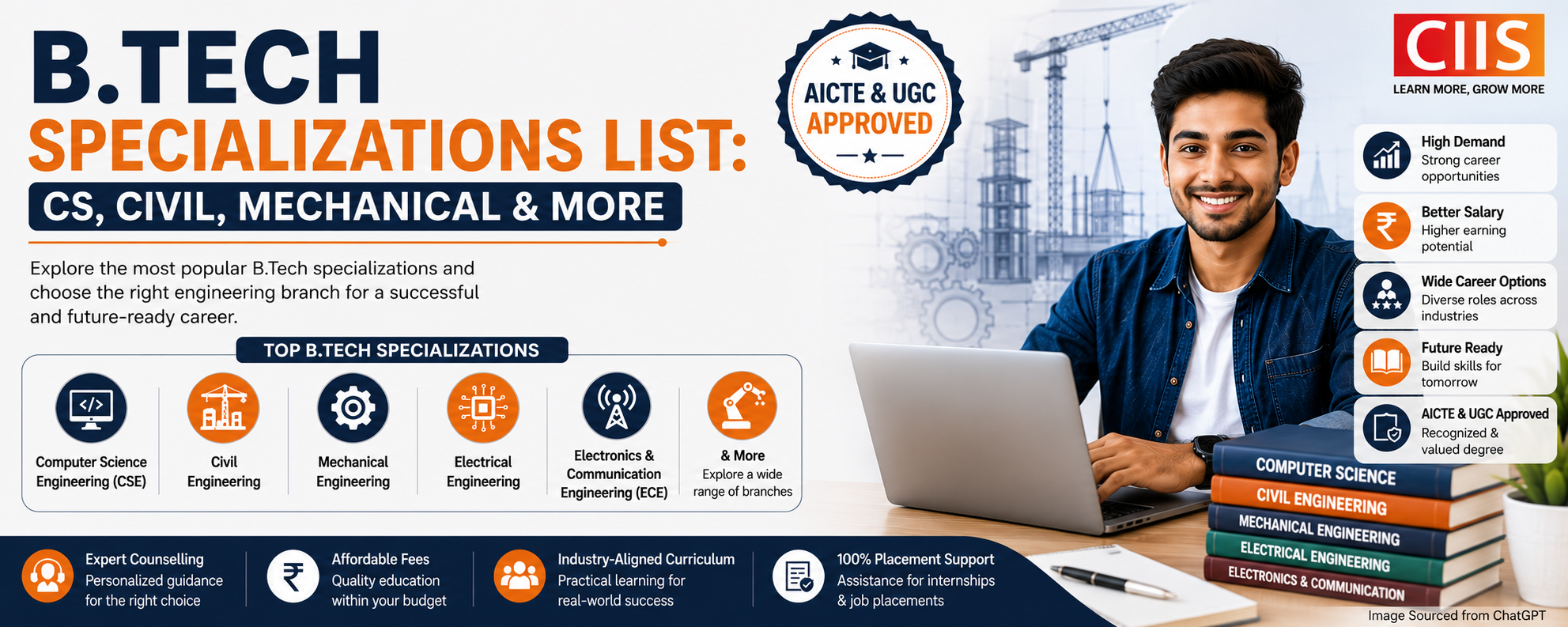
Branch demand does not depend on how you study, but government eligibility does. For branch-wise demand, read: B.Tech Specializations List: CS, Civil, Mechanical & More
For recruiter-side verification, read: Is B.Tech Distance Education Valid for Government Jobs?
15. B.Tech Distance Education – Further Reading and Mumbai
For the wider overview readers often look for, read: B.Tech Distance Education: Everything You Need to Know in 2026
For Mumbai-based applicants, read: B.Tech Distance Education in Mumbai: Apply at CIIS India
16. CIIS India Mumbai – Verification Before You Pay
CIIS India at Sej Plaza, Marve Road, Malad (West), Mumbai helps working technicians and diploma holders choose a route that will hold up.
- Free verification support – we compare the offer with the regulators’ portals and approval letters
- Eligibility check – diploma, B.Sc., Class 12, work experience, and employer position assessed
- Honest route advice – we tell you if an offer is not suitable for your goal
- UGC-DEB notice check as part of every review
- Walk-in at Sej Plaza, Marve Road, Malad (West), Mumbai
Frequently Asked Questions (FAQs)
No university can be named safely, because UGC notices list engineering as not permitted in ODL or online mode. For working people, evaluate work-integrated programs such as BITS Pilani’s WILP and part-time programs at AICTE-approved institutions, and verify each one on the regulators’ portals.
No. WILP is a work-integrated program for employed professionals, with eligibility conditions such as a technical diploma or B.Sc., relevant work experience, and employer consent. BITS states that its WILP programs are UGC approved. Check whether the program’s recognition covers the recruiters you are targeting.
Generally no. Work-integrated B.Tech programs are aimed at technical diploma or B.Sc. holders with work experience. A Class 12 pass should plan for a regular B.Tech through an entrance route.
Ask the university in writing for the AICTE approval covering your branch and mode, and check the latest UGC-DEB notice. Pause further instalments until you have clarity, and seek a refund under the institution’s policy if the answer is unsatisfactory. CIIS India can review your documents for free.
Yes, at many regular institutions, usually into the second year, subject to branch matching and the state’s lateral entry process. Confirm the rules with the institution and your state’s technical education authority.
It depends on the notification. Some accept approved part-time or work-integrated degrees; others specify regular or full-time mode. Read the eligibility clause of the exact post, and ask the recruiting body in writing if it is unclear.
It varies by program. BITS Pilani describes its B.Tech in Information Systems as a seven-semester program for diploma or B.Sc. holders. Regular B.Tech takes four years, and lateral entry typically three.
A certificate may not say so, but verification does not stop there. Recruiters and universities can check a program’s regulatory status and confirm records with the issuing institution, so the mode can surface.