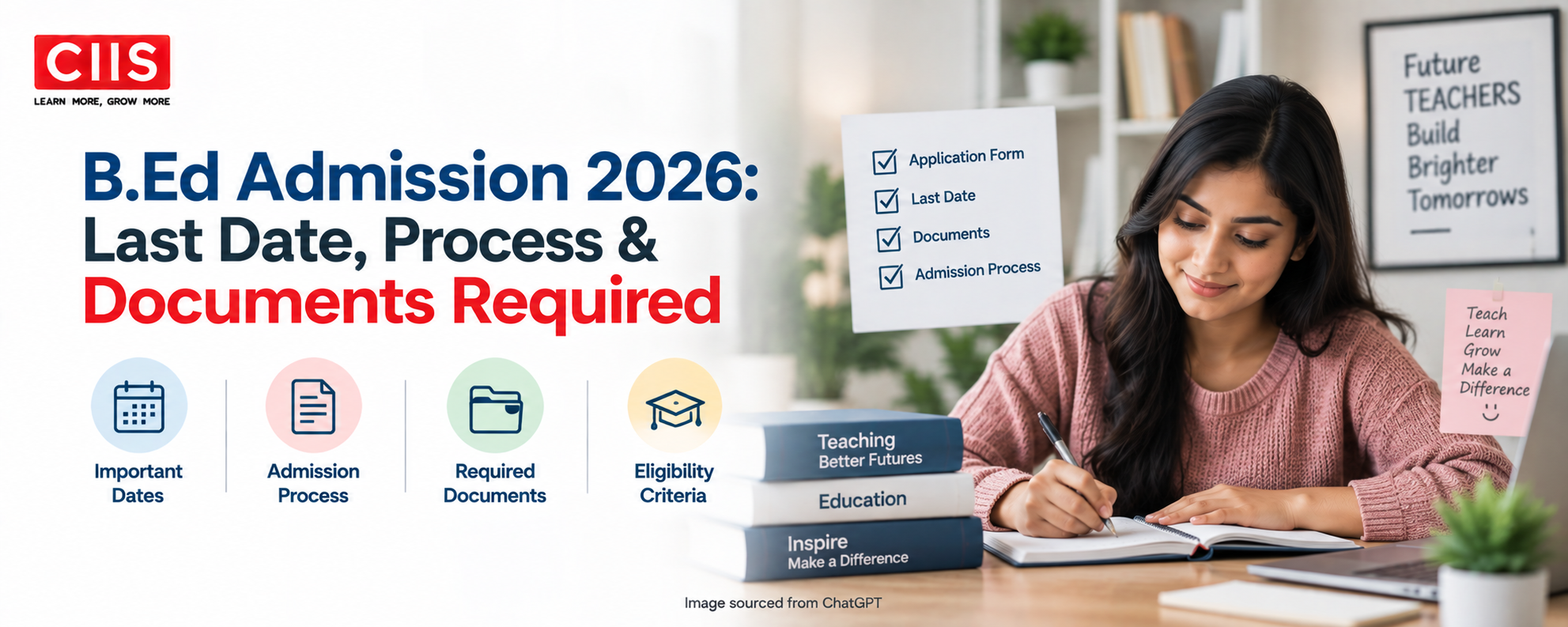
If you are planning to pursue a B.Ed in 2026, whether through regular or distance mode — knowing the exact admission dates, application process, eligibility conditions, and required documents before you start saves you from missing deadlines and avoids costly enrollment errors.
B.Ed admission in India runs on a structured academic calendar, varies by university and state, and requires specific documentation that many applicants are caught off-guard by. This complete guide covers the full 2026 B.Ed admission process — last dates, step-by-step application, eligibility criteria, document checklist, and the specific differences between regular, distance, and online B.Ed admission.
⚡ Quick Answer — B.Ed Admission 2026
- Eligibility: Graduation with minimum 50% marks (45% for SC/ST/OBC/PwD) in any stream; no age limit for distance B.Ed
- Duration: 2 years (mandatory minimum set by NCTE — no 1-year B.Ed exists legally)
- Distance B.Ed admission: January and July sessions at most open universities; rolling admission at private online universities
- Regular B.Ed admission: State-level counselling (July–September); entrance exam in most states
- Key documents: Graduation marksheets, Class 10 and 12 certificates, ID proof, passport photographs, migration certificate (if applicable)
- Regulated by: NCTE — only enroll at NCTE-approved institutions; verify before paying
Want Help With B.Ed Admission 2026 — Documents, Dates & University Selection?
Get free 1-on-1 guidance from CIIS India — Mumbai’s most trusted education consultancy with 9+ years of experience and 50,000+ students enrolled.
1. B.Ed Eligibility Criteria 2026 — Who Can Apply
| Eligibility Parameter | Regular B.Ed | Distance / Online B.Ed |
|---|---|---|
| Minimum qualification | Graduation (BA / BSc / BCom / B.Tech) from a recognised university | Graduation from a UGC-recognised university |
| Minimum marks | 50% aggregate in graduation (45% for SC/ST/OBC/PwD) | 50% aggregate in graduation (45% for SC/ST/OBC/PwD at most universities) |
| Stream requirement | Any graduation stream — arts, science, commerce, engineering | Any graduation stream accepted |
| Age limit | No upper age limit (as per NCTE regulations) | No upper age limit — particularly suitable for working professionals |
| Teaching experience required? | Not required for most states and universities | Not required at most distance universities |
| B.Ed entrance exam | Required in most states — state B.Ed entrance exam (CET / state-specific) | Not required for distance B.Ed at most universities; merit-based admission |
Long tail insight: “What is the minimum qualification required for B.Ed admission 2026?” — The minimum B.Ed qualification requirement is a graduation degree with at least 50% aggregate marks from a UGC-recognised university. SC/ST/OBC/PwD candidates get a 5% relaxation (45% minimum). The graduation stream — arts, science, commerce, or engineering does not disqualify you; any graduate is eligible. Your choice of B.Ed pedagogy subject, however, should align with your graduation subject for eligibility in TGT and PGT posts later.
2. B.Ed Admission Dates 2026 — Session-Wise Reference
| B.Ed Mode | Session | Application Start | Admission Last Date (Approx.) | Classes / Program Start |
|---|---|---|---|---|
| Distance B.Ed — IGNOU | July 2026 | March 2026 | May–June 2026 | July 2026 |
| Distance B.Ed — IGNOU | January 2027 | September 2026 | November 2026 | January 2027 |
| Distance B.Ed — Private online universities | Rolling | Year-round | Rolling — no fixed last date | Within 2–4 weeks of enrollment |
| Regular B.Ed — State CET / entrance exam | 2026–27 academic year | March–April 2026 | May–June 2026 (exam); July–August 2026 (counselling) | September–October 2026 |
| Regular B.Ed — Direct admission (private colleges) | 2026–27 academic year | April–May 2026 | July–August 2026 | August–September 2026 |
Important: Admission last dates vary by state and university. The dates above are approximate based on historical patterns. Always check the official university website or visit CIIS India for the confirmed 2026 admission schedule for your target institution.
Don’t want to miss the B.Ed admission last date? CIIS India tracks admission dates for all major distance and regular B.Ed programs and alerts you before deadlines close. Get free date alerts →
3. Distance B.Ed Admission Process 2026 — Step by Step
| Step | What to Do | Notes |
|---|---|---|
| Step 1 — Verify NCTE approval | Confirm the university is NCTE-approved for B.Ed distance delivery at ncte.gov.in | This is the most critical step a non-NCTE-approved B.Ed is invalid for all teaching jobs |
| Step 2 — Choose pedagogy subjects | Select your two teaching subjects based on your graduation subjects and target TGT/PGT post | Pedagogy subject selection determines which government teaching posts you are eligible for after B.Ed |
| Step 3 — Fill B.Ed online form | Complete the online application form at the university’s official portal; enter personal, academic, and subject details accurately | Use official university portal only; avoid third-party admission agents |
| Step 4 — Upload documents | Upload all required documents in the specified format and size | See Section 5 for the complete document checklist |
| Step 5 — Pay admission fee | Pay the first-year or full program fee online; keep payment receipt | Zero-interest EMI available at CIIS India through Eduvanz, Jodo, Early Salary |
| Step 6 — Receive enrollment confirmation | Enrollment number and study material access provided within 2–4 weeks | Enrollment confirmation letter is required for CTET and state TET application |
4. Regular B.Ed Admission Process 2026 — State Entrance Exam Route
| Stage | Description | Approximate Timeline (2026) |
|---|---|---|
| B.Ed entrance exam registration | Register for state B.Ed CET or university-level entrance exam; most states conduct a centralised B.Ed entrance test | March–April 2026 |
| B.Ed entrance exam | Written test covering general knowledge, teaching aptitude, language proficiency, and subject knowledge (varies by state) | May–June 2026 |
| Results and merit list | State merit list published based on entrance exam score and graduation marks | June–July 2026 |
| B.Ed counselling | Online or offline counselling — choice of college and subject based on merit rank; document verification | July–August 2026 |
| Admission and fee payment | College seat confirmed; admission fee paid to allotted college | August 2026 |
| Classes begin | Regular B.Ed classes start | September–October 2026 |
Long tail insight: “Is a B.Ed entrance exam required for distance B.Ed admission?” — No. The B.Ed entrance exam is a requirement for regular (full-time) B.Ed programs admitted through state-level counselling. For distance and online B.Ed programs, admission is merit-based on graduation marks at most universities — no entrance exam is required. This makes distance B.Ed admission significantly more accessible for working professionals who cannot prepare for a competitive entrance test.
5. Documents Required for B.Ed Admission 2026
| Document | Purpose | Notes |
|---|---|---|
| Class 10 marksheet and certificate | Proof of basic educational qualification and date of birth | Board-issued original; self-attested copy for upload |
| Class 12 marksheet and certificate | Secondary education proof | Board-issued original; required for all modes |
| Graduation marksheets (all years) | Primary eligibility proof — Year 1, Year 2, Year 3 marksheets required | All semester / year marksheets needed; provisional marksheet accepted at some universities if final result awaited |
| Graduation degree / provisional certificate | Confirms completion of graduation qualification | Provisional certificate acceptable if convocation not yet held |
| Transfer / migration certificate | Required if your graduation was from a different university than the B.Ed institution | Obtain from previous university; typically ₹200–₹1,000 fee from previous institution |
| Caste / category certificate | Required for SC/ST/OBC/PwD fee concession and marks relaxation | State-issued certificate; must be current and valid |
| Government-issued ID proof | Identity verification | Aadhaar card, PAN card, voter ID, or passport — any one accepted |
| Passport-size photographs | Online form upload and physical records | Recent photographs on white background; 4–6 copies typically required |
| Signature (scanned) | Online application form requirement | Black ink signature on white paper, scanned clearly |
| Experience certificate (if applicable) | Some distance universities give preference to working teachers | Not mandatory at most universities; employer-issued if applicable |
6. B.Ed Online Form — How to Fill It Correctly
Errors in the B.Ed application form are the most common cause of admission rejection or enrollment delays. Here is what to pay close attention to:
| Section | What to Fill | Common Mistake to Avoid |
|---|---|---|
| Personal details | Name exactly as on Class 10 certificate; date of birth as on matriculation certificate | Name mismatch with certificates causes rejection; use legal name, not common name |
| Academic details | Graduation percentage calculated correctly; all marksheets listed | Incorrect percentage entry or omitting a year’s marksheet leads to eligibility queries later |
| Pedagogy subject selection | Choose subjects you actually studied at graduation level | Choosing a pedagogy subject not aligned with graduation subject makes you ineligible for TGT/PGT in that subject |
| Medium of instruction | Select the language in which you will study (English / Hindi / regional language) | Selecting wrong medium means study materials arrive in a language you cannot use |
| Study centre selection | Choose a study centre nearest to your home or workplace for exam convenience | Selecting a distant centre adds travel burden for practical and exam sessions |
7. B.Ed Admission 2026 — State-Wise Entrance Exam Reference
| State | B.Ed Entrance Exam | Conducting Body | Approx. Exam Month (2026) |
|---|---|---|---|
| Maharashtra | Maharashtra B.Ed CET | State CET Cell, Maharashtra | May–June 2026 |
| Uttar Pradesh | UP B.Ed JEE | Mahatma Jyotiba Phule Rohilkhand University (on rotation) | May 2026 |
| Rajasthan | PTET (Pre Teacher Education Test) | Dungar College / designated university | June 2026 |
| Bihar | Bihar B.Ed CET | Lalit Narayan Mithila University | April–May 2026 |
| Madhya Pradesh | MP Pre B.Ed Test | Professional Examination Board, MP | May–June 2026 |
| Haryana | Haryana B.Ed Entrance | Maharshi Dayanand University | June 2026 |
| Delhi | DU B.Ed Entrance (for Delhi University colleges) | Delhi University | June–July 2026 |
8. Distance B.Ed vs Regular B.Ed — Admission Comparison
| Parameter | Distance B.Ed Admission | Regular B.Ed Admission |
|---|---|---|
| Entrance exam required | No — merit-based at most universities | Yes — state B.Ed CET / entrance exam in most states |
| Application mode | Online — directly through university portal | Online — through state counselling portal or university |
| Admission timeline | January and July sessions; rolling at private universities | Fixed — August–September annually |
| Can working professionals apply? | Yes — specifically designed for working professionals | Difficult — requires full-time daily attendance |
| College seat availability | Not applicable — enrollment-based, no seat limit concern | Limited seats; competition depends on state merit rank |
| Fees | ₹25,000 – ₹90,000 (2-year full program) | ₹40,000 – ₹2,50,000 (varies by state and college) |
| NCTE requirement | Mandatory — verify at ncte.gov.in before paying | Mandatory — college must be NCTE-approved |
For the complete B.Ed distance education program guide including validity, NCTE-approved university list, and career outcomes, read: B.Ed Distance Education: Complete Guide 2026
9. B.Ed Eligibility for Government Teaching Jobs — What You Need to Know Before Applying
Your B.Ed admission decisions — particularly pedagogy subject selection and NCTE approval of your chosen institution — directly determine your eligibility for government teaching jobs after completion. Here is what to verify before you fill the admission form:
| Government Post After B.Ed | What to Verify at Admission Stage |
|---|---|
| TGT (Trained Graduate Teacher) — Classes 6–10 | NCTE approval of your B.Ed institution; pedagogy subject must match the TGT subject you want to teach |
| PGT (Post Graduate Teacher) — Classes 11–12 | You will need postgraduation in addition to B.Ed; confirm your PG qualification is in the relevant subject |
| CTET Paper II eligibility | B.Ed must be from NCTE-approved institution; enrollment confirmation letter needed for CTET application |
| State TET eligibility | State TET allows final-year B.Ed students to apply in many states — keep enrollment number ready |
For the complete guide on government teaching jobs, TGT, PGT, and Primary Teacher salary after B.Ed, read: Government Jobs After B.Ed: TGT, PGT & Primary Teacher Salary
10. B.Ed vs D.El.Ed — Which Should You Apply For?
If you are unsure whether to apply for B.Ed or D.El.Ed, the short answer is: B.Ed qualifies you for Classes 6–12 (TGT and PGT posts); D.El.Ed is for primary teaching (Classes 1–5). For the complete comparison covering eligibility, career scope, salary, and which is better for your teaching goal, read: B.Ed vs D.El.Ed: Which Teaching Course Should You Choose?
11. B.Ed Syllabus and Subjects — What You Will Study After Admission
After completing your B.Ed admission, knowing what the coursework covers helps you prepare mentally and plan your study schedule — especially as a working professional. For the complete B.Ed syllabus breakdown including pedagogy papers, teaching practice, and theory subjects, read: B.Ed Subjects & Syllabus: What Will You Study?
12. Is Distance B.Ed Valid for Teaching Jobs — The Admission Validity Question
Before completing admission to any B.Ed distance program, confirm the key validity question: yes, a B.Ed from an NCTE-approved distance institution is fully valid for TGT, PGT, CTET Paper II, state TET, KVS, and NVS teaching recruitment. For the complete validity reference — including acceptance by KVS, NVS, DSSSB, and all state education boards, read: Is B.Ed Distance Education Valid for Teaching Jobs in India?
13. B.Ed Admission 2026 — CIIS India Mumbai
If you are in Mumbai and want expert guidance on B.Ed admission 2026 — covering the right university, NCTE verification, pedagogy subject selection, and document preparation — CIIS India at Sej Plaza, Marve Road, Malad (West), Mumbai is your most trusted starting point.
- Free 1-on-1 B.Ed admission counselling — NCTE verification, university selection, and pedagogy subject guidance aligned to your teaching career goal
- Complete B.Ed online form filling support — we help you fill the application form accurately to avoid rejection
- Document checklist and preparation guidance — migration certificate, marksheet compilation, and photograph specifications
- Admission last date tracking — we alert you before deadlines for all partner distance B.Ed institutions
- Zero-interest EMI through Eduvanz, Jodo, and Early Salary for B.Ed program fees
- Walk-in available at Sej Plaza, Marve Road, Malad (West), Mumbai
Frequently Asked Questions (FAQs)
B.Ed admission last dates vary by mode and university. For distance B.Ed at IGNOU, the July 2026 session closes approximately May–June 2026. For regular B.Ed through state entrance exams, applications typically close in April–May 2026 with counselling completing in July–August 2026. Private online universities offer rolling admission with no fixed last date. CIIS India tracks all admission deadlines for partner institutions and alerts you before closing dates — free of charge.
The key documents required for B.Ed admission are: Class 10 marksheet and certificate, Class 12 marksheet and certificate, all graduation year marksheets (Year 1, 2, 3), graduation degree or provisional certificate, migration certificate (if graduation was from a different university), government-issued ID proof, caste certificate (if applicable for SC/ST/OBC/PwD), passport-size photographs, and scanned signature. CIIS India provides a personalised document checklist based on your university and prior academic history.
The B.Ed eligibility criteria for 2026 require a graduation degree (BA, BSc, BCom, B.Tech, or any stream) from a UGC-recognised university with a minimum of 50% aggregate marks. SC/ST/OBC/PwD candidates need 45%. There is no upper age limit. No prior teaching experience is required at most universities. The graduation percentage is calculated across all years of the degree, not just the final year.
Yes — distance B.Ed is specifically designed for working professionals. There is no daily attendance requirement. You study through self-paced online or printed materials, with examinations held twice a year. Most working professionals — including current school teachers seeking formal qualification — complete distance B.Ed in the standard 2 years without any interruption to their employment. CIIS India specialises in distance B.Ed guidance for working professionals in Mumbai and across Maharashtra.
No — the B.Ed entrance exam is required only for regular (full-time) B.Ed programs admitted through state-level counselling. For distance and online B.Ed programs, admission is merit-based on your graduation marks at most institutions. This makes distance B.Ed admission more accessible for working professionals who cannot prepare for or appear in a competitive entrance exam.
Selecting a pedagogy subject that does not match your graduation subject is a significant error. Government teacher recruitment (TGT, PGT, CTET) requires your B.Ed pedagogy subject to align with the subject you want to teach — and with your graduation subject. For example, a History graduate applying for TGT History must have History as a B.Ed pedagogy subject. CIIS India guides every student on the correct pedagogy subject choice based on their graduation background and target teaching post before admission.
Yes — CBSE allows final-year B.Ed students to apply for CTET. If you are in the second year of your B.Ed program, you are eligible to appear for CTET Paper II. Your enrollment confirmation letter from the university is required as proof of current B.Ed enrollment. This means you can plan your CTET attempt to coincide with B.Ed completion for fastest entry into government teaching recruitment.
The distance B.Ed admission process for 2026 involves: (1) verify NCTE approval of your chosen institution at ncte.gov.in; (2) select your pedagogy subjects aligned to your graduation background and teaching target; (3) fill the B.Ed online form at the official university portal; (4) upload required documents including all graduation marksheets and ID proof; (5) pay the program fee (EMI available at CIIS India); (6) receive your enrollment number and study materials. CIIS India handles all steps with you — free of charge.