Most readers asking about careers after B.Tech distance education are really asking two questions: what can an engineering degree lead to, and will mine be accepted? The second one comes first. UGC’s Distance Education Bureau lists engineering among programs not permitted in open and distance learning (ODL) or online mode, so a B.Tech sold as distance or online is a risk. The careers described below belong to a B.Tech earned through a route that holds up: a regular program, lateral entry for diploma holders, a part-time or evening program at an approved institution, or a work-integrated program you have verified.
This guide maps the career options after B.Tech into private jobs, government and PSU posts, and higher studies, with indicative salary ranges and pay levels, and explains what to check if you already hold or are considering a B.Tech that was not a regular program.
⚡ Quick Answer — Career Options After B.Tech
- Route warning: A distance or online B.Tech is not a safe basis for a career; verify the program’s approval first
- Typical private fresher pay: Portals commonly report about ₹3 to ₹6 LPA overall, with computer science and allied branches higher and civil at the lower end
- Government entry-level pay: Junior Engineer posts such as SSC JE and RRB JE sit at Pay Level 6, with a basic pay of about ₹35,400
- PSU and scientist routes: Many use GATE or their own exams, with starting basic pay reported around ₹56,100 for Level 10 posts
- Higher studies: M.Tech through GATE, MBA, study abroad, or research are the common next steps
- Before you rely on a degree: Check the latest notice on ugcdeb.gov.in and the AICTE approval for the exact program and mode
Want to Plan an Engineering Career Without the Guesswork? Get Free Guidance at CIIS India
CIIS India helps you check your degree route, choose a branch for the career you want, and verify approvals before you pay any fees. 9+ years of experience. 50,000+ students enrolled.
1. Career Options After B.Tech – Start With How You Earned the Degree
| Route | Career Effect | What to Check |
|---|---|---|
| Regular B.Tech or lateral entry at an AICTE-approved institution | Full eligibility for private jobs, government and PSU recruitment, GATE, and postgraduate study | The institution’s AICTE approval for your branch and year |
| Part-time or evening B.E. or B.Tech at an approved institution | Usually accepted, but some recruiters specify regular or full-time mode | The recruiter’s wording in the notification |
| Work-integrated program for employees | Useful for designation and skills; recruiter acceptance varies | The approval letters and your target employer’s policy |
| Degree sold as distance or online B.Tech | Exposed to rejection at verification, because UGC notices list engineering as not permitted in these modes | Do not enrol before getting written approvals |
Long-tail note: “Can I get a job with a distance B.Tech?” Some private employers hire on skills and may not check the mode, but government recruiters and many PSUs verify the program’s recognition. If you already hold such a degree, ask the university for its approval letters and check the notification of every post you plan to apply for.
2. Scope After B.Tech – What Employers Actually Look For
| Factor | Why It Matters |
|---|---|
| Branch and core knowledge | Decides which roles and government posts you can apply for |
| Practical skills and projects | Private employers hire for what you can build or operate |
| Approved, verifiable degree | Needed for government verification and background checks |
| Internships or work experience | Shortens the path from degree to a good first role |
| Competitive-exam readiness | Required for GATE, SSC JE, RRB JE, and similar routes |
3. Career Paths After B.Tech – Four Directions
| Path | Best For | Typical Starting Point |
|---|---|---|
| Private sector job | Fast entry and skill-led growth | Graduate engineer or trainee roles |
| Government and PSU | Stability and structured pay | SSC JE, RRB JE, GATE-based PSU, ESE, DRDO, ISRO |
| Higher studies | Specialisation, research, or management | M.Tech, MBA, MS abroad, PhD |
| Switch or start your own work | People with a clear idea or a skill pivot | Upskilling, freelancing, or a startup |
4. Job Options After B.Tech – By Branch, With Indicative Fresher Pay
| Branch | Typical Roles | Indicative Fresher Range (Portal Reports) |
|---|---|---|
| Computer Science and IT | Software developer, data analyst, QA engineer, cloud or support engineer | Private-college medians reported around ₹5 to ₹10 LPA, higher at top institutes |
| Electronics and Electrical | Embedded, automation, power systems, and electronics roles | About ₹4 to ₹8 LPA for electronics in private colleges |
| Mechanical | Design, production, maintenance, and manufacturing roles | Core roles commonly reported around ₹4 to ₹7 LPA |
| Civil | Site engineer, planning, and structural roles | Construction roles often reported around ₹2.5 to ₹4 LPA, with government routes higher |
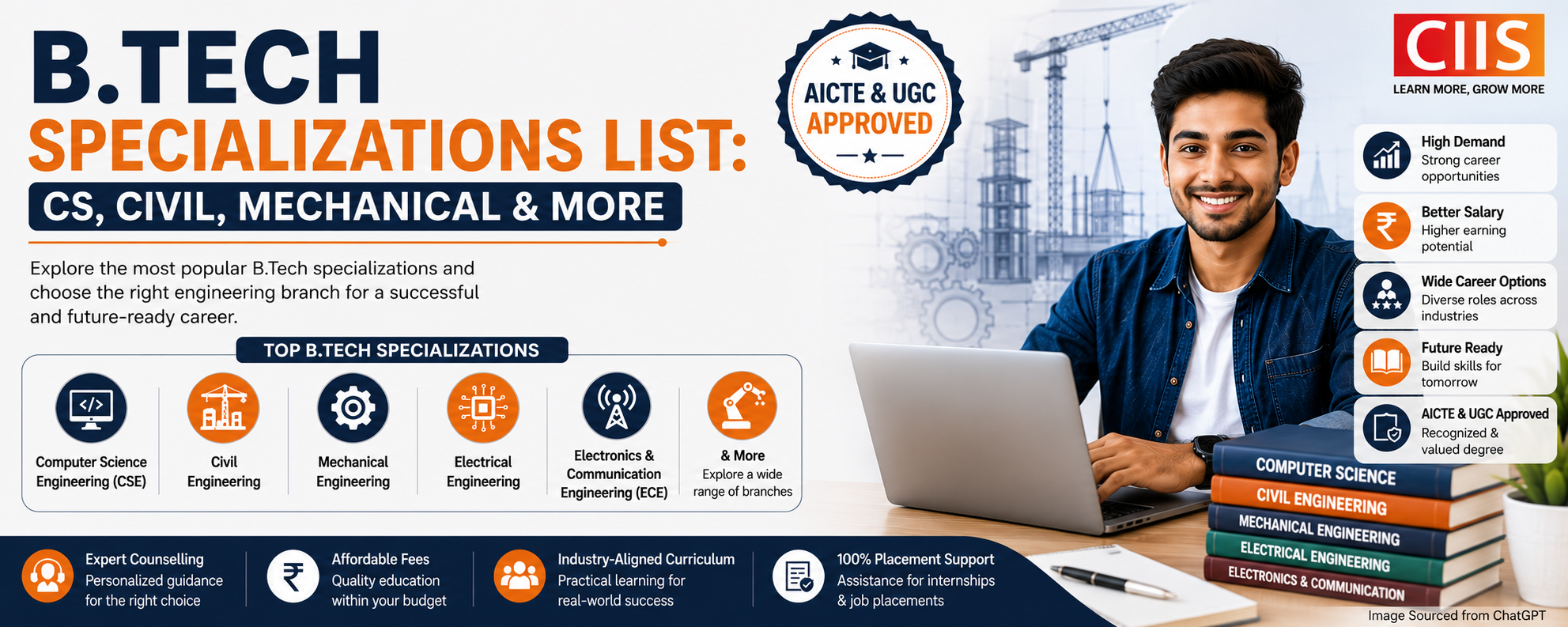
Portal figures differ widely, and averages are pulled up by top-tier campuses. Use these as bands for comparison, not as promises. For branch-wise demand and scope, read: B.Tech Specializations List: CS, Civil, Mechanical & More
5. B.Tech Job Opportunities in the Private Sector
| Sector | Roles | What Helps |
|---|---|---|
| IT and software | Developer, tester, analyst, support engineer | Coding practice, projects, internships |
| Manufacturing and automotive | Production, quality, maintenance, design | Tool knowledge such as CAD, plant exposure |
| Construction and infrastructure | Site, planning, estimation | Site experience, planning software |
| Electronics and telecom | Embedded, network, hardware roles | Circuit design, scripting, protocols |
| Consulting and analytics | Technical consulting, data roles | Statistics, SQL, communication |
6. Government Jobs After B.Tech – Posts, Routes, and Pay Levels
| Post | How You Enter | Pay Level and Basic Start (7th Pay Commission) |
|---|---|---|
| Junior Engineer (SSC JE, RRB JE) | Their own competitive exams, no GATE needed | Level 6, about ₹35,400 |
| Senior Section Engineer (railways) | RRB exam | Level 7, about ₹44,900 |
| Engineering Services (UPSC ESE), DRDO and ISRO scientist or engineer posts | UPSC, DRDO, or ISRO recruitment, often with GATE for some | Level 10, about ₹56,100 |
| PSU executive or engineer trainee | GATE score plus interview for many PSUs | PSU-specific scales; reported starting basic varies by PSU |
Basic pay is shown for each level, with allowances added on top, and in-hand estimates vary by source and city. GATE is needed for many PSUs, but SSC JE, RRB JE, and most state engineer recruitments run their own exams. Government recruiters verify your degree, so read the eligibility clause of each notification, including whether regular mode is specified. For the recruiter-side analysis, read: Is B.Tech Distance Education Valid for Government Jobs?
7. Higher Studies After B.Tech
| Option | Best For | Key Condition |
|---|---|---|
| M.Tech through GATE | Specialisation, research, teaching, and PSU-linked growth | A GATE score and an approved B.Tech |
| MBA | Management and business roles | Any bachelor’s degree and the program’s admission route |
| MS abroad | Global careers and research | Test scores, credential evaluation, and funding |
| PhD | Research and university teaching | Strong academic record and a research proposal |
8. Salary Reality – What Moves Pay Up
Pay rises with branch demand, city, employer type, and skills. Government pay follows pay levels, while private pay follows the market. A strong portfolio, internships, and a specialised skill often matter more than the institution’s name for mid-career growth. For salary expectations specific to this route, read: Salary After B.Tech Distance Education: Is It Worth It?
9. For Diploma Holders – Lateral Entry
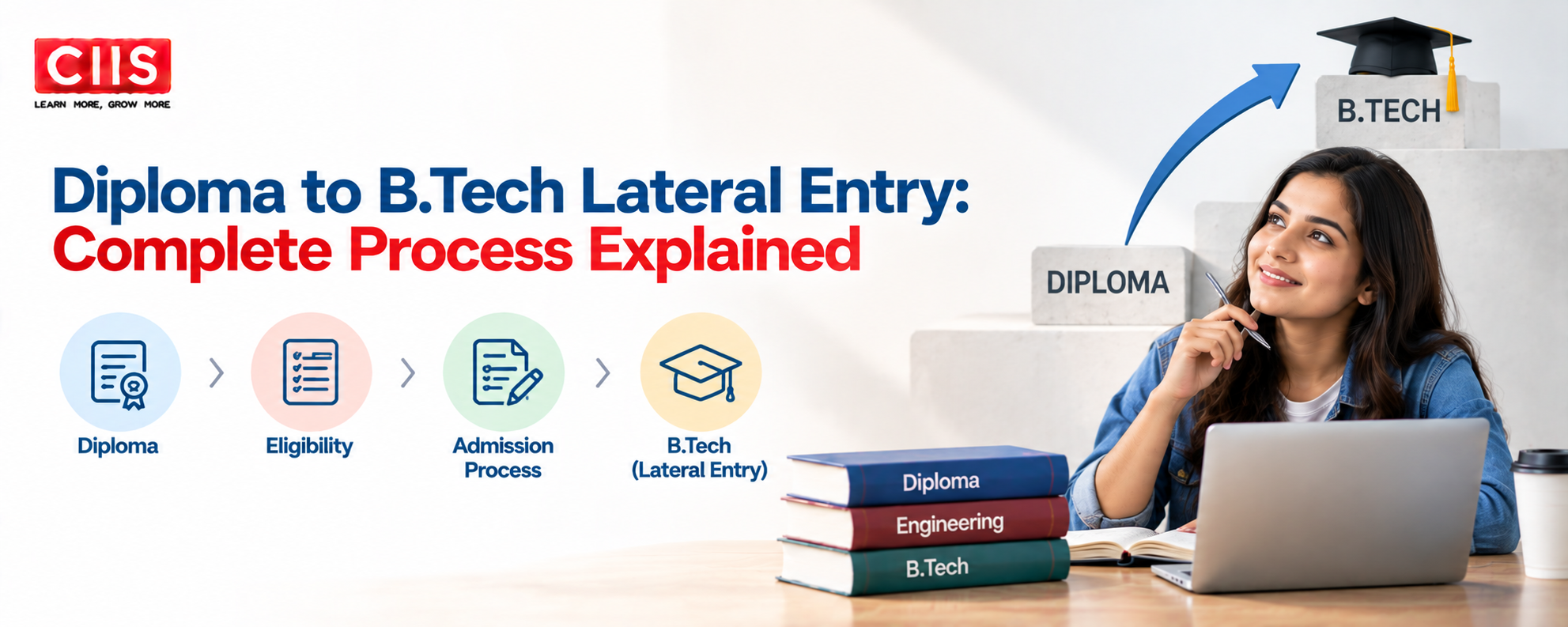
Diploma holders can often enter a regular B.Tech in the second year, subject to branch matching and the state’s lateral entry process. For the full process, read: Diploma to B.Tech Lateral Entry: Complete Process Explained
10. Choosing a Route That Holds Up
For the comparison between work-integrated and distance options, read: B.Tech WILP vs Distance Education: Which Should You Choose?
For the approval analysis, read: Is B.Tech Distance Education Valid? AICTE Approved? 2026
For a verified shortlist of routes, read: Top 10 Universities for B.Tech Distance Education in India 2026
For eligibility, read: B.Tech Distance Education Eligibility: Who Can Apply?
For fee comparisons across routes, read: B.Tech Distance Education Fees 2026 — University Comparison
For the wider overview readers often search for, read: B.Tech Distance Education: Everything You Need to Know in 2026
For Mumbai-based applicants, read: B.Tech Distance Education in Mumbai: Apply at CIIS India
11. CIIS India Mumbai – Career and Route Guidance
CIIS India at Sej Plaza, Marve Road, Malad (West), Mumbai helps engineers and diploma holders plan a career on a degree that holds up.
- Free review of your degree route and approval documents
- Career-to-branch matching based on your goals and background
- Eligibility check for lateral entry, part-time, and work-integrated options
- UGC-DEB notice check as part of every review
- Honest advice on whether an offer suits your target job
- Walk-in at Sej Plaza, Marve Road, Malad (West), Mumbai
Frequently Asked Questions (FAQs)
Portals commonly report about ₹3 to ₹6 LPA as a typical fresher range, with computer science and allied branches higher and civil construction roles lower. Averages are pulled up by top campuses, so treat the figures as bands.
SSC JE and RRB JE at Pay Level 6, railway SSE posts at Level 7, Engineering Services, DRDO and ISRO roles at Level 10, and PSU roles that mostly use GATE. Each notification states eligibility, age, and branch.
No. GATE is used by many PSUs and some higher posts, but SSC JE, RRB JE, and state engineer recruitments run their own exams.
It is a risk. UGC notices list engineering as not permitted in ODL or online mode, and recruiters verify recognition. Check the notification wording and the program’s approvals before relying on such a degree.
M.Tech through GATE for specialisation and research, an MBA for management, MS abroad for global careers, and a PhD for research and teaching. The right choice depends on your goal.
Diploma holders can apply for some junior engineer posts, and lateral entry into a regular B.Tech opens degree-level routes. Confirm branch matching and the state’s process.
Computer science and allied branches lead on fresher pay, while core branches such as mechanical, civil, and electrical have strong government and PSU routes. Choose by the career you want, not by pay averages alone.
Build projects, take internships, learn tools relevant to your branch, prepare early for GATE or other exams, and keep your degree and approval documents ready for verification.