If you are working and weighing a postgraduate degree, the real question is not which degree is better in general but which one moves your career in the direction you want. An MBA builds management and business skills across functions, while an MSc deepens expertise in a scientific or technical subject. Both usually take two years, both can be studied while working at approved universities, and both can lift pay, but they lead to different kinds of roles.
This guide compares the two on purpose, eligibility, duration, approval rules, career paths, and salary, and ends with a simple decision framework. Salary figures come from career portals and university pages, which often run high, so treat them as bands for comparison.
⚡ Quick Answer — MBA vs MSc for Working Professionals
- Choose an MBA if: You want to move into management, business, or cross-functional roles, and your graduation can be in any subject
- Choose an MSc if: You want deeper subject expertise, research, teaching through a national eligibility test, or technical specialist roles, and your graduation matches the subject
- Duration: Typically two years in four semesters for both
- Eligibility: MBA accepts a bachelor’s degree in any subject, while MSc usually needs a relevant bachelor’s subject
- Approval: For either degree, check that the university is recognised for ODL or entitled for online mode for your session and your exact program on ugcdeb.gov.in
- Pay: Portals report roughly ₹3.5 to ₹8 LPA as a starting range for distance MBAs and about ₹3 to ₹6 LPA for many MSc roles, with wide variation by role and experience
Torn Between an MBA Distance Education and an MSc Distance Education? Get Free Guidance at CIIS India
CIIS India maps your background and goal to the right degree, verifies UGC approval, and handles admission, free, before you pay any fees. 9+ years of experience. 50,000+ students enrolled.
1. MBA vs MSc — The Quick Comparison
| Parameter | MBA | MSc |
|---|---|---|
| Focus | Management, strategy, finance, marketing, operations, people | Depth in one scientific or technical subject |
| Best for | Managerial and business roles | Specialist, research, and teaching roles |
| Typical entry | Any bachelor’s degree | A bachelor’s degree in a relevant subject |
| Typical duration | Two years | Two years |
| Follow-on options | Senior management, entrepreneurship, doctoral study in management | PhD, fellowships, college teaching, specialist industry roles |
2. Difference Between MBA and MSc — What Each Teaches
| Degree | What You Study | How You Apply It |
|---|---|---|
| MBA | Core business areas such as accounting, marketing, human resources, operations, finance, and strategy, followed by a specialisation | Leading teams, owning budgets, running functions, and making business decisions |
| MSc | Advanced theory and methods in a subject such as data science, mathematics, chemistry, or life sciences | Analysis, research, technical problem-solving, and teaching |
For what an MBA syllabus covers, read: MBA Distance Education Syllabus: What Will You Study?
3. MBA vs MSc for Working Professionals — Which Fits Your Situation
| Your Situation | Usually Fits Better |
|---|---|
| Team lead or executive who wants to move into management | MBA |
| Analyst or lab professional who wants deeper technical credibility | MSc in your subject |
| Graduate from a non-science subject who wants a business career | MBA, since MSc usually needs a relevant degree |
| Teacher or researcher aiming at college teaching | MSc plus a national eligibility test |
| Professional aiming at a PSU management trainee post | MBA, as per the notification’s wording |
Long-tail note: “Can I do an MBA after an MSc?” — Yes. An MBA accepts a bachelor’s degree in any subject, so many science graduates add one later to move into management. The reverse is harder, because an MSc usually needs a relevant bachelor’s subject.
4. MBA vs MSc Eligibility
| Item | MBA | MSc |
|---|---|---|
| Qualification | Bachelor’s degree in any subject, at most universities | Bachelor’s degree in a relevant subject |
| Marks | Set by each university | Set by each university |
| Work experience | Some online programs ask for it, while many do not | Usually not required |
| Entrance exam | Varies; read each admission notice | Varies; many admit on marks |
For the full MBA eligibility guide, read: MBA Distance Education Eligibility: Who Can Apply?
5. MBA vs MSc Course Duration
| Item | Typical Position |
|---|---|
| Minimum duration | Two years for both, in four semesters |
| Maximum period | Set by each university; confirm if you may need extra time |
| Project | Most MBAs and many MSc programs end with a project or dissertation |
6. MBA Distance Education and MSc Distance Education — Approval Rules to Check
| Check | MBA | MSc |
|---|---|---|
| UGC status | The awarding university must be recognised for ODL or entitled for online mode for your session | The same |
| Regulator beyond UGC | Central, state, and private universities are reported to need no AICTE approval for management programs in ODL or online mode, but deemed universities must seek AICTE approval or a no-objection certificate | No AICTE role for MSc |
| Subject limits | Few | Lab subjects usually need contact practicals and are rarely fully online |
| Enrolment ID | ABC-ID used to generate a DEB-ID | The same |
Be careful with edtech partners. The government told Parliament in August 2026 that UGC had noticed companies advertising degrees in association with recognised or entitled universities, so confirm that the degree is awarded by the university itself and that your program is listed. For approval checks, read: Is MBA Distance Education UGC Approved? Validity Explained
For employer and government acceptance, read: Is MBA Distance Education Valid for Government & Private Jobs?
7. MBA Course for Working Professionals and MSc Course for Working Professionals — What to Expect
| Element | MBA | MSc |
|---|---|---|
| Format | Recorded and live sessions, assignments, and exams on a fixed calendar | Similar, with practicals where the subject needs them |
| Weekly time | Plan for roughly 10 to 15 hours alongside work, as a planning assumption | Similar for theory subjects |
| Specialisation | Chosen from options such as finance, marketing, HR, operations, analytics | Fixed by the subject you enrol in |
| Employer relevance | Broad across industries | Strong in specific industries and research |
For choosing an MBA specialisation, read: MBA Specializations List: Which Should You Choose?
8. MBA vs MSc Career Opportunities
| Area | MBA Roles | MSc Roles |
|---|---|---|
| Private sector | Manager, business analyst, product or marketing manager, finance and HR roles | Data scientist, analyst, QC and R&D scientist, clinical research, software |
| Government | PSU and bank management routes, as per notifications | Subject-specific posts, research positions, college teaching with a national eligibility test |
| Academic | Management teaching with the relevant eligibility test | Subject teaching and research with a fellowship or test |
9. MBA vs MSc Career Scope — Where Each Path Leads
| Stage | MBA Path | MSc Path |
|---|---|---|
| First 2 years after | Move into a managerial or business role in your current field | Move into a specialist role with greater technical depth |
| Years 3 to 7 | Team and function leadership | Senior specialist, research lead, or doctoral study |
| Beyond | Senior management or entrepreneurship | Principal scientist, professor, or technical head |
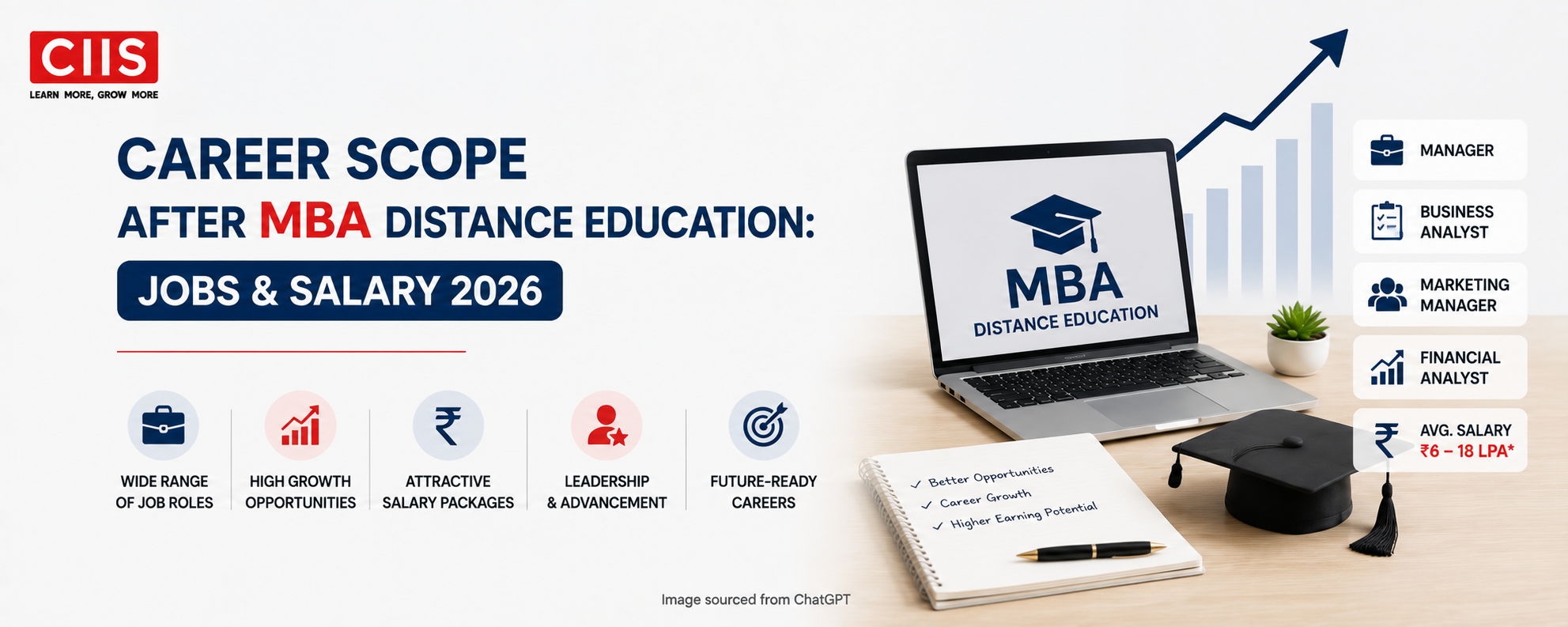
For MBA career outcomes in detail, read: Career Scope After MBA Distance Education: Jobs & Salary 2026
10. MBA vs MSc Salary — Indicative Bands
| Degree | Reported Range | Caution |
|---|---|---|
| Distance or online MBA | A 2026 portal puts starting salaries at about ₹3.5 to ₹8 LPA, with experienced professionals reaching about ₹12 LPA on average. Other pages quote wider ranges up to about ₹18 to ₹25 LPA | The high ends come from university marketing and strong experience profiles |
| MSc | Many roles are reported at about ₹3 to ₹6 LPA for freshers, with data and statistics roles higher | Subject and skills decide where you land |
| Salary hike for working professionals | Marketing pages claim hikes of 30 to 50 percent for an MBA | Treat these as upper-end claims and ask for evidence |
For fees, which affect your return on investment, read: MBA Distance Education Fees 2026 — University-wise Comparison
11. MBA or MSc Which Is Better — A Decision Framework
| Ask Yourself | If Yes |
|---|---|
| Do I want to manage people, budgets, and business functions? | Lean MBA |
| Do I want to become the expert in a technical or scientific subject? | Lean MSc |
| Is my graduation subject unrelated to a science field? | MBA is more open |
| Do I need a research or teaching route? | MSc plus a qualifying test |
| Is my target post a PSU management trainee or bank management role? | Read the notification, which often names the MBA |
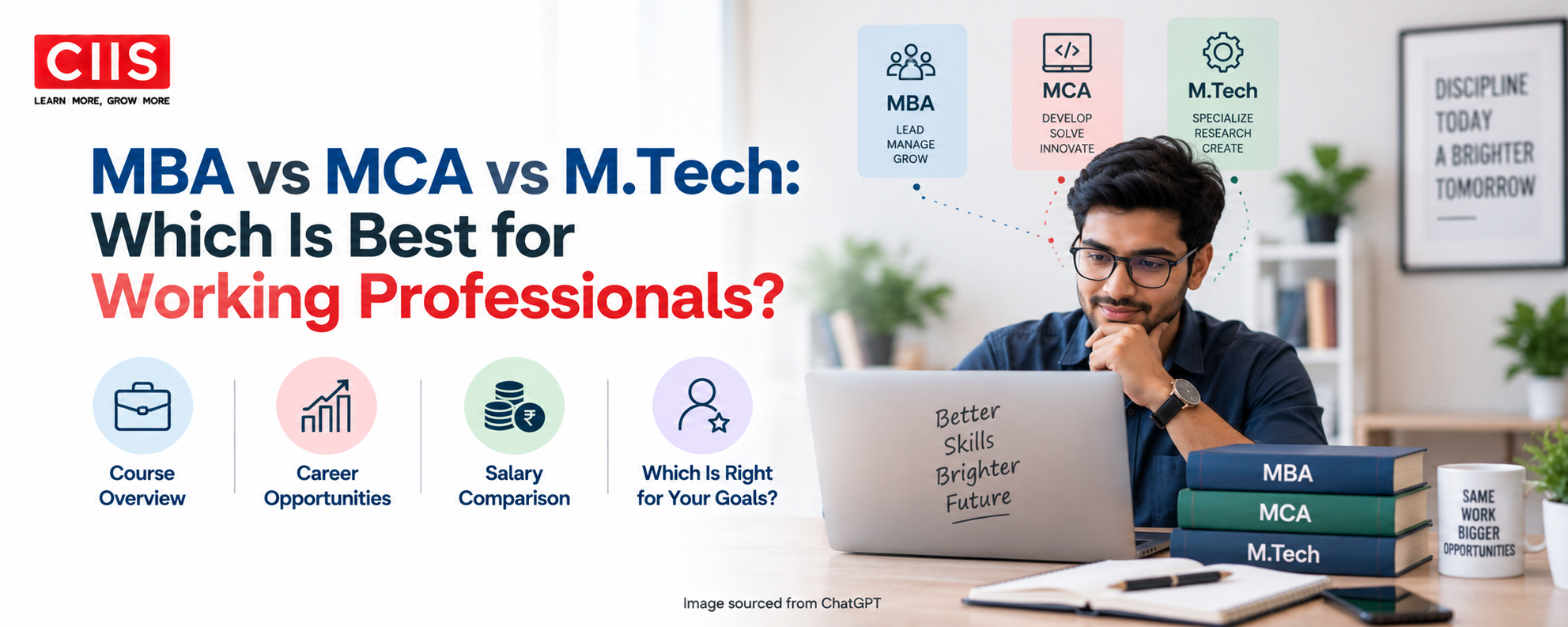
| Could a computing or engineering degree suit me better? | Compare MBA, MCA and M.Tech options |
For a three-way comparison, read: MBA vs MCA vs M.Tech: Which Is Best for Working Professionals?
For a senior-level alternative, read: Executive MBA vs Distance MBA: Key Differences in 2026
12. Admission, Universities, and Further Reading
For dates, process, and documents, read: MBA Admission 2026: Last Date, Process & Documents Required
For a shortlist of universities, read: Top Universities for MBA Distance Education in India 2026
For the wider overview, read: MBA Distance Education: Everything You Need to Know in 2026
13. CIIS India Mumbai — Help Choosing Between Degrees
CIIS India at Sej Plaza, Marve Road, Malad (West), Mumbai helps working professionals pick the degree that fits their goal.
- Free comparison of an MBA and an MSc for your background and target role
- UGC-DEB check of the university and your exact program before you pay
- Eligibility check and specialisation advice
- Admission support including ABC-ID, DEB-ID, documents, and enrolment
- Zero-interest EMI options through Eduvanz, Jodo, and Early Salary where the fee allows
- Walk-in at Sej Plaza, Marve Road, Malad (West), Mumbai
Frequently Asked Questions (FAQs)
It depends on direction. An MBA suits a move into management or business roles, while an MSc suits deeper technical expertise, research, or teaching. Pick the one that matches the job you want in five years.
Yes. An MBA accepts a bachelor’s degree in any subject at most universities, and many science graduates add one to move into management.
Usually only if the bachelor’s subject is relevant to the MSc. Some programs, such as data science, accept graduates who studied mathematics or statistics. Check each prospectus.
Portals report roughly ₹3.5 to ₹8 LPA as a starting range for distance MBAs and about ₹3 to ₹6 LPA for many MSc roles, with data roles higher. Pay depends mainly on role, experience, and employer, and marketing figures run high.
UGC’s regulations treat degrees from recognised or entitled universities as equivalent. Validity depends on the university being recognised or entitled for your session and your program being listed, and employers decide whom to hire.
For central, state, and private universities offering management programs in ODL or online mode, no AICTE approval is reported to be needed. Deemed universities must seek AICTE approval or a no-objection certificate, and standalone institutes offering PGDM need AICTE approval.
Yes, at approved universities that offer ODL or online delivery. Check the exam format and calendar, and for an MSc check whether practicals need contact sessions.
It depends on the post. PSU management and bank management roles often name an MBA, while subject-specific posts, research roles, and college teaching favour an MSc with a national eligibility test. Read the notification’s eligibility clause.