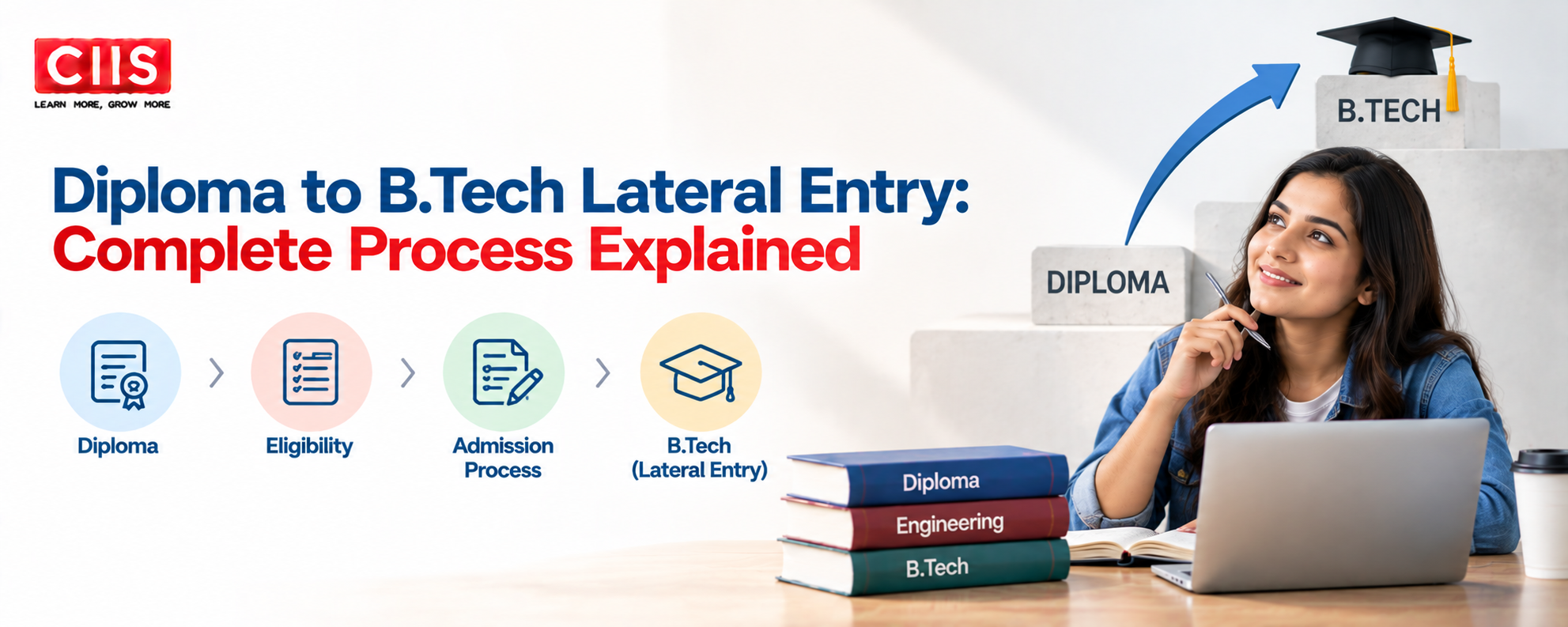
If you hold a 3-year engineering diploma and want a B.Tech degree without starting from scratch, lateral entry is the most direct and cost-effective route available to you. Instead of spending 4 years completing a full B.Tech, you enter directly into the second year saving one full year of fees and study time.
This complete guide covers everything you need to know about diploma to B.Tech lateral entry: who is eligible, how the admission process works, which specialisations are available, the fee difference between lateral entry and regular B.Tech, and what the degree unlocks for your career.
⚡ Quick Answer — Diploma to B.Tech Lateral Entry
- What it is: Direct admission into Year 2 of B.Tech for 3-year diploma holders complete B.Tech in 3 years instead of 4
- Eligibility: 3-year engineering diploma with a minimum of 45%–50% marks from a recognised polytechnic
- Duration after lateral entry: 3 years (Year 2 + Year 3 + Year 4 of B.Tech)
- Available through: Regular colleges (entrance exam required) and distance/online mode (AICTE-approved universities)
- Distance lateral entry: No entrance exam at most universities; no daily attendance; study while working
- Branch alignment: Diploma branch should match or be related to B.Tech specialisation
Want to Know If You Qualify for B.Tech Lateral Entry and Which Route to Choose?
Get free 1-on-1 guidance from CIIS India Mumbai’s most trusted education consultancy with 9+ years of experience and 50,000+ students enrolled.
1. What Is B.Tech Lateral Entry — And Why Diploma Holders Choose It
B.Tech lateral entry is a provision under AICTE regulations that allows diploma holders to skip Year 1 of a 4-year B.Tech program and enter directly into Year 2 — on the basis that their 3-year engineering diploma covers foundational engineering concepts equivalent to Year 1.
| Parameter | Regular B.Tech (4 Years) | B.Tech via Lateral Entry (3 Years) |
|---|---|---|
| Entry point | Year 1 (after 10+2 / Class 12) | Year 2 (directly, after 3-year diploma) |
| Total duration | 4 years | 3 years (Years 2, 3, and 4 of B.Tech) |
| Minimum prior qualification | 10+2 with PCM | 3-year engineering diploma from recognised polytechnic |
| Total fees saved | Full 4-year fees | One full year of fees saved vs regular B.Tech route |
| Final degree | B.Tech (Bachelor of Technology) | B.Tech (Bachelor of Technology) identical degree |
| Career recognition | Full B.Tech eligibility for all government and private jobs | Full B.Tech eligibility lateral entry is noted nowhere on the degree certificate |
Long tail insight: “What is the benefit of B.Tech lateral entry for diploma holders?” Lateral entry saves one full year of time and fees compared to a regular B.Tech. A diploma engineer who enters Year 2 directly completes the degree 1 year faster, pays approximately 25% less in total fees, and earns a B.Tech certificate that is identical to one completed through the regular 4-year route. The degree certificate does not mention lateral entry.
2. B.Tech Lateral Entry Eligibility — Who Can Apply
| Eligibility Condition | Standard Requirement | Notes |
|---|---|---|
| Minimum qualification | 3-year engineering diploma in the relevant branch from an AICTE-recognised polytechnic or state board of technical education | Diploma in Mechanical, Civil, ECE, EEE, Computer Science, IT, Chemical, or other engineering branch |
| Minimum marks | 45%–50% aggregate in diploma (varies by university and state) | Some states require 45%; others require 50% for lateral entry; SC/ST typically get 5% relaxation |
| Branch alignment | Diploma branch must match or be closely related to B.Tech specialisation | Diploma in Mechanical → B.Tech Mechanical; Diploma in ECE → B.Tech ECE or EEE; Diploma in CS → B.Tech CSE or IT |
| Age limit | No upper age limit as per AICTE norms | Working professionals in their 30s and 40s are eligible |
| Work experience required? | Not required — freshers and working professionals both eligible | Working diploma engineers are the most common applicant profile |
| 10+2 required for lateral entry? | Not mandatory for most states and distance universities diploma is the qualifying qualification | Some state counselling processes may ask for 10+2 as secondary document check state-specific rules |
3. Lateral Entry Admission in B.Tech — Two Routes: Regular vs Distance
| Parameter | Regular B.Tech Lateral Entry (Campus) | Distance B.Tech Lateral Entry |
|---|---|---|
| Entrance exam required | Yes state-level lateral entry entrance exam (LEET, DELET, or equivalent) | Not required at most universities — merit-based on diploma percentage |
| Daily attendance | Mandatory full-time campus program | Not required fully self-paced |
| Working professionals eligible? | Difficult daily attendance conflicts with full-time employment | Yes specifically suited for working diploma engineers |
| Admission process | State counselling based on LEET rank; seat allocation | Direct application at university portal; document upload; fee payment |
| Fees | ₹50,000 – ₹2,00,000 per year at private colleges | ₹12,000 – ₹40,000 per year at AICTE-approved distance universities |
| AICTE regulation | AICTE-approved college required | AICTE-approved + UGC-DEB listed for distance delivery |
| Duration | 3 years (Years 2–4) | 3 years (flexible pace; up to 5 years at some open universities) |
4. State-Wise Lateral Entry Engineering Admission — Entrance Exam Reference
For regular campus-based B.Tech lateral entry, each state conducts its own entrance examination:
| State | Lateral Entry Exam | Conducting Body | Approx. Exam Month (2026) |
|---|---|---|---|
| Maharashtra | MH CET (Lateral Entry) | State CET Cell, Maharashtra | March–April 2026 |
| Karnataka | DCET (Diploma CET) | Karnataka Examinations Authority | July–August 2026 |
| Uttar Pradesh | UPSEE Lateral Entry | Dr. APJ Abdul Kalam Technical University | April–May 2026 |
| Andhra Pradesh | AP ECET | APSCHE | May 2026 |
| Telangana | TS ECET | TSCHE | May 2026 |
| Tamil Nadu | TNEA Lateral Entry | Anna University | June–July 2026 |
| Gujarat | GUJCET Lateral Entry | GSEB | March–April 2026 |
| West Bengal | JELET | WBJEEB | May–June 2026 |
Working full-time and cannot attend a campus-based B.Tech? Distance B.Tech lateral entry requires no entrance exam, no attendance, and no career break. CIIS India handles the entire application process for you — free. Get free admission help →
5. Direct Second Year B.Tech Admission — Distance Route Process
| Step | What You Do | Notes |
|---|---|---|
| Step 1 — Verify AICTE and UGC-DEB approval | Confirm the university holds AICTE approval for B.Tech lateral entry AND is listed on ugcdeb.gov.in | Both approvals required; CIIS India does this verification free |
| Step 2 — Confirm branch alignment | Verify your diploma branch qualifies for your target B.Tech specialisation | Most universities publish a branch eligibility matrix — CIIS India provides this for free |
| Step 3 — Fill direct second year B.Tech application | Apply online at university portal; select “lateral entry” option; upload diploma details | Specify lateral entry status in the application form — critical for correct year placement |
| Step 4 — Upload documents | All diploma semester marksheets, diploma certificate, 10th marksheet, ID proof, photographs | See Section 6 for complete document list |
| Step 5 — Pay fees | Pay first-year (Year 2) fees online; EMI available through CIIS India | You pay fees for 3 years only — Year 1 fee is not charged |
| Step 6 — Begin Year 2 | Receive enrollment confirmation, LMS access, and study materials | You are formally placed in Year 2 of the B.Tech program |
6. Documents Required for Lateral Entry B.Tech Admission
| Document | Purpose | Notes |
|---|---|---|
| All diploma semester marksheets | Primary eligibility proof; percentage calculation | All 6 semesters (or all year marksheets) required |
| Diploma certificate / provisional certificate | Confirms completion of 3-year diploma | Provisional acceptable if convocation not yet held |
| Class 10 marksheet and certificate | Date of birth proof and basic qualification | Required as supporting document |
| Class 12 marksheet (if available) | Some universities ask for 12th as secondary qualification | Not mandatory at most distance universities for lateral entry route |
| Government-issued ID proof | Identity verification | Aadhaar card, PAN card, voter ID, or passport |
| Passport-size photographs | Application and records | Recent photographs on white background; 4–6 copies |
| Caste / category certificate (if applicable) | SC/ST/OBC/PwD fee concession and marks relaxation | State-issued; must be current and valid |
| Work experience certificate (optional) | Some universities give preference to working diploma engineers | Employer-issued letter on company letterhead; not mandatory |
7. B.Tech Lateral Entry Courses — Specialisations Available
| Diploma Branch | B.Tech Specialisation Available (Lateral Entry) | Distance Mode Available? |
|---|---|---|
| Diploma in Computer Science / IT | B.Tech CSE, B.Tech IT, B.Tech AI/Data Science | Yes — widely available |
| Diploma in Mechanical Engineering | B.Tech Mechanical, B.Tech Production, B.Tech Automobile | Yes |
| Diploma in Civil Engineering | B.Tech Civil Engineering | Yes |
| Diploma in Electronics / ECE | B.Tech ECE, B.Tech EEE, B.Tech Embedded Systems | Yes — select universities |
| Diploma in Electrical Engineering | B.Tech EEE, B.Tech Electrical Engineering | Yes |
| Diploma in Chemical Engineering | B.Tech Chemical Engineering | Yes — select universities |
For the complete branch-wise demand and career scope analysis of all B.Tech specialisations, read: B.Tech Specialisations List: CS, Civil, Mechanical & More
8. B.Tech Lateral Entry Fees — Distance vs Regular
| Route | Annual Fee (Approx.) | Total 3-Year Fee (Lateral Entry) | Notes |
|---|---|---|---|
| Distance lateral entry — IGNOU / open university | ₹10,000 – ₹18,000 | ₹30,000 – ₹55,000 | Lowest cost; government-backed; AICTE-approved |
| Distance lateral entry — private NAAC A+ university | ₹25,000 – ₹45,000 | ₹75,000 – ₹1,35,000 | Digital delivery; stronger employer brand; CIIS India partner |
| Regular campus lateral entry — private engineering college | ₹60,000 – ₹2,00,000 | ₹1,80,000 – ₹6,00,000 | Full-time; daily attendance; cannot work simultaneously |
| Regular campus lateral entry — government / aided college | ₹10,000 – ₹30,000 | ₹30,000 – ₹90,000 | Low fees but requires full-time attendance; competitive entrance |
For the complete university-wise B.Tech distance fee breakdown, read: B.Tech Distance Education Fees 2026 — University Comparison
9. Is B.Tech via Lateral Entry Valid? — What Diploma Engineers Need to Know
| Validity Context | Is B.Tech via Lateral Entry Valid? |
|---|---|
| Government jobs (SSC JE, RRB JE, PSU GET) | Yes — B.Tech via lateral entry is a full B.Tech; all government engineering posts accept it |
| GATE examination eligibility | Yes — AICTE-approved B.Tech (lateral entry) qualifies for GATE |
| M.Tech admission | Yes — B.Tech via lateral entry is accepted for M.Tech admission |
| Private sector engineering jobs | Yes — background verification checks AICTE approval; lateral entry is not a disqualifier |
| Degree certificate appearance | Identical — certificate says “B.Tech in [Branch]”; no mention of lateral entry route |
For the complete validity guide covering all employer and government contexts for B.Tech distance education, read: Is B.Tech Distance Education Valid? AICTE Approved? 2026
10. WILP vs Distance Lateral Entry — Which Is Better for Working Engineers?
Working diploma engineers have two main distance routes to a B.Tech: the standard distance lateral entry at AICTE-approved universities, and BITS Pilani’s WILP (Work Integrated Learning Programme), which is a structured program specifically for employed engineers. For the complete comparison covering fees, brand recognition, and career outcomes, read: B.Tech WILP vs Distance Education: Which Should You Choose?
| Parameter | Standard Distance Lateral Entry | BITS Pilani WILP |
|---|---|---|
| Total fees | ₹30,000 – ₹1,35,000 | ₹2,70,000 – ₹3,30,000 |
| Entrance requirement | None for distance; LEET for regular | Company must be a BITS partner employer |
| Brand recognition | AICTE-approved degree | BITS Pilani brand — highest recognition |
| Work experience required | Not required | Minimum 1 year in eligible company |
11. Career and Salary After B.Tech Lateral Entry
The career and salary outcomes after B.Tech lateral entry are the same as for any B.Tech graduate the lateral entry route is not mentioned anywhere in the degree or on any official record.
| Diploma Engineer Before B.Tech | Career After B.Tech via Lateral Entry | Salary Change |
|---|---|---|
| Diploma engineer in PSU — diploma-grade salary | B.Tech unlocks degree-grade PSU posts; grade upgrade eligibility | ₹1.0 – ₹2.5 LPA additional through grade upgrade |
| Diploma engineer targeting SSC JE / RRB JE | B.Tech unlocks JE (degree-based) category; salary ₹4.5 – ₹8.5 LPA | Full new government salary track unlocked |
| IT diploma engineer in services company | B.Tech designation eligibility; lateral hire into Associate Engineer or ASE roles | 20%–35% salary increase within 12–24 months |
| Mechanical diploma engineer in manufacturing | Engineer designation; eligible for Graduate Engineer Trainee (GET) at MNCs | 20%–40% salary increase through designation upgrade |
For the complete salary impact analysis of B.Tech distance education for diploma engineers, read: Salary After B.Tech Distance Education: Is It Worth It?
12. Complete B.Tech Program — What You Study After Lateral Entry
When you enter Year 2 via lateral entry, you study Years 2, 3, and 4 of the B.Tech curriculum. For the complete program overview covering what the curriculum covers, how the coursework is structured, and what the career scope looks like after B.Tech completion read: B.Tech Distance Education: Everything You Need to Know in 2026
13. B.Tech Lateral Entry for Diploma Engineers — CIIS India Mumbai
If you are a diploma engineer in Mumbai and want free guidance on lateral entry into B.Tech whether through distance mode or regular campus admission CIIS India at Sej Plaza, Marve Road, Malad (West), Mumbai provides expert eligibility assessment and admission support with 9+ years of experience and 50,000+ students enrolled.
- Free eligibility check — we confirm whether your diploma branch and marks qualify for B.Tech lateral entry at your target university
- Branch alignment verification — we map your diploma specialisation to eligible B.Tech programs before you apply
- AICTE and UGC-DEB verification for all distance B.Tech lateral entry programs we recommend
- Complete admission support — application form, document checklist, and enrollment tracking
- Zero-interest EMI through Eduvanz, Jodo, and Early Salary
- Walk-in available at Sej Plaza, Marve Road, Malad (West), Mumbai
Frequently Asked Questions (FAQs)
B.Tech lateral entry is a provision under AICTE regulations that allows 3-year engineering diploma holders to enter directly into Year 2 of a 4-year B.Tech program, completing the degree in 3 years instead of 4. The 3-year engineering diploma is recognised as equivalent to Year 1 of B.Tech. The final degree certificate is identical to one earned through the regular 4-year route “B.Tech in [Branch]” with no mention of lateral entry.
The eligibility for B.Tech lateral entry requires a 3-year engineering diploma in the relevant branch from an AICTE-recognised polytechnic or state board of technical education, with a minimum of 45%–50% aggregate marks depending on the university and state. SC/ST/PwD candidates typically get a 5% relaxation. The diploma branch must be related to the B.Tech specialisation you are applying for. No GATE score or work experience is required.
Yes — through the distance B.Tech lateral entry route at AICTE-approved universities. No daily attendance is required. You study through self-paced online material or printed books outside working hours, and appear for examinations twice a year at a centre near your location. This is the most common route for working diploma engineers who want a B.Tech without leaving their job. CIIS India specialises in distance B.Tech lateral entry for working engineers in Mumbai.
For regular campus-based B.Tech lateral entry, a state-level entrance exam (LEET, DCET, AP ECET, TS ECET, JELET, etc.) is typically required. For distance B.Tech lateral entry at most private and open universities, no entrance exam is required admission is merit-based on your diploma aggregate percentage. Working engineers who cannot prepare for or appear in a competitive entrance exam prefer the distance route for this reason.
Yes a B.Tech obtained through lateral entry from an AICTE-approved institution is fully valid for all government engineering posts including SSC JE, RRB JE, PSU Graduate Engineer Trainee, UPSC Engineering Services, and state PSC engineering posts. The degree certificate does not mention lateral entry, and government recruitment boards do not distinguish between the 4-year and lateral entry routes when AICTE approval of the institution is confirmed.
The core documents for B.Tech lateral entry admission are: all diploma semester marksheets (all 6 semesters), diploma certificate or provisional certificate, Class 10 marksheet and certificate, government-issued ID proof (Aadhaar / PAN / voter ID), passport-size photographs, caste certificate if applicable for SC/ST/OBC/PwD concession, and optionally a work experience certificate. Class 12 is not mandatory at most distance universities for lateral entry.
B.Tech via lateral entry takes 3 years you complete Years 2, 3, and 4 of the B.Tech program (Year 1 is waived on the basis of your diploma). Through distance mode, most open universities allow up to 5 years for completion, giving working engineers the flexibility to study at a pace compatible with their job demands. The total degree duration (diploma + B.Tech lateral entry) is 6 years – 3 years diploma + 3 years B.Tech which meets all UGC and AICTE duration norms.
Generally no the lateral entry provision requires diploma and B.Tech branch alignment. A Mechanical Diploma holder enters B.Tech Mechanical; a Diploma in CS enters B.Tech CSE or IT. Cross-branch lateral entry (e.g., Mechanical Diploma to CSE B.Tech) is not permitted under standard AICTE lateral entry norms. The only exception is CSE and IT B.Tech, which some universities open to Electronics or EEE diploma holders given the overlap in foundational subjects. CIIS India advises on your specific branch eligibility before you apply.