If you are a working professional considering a postgraduate degree, the MSc vs MBA decision is one of the most consequential career choices you will make. Both are credible, well-recognised postgraduate qualifications, but they take your career in fundamentally different directions, suit different professional profiles, and deliver very different salary outcomes depending on your background.
This complete 2026 guide gives working professionals an honest, comparison-first breakdown of MSc and MBA across every parameter that matters: career direction, salary, eligibility, fees, government job suitability, and which one makes more sense for your specific situation.
⚡ Quick Answer — MSc vs MBA: Which Is Better for Working Professionals?
- Choose MSc if: You want to deepen expertise in a science, technology, or research domain; pursue government scientist posts; or build a specialist technical career
- Choose MBA if: You want to move into management, business leadership, marketing, finance, or operations; transition from a technical to a managerial role
- Salary edge: MBA has a higher average ceiling in management tracks; MSc leads in specialist research, data science, and AI roles
- Government jobs: MSc is stronger for scientist and technical officer posts; MBA is stronger for management trainee and banking roles
- For working professionals: Both are available through distance/online mode at UGC-DEB approved universities no career break required
- Verify before enrolling: ugcdeb.gov.in and ugc.ac.in
Not Sure Whether MSc or MBA Is Right for Your Career?
Get free 1-on-1 career counselling from CIIS India Mumbai’s most trusted education consultancy with 9+ years of experience and 50,000+ students enrolled.
1. MSc vs MBA — The Fundamental Difference
Before comparing salaries and career options, understand what each postgraduate degree is actually designed to do:
| Parameter | MSc (Master of Science) | MBA (Master of Business Administration) |
|---|---|---|
| Core purpose | Deepens expertise in a specific science, technology, or research discipline | Develops cross-functional business management and leadership capability |
| Knowledge type | Technical, specialist, domain-specific — science education rooted in one field | Generalist management skills: strategy, finance, marketing, HR, operations |
| Best for | Science and technology graduates who want to go deeper in their domain | Any graduate who wants to move into business, management, or leadership roles |
| Regulated by | UGC + UGC-DEB (distance mode) | UGC + UGC-DEB (distance MBA); AICTE (full-time PGDM) |
| Career track | Research, academia, government scientist posts, specialist technical roles | Corporate management, banking, consulting, entrepreneurship, business operations |
| Duration (distance) | 2 years | 2 years |
2. MSc vs MBA Salary — The Complete 2026 Comparison
| Career Stage | MSc Salary Range | MBA Salary Range |
|---|---|---|
| Entry level (0–3 years post-PG) | ₹4.0 – ₹8.0 LPA (general science); ₹6.0 – ₹12.0 LPA (Data Science, AI) | ₹5.0 – ₹10.0 LPA (general MBA); ₹8.0 – ₹15.0 LPA (Finance, Marketing at top institutes) |
| Mid-level (4–8 years post-PG) | ₹8.0 – ₹16.0 LPA (specialist); ₹14.0 – ₹25.0 LPA (Data Science / AI) | ₹10.0 – ₹20.0 LPA (mid management); ₹18.0 – ₹30.0 LPA (IIM / top B-school) |
| Senior level (8+ years) | ₹14.0 – ₹30.0 LPA (research lead, AI); ₹10.0 – ₹18.0 LPA (government scientist) | ₹18.0 – ₹40.0 LPA+ (VP / GM / Director); ₹12.0 – ₹22.0 LPA (PSU management) |
| Government post salary | ₹6.0 – ₹14.0 LPA (CSIR, DRDO, state science dept.) | ₹7.0 – ₹14.0 LPA (PSU Management Trainee, banking) |
| Salary ceiling (specialist track) | ₹30.0 – ₹45.0 LPA+ (AI / ML research lead at top tech firms) | ₹30.0 – ₹50.0 LPA+ (C-suite, investment banking, consulting) |
Long tail insight: “Which pays more — MSc or MBA for working professionals in India in 2026?” Neither is definitively higher. The salary outcome depends on specialisation and career track. An MSc Data Science professional at a top tech firm can earn as much or more than an MBA Finance graduate at a mid-tier bank. An MBA from IIM or a top B-school commands salaries that most MSc programs cannot match at entry level. For distance mode graduates, the gap narrows further career track, employer, and work experience become the primary salary determinants.
3. MSc Career Options — What You Can Do After MSc
| MSc Career Path | Best MSc Specialisation | Salary Range | Employer Type |
|---|---|---|---|
| Data Scientist / ML Engineer | MSc Data Science, MSc CS, MSc Statistics | ₹8.0 – ₹25.0 LPA | Tech companies, fintech, e-commerce |
| Research Scientist | MSc Physics, Chemistry, Biotechnology, Mathematics | ₹6.0 – ₹14.0 LPA | CSIR, DRDO, ISRO, pharmaceutical R&D |
| Government Scientist / Technical Officer | MSc in relevant science branch | ₹6.0 – ₹12.0 LPA + perks | CSIR labs, state science departments, BARC |
| College Lecturer / Assistant Professor | MSc + NET/SET qualification | ₹5.0 – ₹9.5 LPA (govt.); ₹3.5 – ₹7.0 LPA (private) | Government colleges, private colleges |
| Clinical / Lab Scientist | MSc Biotechnology, Microbiology, MLT | ₹4.5 – ₹9.0 LPA | Hospitals, diagnostics, pharma |
| Environmental Consultant | MSc Environmental Science, Chemistry | ₹4.0 – ₹8.0 LPA | Consulting firms, government bodies, NGOs |
| Actuarial / Statistical Analyst | MSc Mathematics, Statistics | ₹6.0 – ₹14.0 LPA | Insurance, banking, fintech |
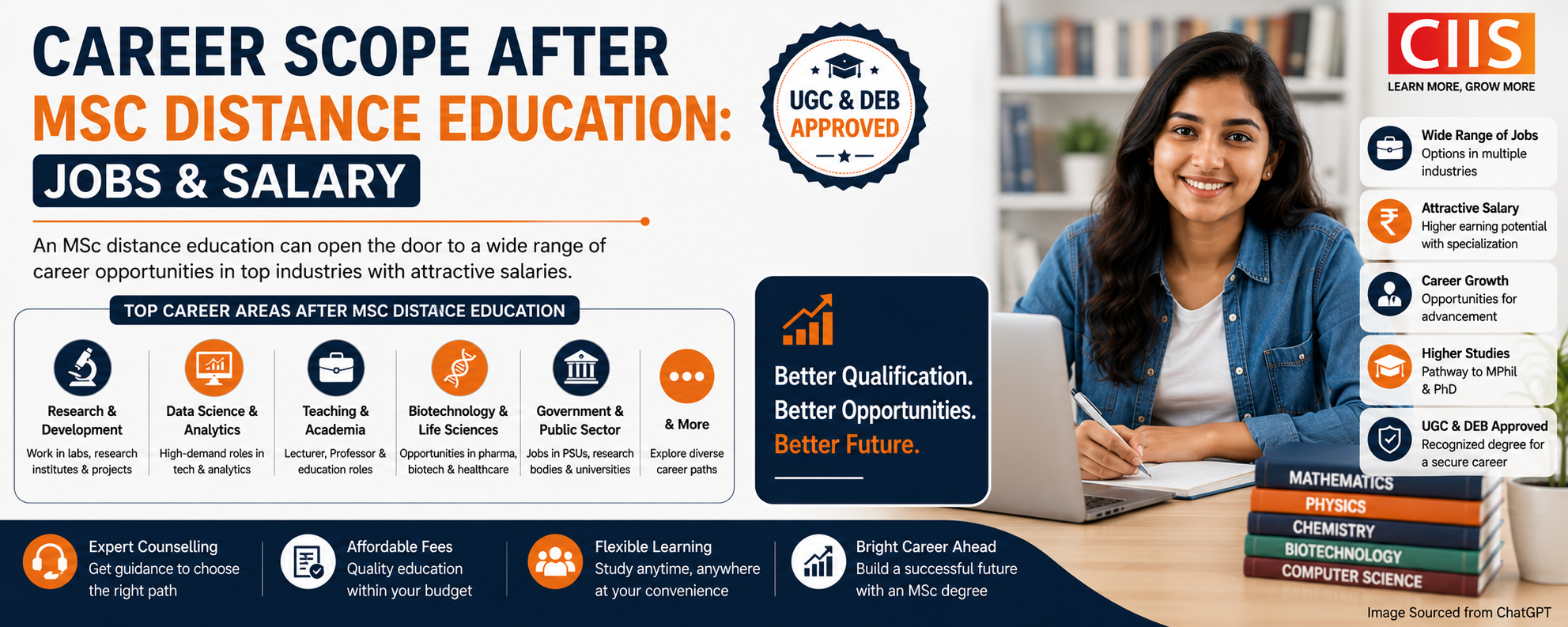
For the complete career scope guide including government job salaries and employer-wise breakdowns, read: Career Scope After MSc Distance Education: Jobs & Salary
4. MBA Career Options — What You Can Do After MBA
| MBA Career Path | Best MBA Specialisation | Salary Range | Employer Type |
|---|---|---|---|
| Finance Manager / CFO Track | MBA Finance | ₹8.0 – ₹30.0 LPA | Banks, NBFCs, corporates, investment firms |
| Marketing Manager / Brand Lead | MBA Marketing | ₹7.0 – ₹22.0 LPA | FMCG, e-commerce, media, startups |
| HR Business Partner / CHRO Track | MBA Human Resources | ₹6.0 – ₹18.0 LPA | MNCs, large corporates, IT firms |
| Operations / Supply Chain Manager | MBA Operations | ₹7.0 – ₹18.0 LPA | Manufacturing, logistics, FMCG, pharma |
| Business Development / Sales Lead | MBA Marketing / International Business | ₹7.0 – ₹20.0 LPA | Tech companies, B2B firms, startups |
| PSU Management Trainee | MBA (any specialisation) | ₹8.0 – ₹14.0 LPA + full perks | ONGC, BHEL, NTPC, SAIL, GAIL |
| Banking / IBPS PO Track | MBA Finance or any MBA | ₹6.0 – ₹12.0 LPA | Public sector banks, RBI, NABARD |
For the complete career scope guide including employer-wise salaries and government job pathways, read: Career Scope After MBA Distance Education: Jobs & Salary 2026
Still undecided between MSc and MBA? Our counsellors assess your current role, degree background, and career goal to give you a personalised recommendation — completely free. Get free guidance →
5. MSc vs MBA for Working Professionals — Key Differences
| Parameter | MSc for Working Professionals | MBA for Working Professionals |
|---|---|---|
| Can I do it while working? | Yes — distance/online MSc available at UGC-DEB approved universities | Yes — distance/online MBA widely available at UGC-DEB approved universities |
| Work experience required? | Not required — fresh graduates and working professionals both eligible | Not required for distance MBA; Executive MBA requires 5+ years experience |
| Career direction change | Deepens current domain; limited cross-domain pivot unless switching to Data Science / AI | Strong career pivot tool — enables transition from technical to managerial roles |
| Best suited for | BSc / BCom / BA graduates in science who want specialist advancement | Any graduate — especially engineers, BCom, BA, or BSc wanting management roles |
| Employer recognition | Strong in research, pharma, government science departments, tech (Data Science) | Strong in corporate sector, banking, FMCG, consulting, PSU management |
| Government job advantage | Scientist posts, technical officer, college lectureship (with NET/SET) | Management trainee, banking PO, PSU officer-grade posts |
| Postgraduate education fee (distance) | ₹25,000 – ₹80,000 (full 2-year program) | ₹30,000 – ₹1,20,000 (full 2-year program) |
6. Government Jobs — MSc vs MBA
| Government Job Category | MSc Advantage | MBA Advantage |
|---|---|---|
| CSIR / DRDO / ISRO Scientist posts | MSc wins — MSc in relevant science branch is the primary qualifying degree | MBA not applicable for scientist roles |
| PSU Management Trainee (ONGC, BHEL, NTPC) | MSc not preferred for management track | MBA wins — MBA is the standard qualifying degree for PSU MT posts |
| College Lecturer / Assistant Professor | MSc wins — MSc + UGC NET/SET qualifies for government college lectureship in science | MBA + NET qualifies for commerce/management lectureship only |
| Banking (IBPS PO / SBI PO / RBI) | Any graduate degree accepted — MSc included | MBA Finance preferred — MBA often cited as preferred qualification in bank officer posts |
| State government technical officer | MSc wins — State science and agriculture departments prefer MSc candidates | MBA applicable for administrative and management roles within these departments |
| UPSC Civil Services | Both accepted — graduation is the minimum; MSc or MBA both qualify | Both accepted — subject knowledge advantage for relevant optional papers |
For the complete guide on MSc distance education validity for government posts, read: Is MSc Distance Education Valid for Government Jobs?
For the corresponding MBA validity guide covering PSU, banking, and private sector acceptance, read: Is MBA Distance Education Valid for Government & Private Jobs?
7. MSc vs MBA — Fees Comparison (Distance Mode, 2026)
| Institution Type | MSc Distance Fees (2-year total) | MBA Distance Fees (2-year total) |
|---|---|---|
| IGNOU (government open university) | ₹16,000 – ₹30,000 | ₹32,000 – ₹45,000 |
| State open universities (YCMOU, KSOU, VMOU) | ₹18,000 – ₹35,000 | ₹25,000 – ₹45,000 |
| Private NAAC A / A+ universities | ₹40,000 – ₹80,000 | ₹55,000 – ₹1,20,000 |
| Premium NAAC A++ online universities | ₹60,000 – ₹1,00,000 | ₹80,000 – ₹1,50,000 |
For the complete university-wise MSc fee breakdown, read: MSc Distance Education Fees 2026 — University wise Comparison
For the corresponding MBA fee guide, read: MBA Distance Education Fees 2026 — University wise Comparison
8. MSc vs MBA — Who Should Choose Which?
| Your Profile | Recommended | Why |
|---|---|---|
| BSc graduate working in pharma / biotech / lab | MSc | Deepens domain expertise; qualifies for senior scientist and lecturer roles |
| BSc / BA graduate wanting to move into corporate management | MBA | Opens management track; significant career pivot from science/arts to business |
| Engineer (B.Tech) wanting to transition to management | MBA | Technical + management combination is highly valued; enables tech leadership or business roles |
| Engineer wanting to specialise in Data Science / AI | MSc Data Science / CS | Technical depth in AI/ML is more valued than management skills for this track |
| Commerce / BCom graduate in banking or finance | MBA Finance | Natural progression; strengthens existing finance domain with management skills |
| Science graduate targeting government scientist posts | MSc | CSIR, DRDO, ISRO scientist posts explicitly require MSc in the relevant science branch |
| Any graduate wanting fastest route to corporate salary increase | MBA | MBA’s management skills have broader cross-industry applicability; faster salary progression in corporate sector |
| Graduate targeting UGC NET / college teaching career | MSc (science subjects) or MBA (management / commerce) | Both qualify for UGC NET in their respective subject domains — choose based on subject |
Long tail insight: “Should I do MSc or MBA after BSc for better career growth?” If you want to stay in a science or technology domain and build deep expertise, MSc is the right choice — it qualifies you for research roles, government science posts, and specialist technical careers. If you want to move into business functions like marketing, finance, or operations, MBA opens those doors far more effectively. The BSc + MBA combination is increasingly popular among science graduates who want corporate management roles without another science degree.
9. MSc Specialisations vs MBA Specialisations — Which Offers More Choice?
| MSc — Top Specialisations (Distance) | MBA — Top Specialisations (Distance) |
|---|---|
| MSc Data Science | MBA Finance |
| MSc Computer Science | MBA Marketing |
| MSc Physics | MBA Human Resources |
| MSc Chemistry | MBA Operations Management |
| MSc Mathematics / Statistics | MBA Business Analytics |
| MSc Biotechnology | MBA International Business |
| MSc Psychology | MBA Healthcare Management |
| MSc Environmental Science | MBA Logistics & Supply Chain |
For a full analysis of which MBA specialisation has the strongest career demand in 2026, read: MBA Specialisations List: Which Should You Choose?
10. MSc and MBA Admission — What Working Professionals Need to Know
| Admission Parameter | MSc Distance Education | MBA Distance Education |
|---|---|---|
| Minimum qualification | BSc (or BA with relevant science subjects) with 45%–50% marks | Any graduation with 45%–50% marks in any stream |
| Entrance exam required? | Not required at most distance universities; some have merit-based admission | Not required for distance MBA; some universities have their own entrance |
| Work experience required? | Not required | Not required for standard distance MBA; required for Executive MBA only |
| Admission cycle | January and July sessions (most open universities); rolling at private universities | January and July sessions; rolling at most private online universities |
For the complete MSc admission guide including eligibility, last dates, and document checklist, read: MSc Admission 2026: Eligibility, Process & Last Dates
For the complete MBA distance education program overview, read: MBA Distance Education: Everything You Need to Know in 2026
11. Top Universities for MSc and MBA Distance Education — 2026
| University | NAAC Grade | MSc Available | MBA Available | UGC-DEB Approved |
|---|---|---|---|---|
| IGNOU | A | Yes — multiple specialisations | Yes | Yes |
| Amity University Online | A+ | Yes | Yes | Yes |
| LPU Distance | A+ | Yes | Yes | Yes |
| Chandigarh University Online | A+ | Yes | Yes | Yes |
| Jain University Online | A++ | Yes | Yes | Yes |
| Manipal University Jaipur | A | Yes | Yes | Yes |
| Sikkim Manipal University (SMU) | A | Yes | Yes | Yes |
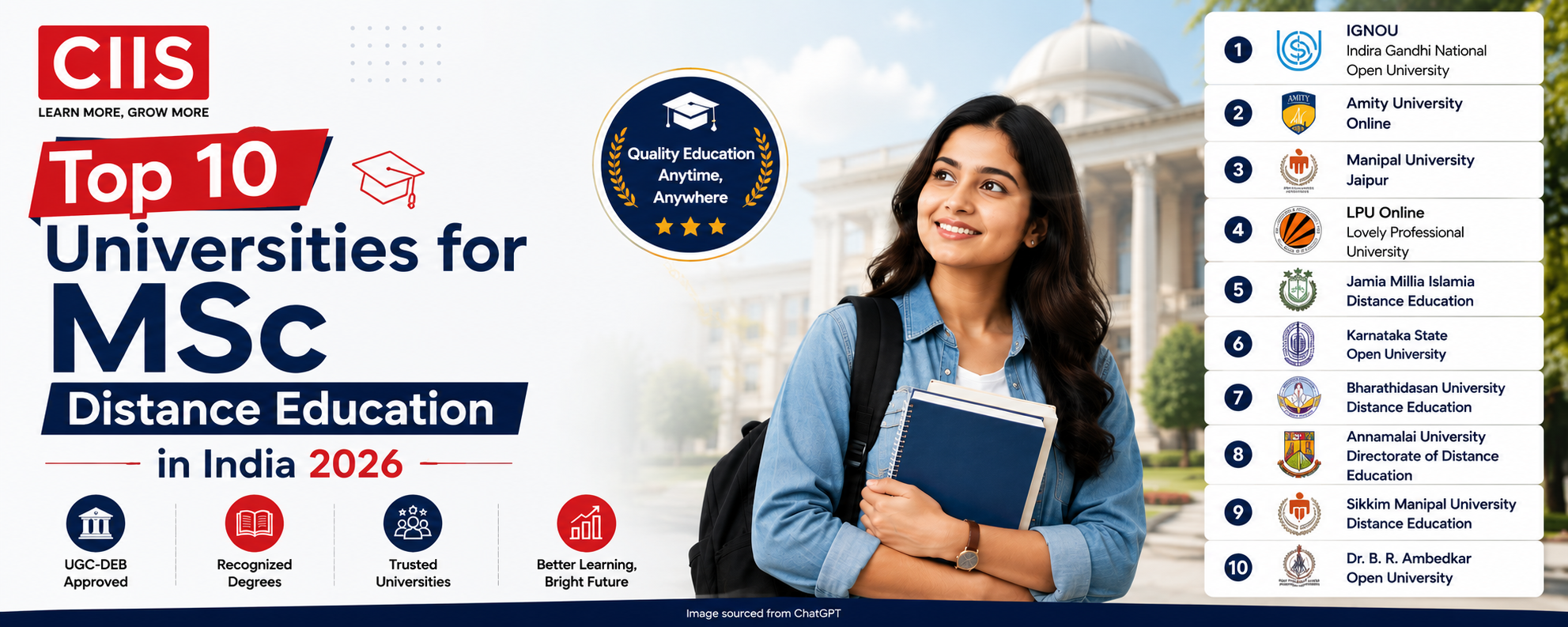
For the complete ranking and analysis of the best universities for MSc distance education, read: Top 10 Universities for MSc Distance Education in India 2026
12. MSc vs MBA — CIIS India Mumbai
If you are in Mumbai and are weighing MSc against MBA for your next career step, CIIS India at Sej Plaza, Marve Road, Malad (West), Mumbai provides free, personalised guidance to help you make the right call — based on your degree background, current role, and career goal.
- Free 1-on-1 career counselling — MSc vs MBA mapped to your specific profile and target role
- Specialisation guidance for both MSc and MBA — which branch delivers the best ROI for your background
- Admission support for all major UGC-DEB approved MSc and MBA distance programs
- UGC and UGC-DEB verification before you pay any fees
- Zero-interest EMI through Eduvanz, Jodo, and Early Salary
- Walk-in available at Sej Plaza, Marve Road, Malad (West), Mumbai
Frequently Asked Questions (FAQs)
Neither is universally better the right choice depends on your career direction. MSc is better if you want to deepen technical expertise in a science or technology domain, target government scientist posts, or build a specialist research career. MBA is better if you want to move into business management, corporate leadership, banking, marketing, or operations. Both are available through distance education at UGC-DEB approved universities no career break required.
It depends on the specialisation and sector. MBA Finance or Marketing from a top B-school commands higher entry-level salaries than most MSc programs. However, MSc Data Science and AI professionals at senior levels often earn ₹25.0 – ₹45.0 LPA comparable to senior MBA roles. For distance graduates, the salary difference between MSc and MBA narrows significantly; career performance, specialisation, and employer type become the primary salary determinants.
Yes both MSc and MBA are available through distance and online mode at UGC-DEB approved universities. You study at your own pace, attend no daily classes, and appear for examinations as scheduled — typically twice a year. Most working professionals complete both programs in 2 years without any interruption to their employment. CIIS India helps you identify the right university and manage admissions alongside your current job.
Yes MSc from a UGC-recognised, UGC-DEB approved institution is valid for government scientist posts (CSIR, DRDO, state science departments), college lectureship with UGC NET/SET, and UPSC Civil Services eligibility. The degree carries full legal validity regardless of distance delivery mode, provided both UGC and UGC-DEB approvals are in place for the specific program.
Yes MBA from a UGC-DEB approved institution is valid for PSU Management Trainee posts, banking recruitment, and private sector corporate roles. Background verification at large employers checks UGC and UGC-DEB approval of the MBA institution. Degrees from approved institutions pass verification. Always confirm the specific PSU recruitment notification for any distance-mode restrictions before applying.
MSc distance programs are generally 10%–30% cheaper than comparable MBA programs at the same institution. At IGNOU, a full 2-year MSc costs ₹16,000 – ₹30,000 versus ₹32,000 – ₹45,000 for MBA. At private NAAC A+ universities, MSc fees range from ₹40,000 – ₹80,000 versus ₹55,000 – ₹1,20,000 for MBA. Zero-interest EMI through Eduvanz, Jodo, and Early Salary is available at CIIS India for both programs.
It depends on your career goal. If you want to deepen your science expertise, qualify for government scientist or lecturer posts, or move into Data Science and research roles, MSc is the natural next step after BSc. If you want to pivot into business, marketing, finance, or management particularly in the corporate sector MBA opens those doors far more effectively. The BSc + MBA combination is increasingly popular for science graduates targeting corporate management roles.
Yes. An MSc graduate can pursue MBA as a second postgraduate degree and many do, to add management skills to their technical expertise. Conversely, an MBA graduate can pursue MSc if they want to add specialist technical depth. For distance mode, both programs require only a graduation degree as the minimum eligibility not a specific prior postgraduate qualification. CIIS India advises on the best sequencing for your specific profile.