Are you a science graduate dreaming of a postgraduate degree — but stuck between a full-time job and a classroom schedule that simply doesn’t work? You are not alone.
Every year, thousands of working professionals, fresh graduates, and career-changers across India ask the same question: “Can I do an MSc without attending college every day?”
The answer is a clear, confident yes – and it is called MSc distance education.
In this complete guide for 2026, you will learn exactly what MSc distance education is, whether it is valid and UGC-approved, what it costs, which universities offer it, which specializations are available, and — most importantly — how CIIS India can help you enroll in the right program without any confusion.
Whether you are a working professional seeking a promotion, a BSc graduate looking to level up, or someone who missed out on a master’s degree earlier in life, this guide is written specifically for you.
What is MSc Distance Education?
MSc distance education, also referred to as correspondence master’s degree in science or distance MSc, is a postgraduate program that allows students to earn a Master of Science degree without physically attending a college or university campus.
Instead of sitting in a classroom every day, students receive study materials, attend online classes or webinars, complete assignments, and appear for examinations — all while managing their own schedule from home or from work.
The full form of MSc is Master of Science. It is a two-year postgraduate degree (divided into four semesters) that builds advanced knowledge in science disciplines such as Mathematics, Physics, Chemistry, Biotechnology, Computer Science, Microbiology, and many more.
In distance learning mode, the same MSc degree is delivered through:
- Printed or digital study materials sent by the university
- Online lectures and recorded video sessions
- Virtual doubt-clearing sessions and webinars
- Online or centre-based semester examinations
- Project work and dissertations (where applicable)
The biggest appeal is flexibility – you study at your own pace, from your own location, without giving up your job or other responsibilities.
Quick Fact: India’s online education market is projected to grow at a CAGR of 19.9% by 2030, and MSc distance programs are one of the fastest-growing segments within this boom.
Is MSc Distance Education Valid in India?
This is the most important question – and the answer matters for your career.
Yes, MSc distance education is valid in India, provided it is offered by a university approved by the University Grants Commission – Distance Education Bureau (UGC-DEB).
The UGC-DEB is the regulatory authority that officially approves and monitors distance education programs in India. Any MSc distance program offered by a UGC-DEB approved university is:
- Recognized for government job applications
- Valid for pursuing PhD programs
- Accepted by employers in both public and private sectors
- Eligible for NET/SET examinations (which qualify candidates for lectureships)
- Recognized internationally through bodies like WES (World Education Services) for those planning to study or work abroad
At CIIS India, every MSc distance program is offered through universities that hold UGC approval, AIU membership, and WES recognition — so your degree is respected wherever you take it.
Accreditations that Matter
| Accreditation Body | What It Means for You |
|---|---|
| UGC (University Grants Commission) | Your degree is officially recognized by the Government of India |
| UGC-DEB (Distance Education Bureau) | The distance mode specifically is authorized and valid |
| AIU (Association of Indian Universities) | Your degree is accepted by universities across India |
| WES (World Education Services) | Your degree is evaluated and accepted internationally |
| NAAC A/A+ Grade | Quality assurance — the university meets academic excellence standards |
| AICTE | Relevant for technology-based MSc programs |
MSc Distance Education vs Regular MSc – Key Differences
One of the most common dilemmas students face is choosing between a regular (full-time) MSc and a distance MSc. Here is a side-by-side comparison to help you decide.
MSc Distance Education vs Regular MSc: Complete Comparison Table
| Parameter | MSc Distance Education | Regular MSc (Full-Time) |
|---|---|---|
| Mode of Study | Online / Correspondence / Hybrid | Classroom-based, on-campus |
| Schedule | Flexible — study anytime | Fixed timetable, daily attendance |
| Duration | 2 to 4 years (flexible) | 2 years (fixed) |
| Ideal For | Working professionals, homemakers, remote learners | Fresh graduates with no work commitments |
| Annual Fees | ₹14,500 – ₹76,000 | ₹30,000 – ₹2,00,000+ |
| College Attendance | Not required (exams may need centre visit) | Daily attendance mandatory |
| Degree Certificate | Same university degree (no “distance” tag visible) | Same university degree |
| UGC Validity | Valid (if from UGC-DEB approved university) | Valid |
| Career Outcomes | Same as regular MSc | Same as distance MSc |
| NET/SET Eligibility | Yes | Yes |
| EMI / Loan Options | Available (0% EMI options at CIIS India) | Limited |
| Geographic Access | Study from anywhere in India | Must relocate to university city |
Key Takeaway: Both degrees carry the same academic weight when obtained from an accredited university. The difference is purely in the mode of delivery and your flexibility.
Eligibility Criteria for MSc Distance Education 2026
Before applying for MSc distance education in India, you must meet the following eligibility criteria. While each university has its own specific requirements, the general framework is:
General Eligibility for MSc Distance Education
| Criteria | Requirement |
|---|---|
| Minimum Qualification | Bachelor’s degree in Science (BSc) or relevant field |
| Minimum Marks | 45% – 50% aggregate in graduation (general category) |
| SC/ST/OBC Relaxation | 5% relaxation in minimum marks |
| Age Limit | No upper age limit — open to all age groups |
| Work Experience | Not mandatory, but preferred for some specializations |
| Language Requirement | Basic English proficiency (most courses are in English) |
| Entrance Exam | Not required at most universities; merit-based admission |
Specialization-Specific Eligibility
Certain specializations may require that your graduation included specific subjects:
| MSc Specialization | Required Background in Graduation |
|---|---|
| MSc Mathematics | BSc with Mathematics as a major subject |
| MSc Physics | BSc with Physics as a core subject |
| MSc Chemistry / Organic Chemistry | BSc with Chemistry |
| MSc Biotechnology | BSc Biology / Biochemistry / Microbiology |
| MSc Computer Science / IT | BSc Computer Science, BCA, or BCS |
| MSc Agriculture | BSc Agriculture or related field |
| MSc Microbiology | BSc Microbiology / Life Sciences / Botany |
MSc Distance Education Specializations Available in India
One of the greatest advantages of MSc distance education is the wide range of specializations available. You are not limited to one or two options — you can choose a field that aligns with your career goals and educational background.
Full List of MSc Distance Education Specializations
| Category | Specializations Available |
|---|---|
| Science & Technology | Mathematics, Physics, Chemistry, Analytical Chemistry, Organic Chemistry, Biochemistry |
| Life Sciences | Biotechnology, Microbiology, Zoology, Botany, Bioinformatics |
| Agriculture | MSc Agriculture, Agronomy, Horticulture, Entomology, Plant Pathology |
| Computer & IT | Computer Science, Information Technology |
| Allied Sciences | Nuclear Medicine, Psychology, Environmental Science, Food & Nutrition |
| Management & Quality | Total Quality Management (TQM) |
At CIIS India, we offer MSc distance education in over 19 specializations, including Agriculture, Biochemistry, Bioinformatics, Biotechnology, Botany, Chemistry, Mathematics, Microbiology, Nuclear Medicine, Organic Chemistry, Physics, Psychology, Total Quality Management, Zoology, and several Agriculture sub-streams.
Explore All MSc Specializations at CIIS India →
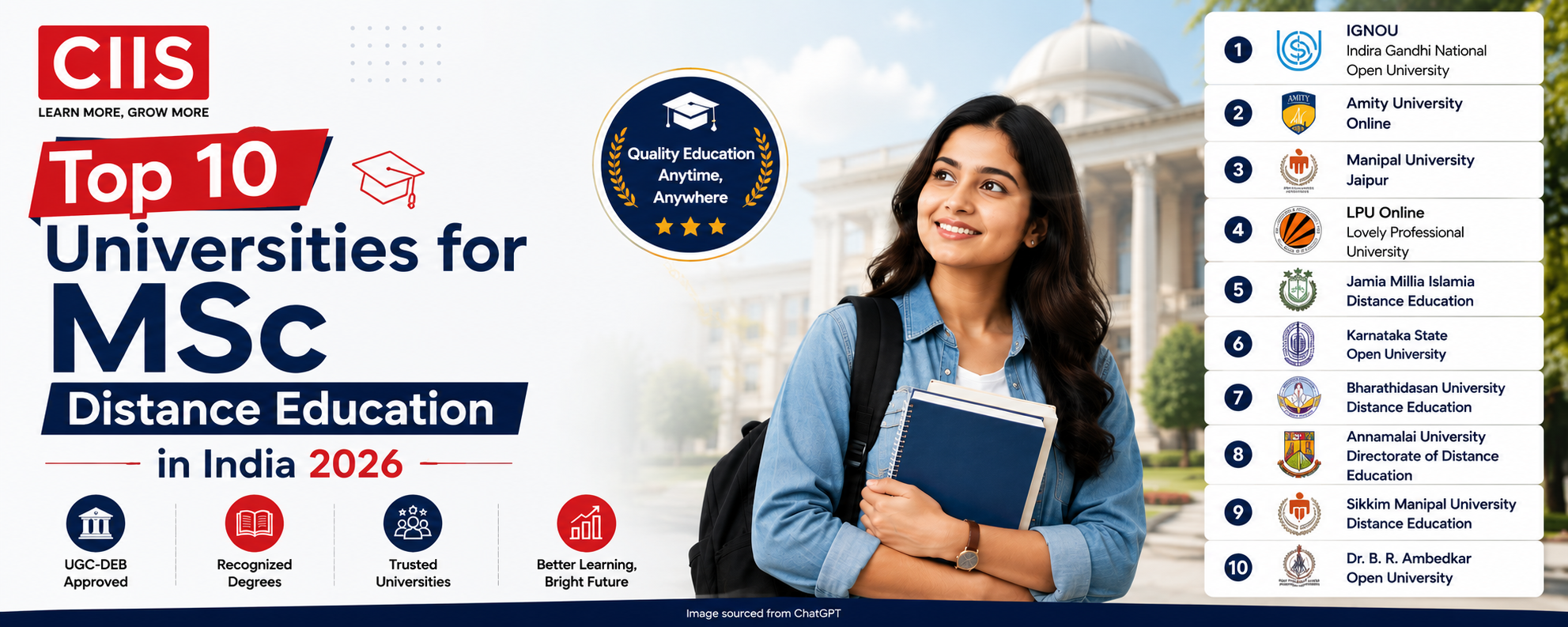
Top Universities Offering MSc Distance Education in India 2026
Choosing the right university is critical because it determines the validity, quality, and recognition of your degree. Here is a comparison of top universities offering MSc distance education in India.
Top Universities for MSc Distance Education – 2026 Comparison
| University | NAAC Grade | Specializations Offered | Approx. Annual Fee | UGC-DEB Approved |
|---|---|---|---|---|
| IGNOU (New Delhi) | A++ | Maths, Env. Science, Food & Nutrition, Counselling | ₹14,500 – ₹30,000 | Yes |
| Mumbai University (IDOL) | A++ | Mathematics, IT, Computer Science | ₹15,000 – ₹35,000 | Yes |
| YCMOU (Maharashtra) | A | Multiple science specializations | ₹20,000 – ₹40,000 | Yes |
| Annamalai University (Tamil Nadu) | B+ | Science, Chemistry, Maths | ₹25,000 – ₹50,000 | Yes |
| Mangalayatan University (UP) | A+ | Multiple specializations | ₹25,000 – ₹55,000 | Yes |
| LPU (Punjab) | A++ | Information Technology | ₹30,000 – ₹60,000 | Yes |
| Madras University | A++ | Multiple science streams | ₹4,000 – ₹12,000 | Yes |
| University through CIIS India | Multiple | 19+ Specializations | ₹40,000 – ₹60,000 | Yes |
Pro Tip: Fees alone should not be your only criterion. Consider UGC-DEB approval, WES recognition, student support services, and post-admission counseling. CIIS India helps you compare all these factors before you enroll.
MSc Distance Education Fees 2026 – University-wise Breakdown
Fees for MSc distance education in India vary significantly depending on the university and specialization chosen. Here is a comprehensive fee comparison for 2026.
MSc Distance Education Fee Structure 2026
| Fee Component | Amount (Approx.) |
|---|---|
| Total Program Fee (2 Years) | ₹14,500 – ₹76,000 per year |
| Application Fee (One-Time) | ₹500 – ₹5,000 |
| Course Material Fee | ₹2,000 – ₹3,000 per semester |
| Examination Fee | ₹1,000 – ₹1,500 per semester |
| Registration / Enrollment Fee | Included in program fee (most universities) |
Total MSc Distance Education Cost Estimate (2 Years)
| University Type | Estimated Total Fee (2 Years) |
|---|---|
| Government Open Universities (IGNOU, YCMOU, Madras) | ₹29,000 – ₹75,000 |
| Private UGC-Approved Universities | ₹60,000 – ₹1,50,000 |
| Via CIIS India (Multiple University Options) | ₹40,000 – ₹60,000 per year |
EMI & Loan Options
At CIIS India, we understand that fees should never be a barrier to your education. We offer:
- 0% interest EMI plans through Eduvanz, Early Salary, LiquiLoans, FinancePeer, Propelld, Credenc, and Jodo
- Flexible installment options based on your monthly income
- Zero-cost education loans for eligible students
- No processing fee on select EMI plans
MSc Distance Course Structure & Syllabus
Understanding what you will study helps you make the right specialization choice. Here is a general overview of how the MSc distance education course is structured.
MSc Distance Education: Course Structure
| Parameter | Details |
|---|---|
| Total Duration | 2 years (minimum) to 4 years (maximum) |
| Semester Structure | 4 semesters (2 per year) |
| Credit System | Credit-based as per UGC guidelines |
| Study Mode | Self-paced with online support |
| Examinations | Online or centre-based, semester-wise |
| Project / Dissertation | Required in final year (specialization-dependent) |
MSc Mathematics Distance Education — Sample Syllabus
| Semester | Core Subjects |
|---|---|
| Semester 1 | Real Analysis, Abstract Algebra, Linear Algebra, Differential Equations |
| Semester 2 | Complex Analysis, Topology, Numerical Methods, Probability & Statistics |
| Semester 3 | Functional Analysis, Number Theory, Dynamical Systems, Operations Research |
| Semester 4 | Electives + Dissertation / Project |
MSc Biotechnology Distance Education — Sample Syllabus
| Semester | Core Subjects |
|---|---|
| Semester 1 | Cell Biology, Biochemistry, Genetics, Molecular Biology |
| Semester 2 | Microbial Biotechnology, Plant Biotechnology, Immunology |
| Semester 3 | Bioinformatics, Genetic Engineering, Fermentation Technology |
| Semester 4 | Electives + Research Project |
Admission Process for MSc Distance Education 2026
Applying for MSc distance education has never been easier. Here is a step-by-step guide to the admission process in 2026.
Step-by-Step Admission Process
Step 1 — Talk to an Expert Counselor
Before filling any form, speak with an academic counselor (free at CIIS India) to identify the right university and specialization based on your background and career goals.
Step 2 — Fill the Online Application Form
Visit the CIIS India website or the university’s official portal and complete the online admission form. Most universities do not require an entrance examination for MSc distance courses — admission is merit-based.
Step 3 — Upload Required Documents
Prepare and upload the following documents:
| Document | Requirement |
|---|---|
| 10th Mark Sheet & Certificate | For age and identity verification |
| 12th Mark Sheet & Certificate | Proof of higher secondary qualification |
| Graduation (BSc) Mark Sheets | All semester / year mark sheets |
| Graduation Degree / Provisional Certificate | Proof of degree completion |
| Government Photo ID | Aadhaar Card / PAN Card / Passport |
| Recent Passport-size Photographs | Digital format (JPEG/PNG) |
| Work Experience Certificate | If applicable (preferred, not mandatory) |
| Caste Certificate | For SC/ST/OBC relaxation (if applicable) |
Step 4 — Pay the Admission Fee
Pay through net banking, credit/debit card, UPI, or choose the EMI option. At CIIS India, we offer 0% interest EMI with partnered NBFCs.
Step 5 — Document Verification
The university reviews and verifies your submitted documents. Approval typically takes 5–10 working days.
Step 6 — Receive Confirmation & Access
After approval, you receive your admission confirmation, student ID, and login credentials for the online student portal to begin your studies.
Important Admission Dates for MSc Distance Education 2026
| Event | Date |
|---|---|
| Admission Portal Open | January 2026 (ongoing) |
| Last Date for Applications | May 15–20, 2026* |
| Document Verification Period | Within 10 working days of form submission |
| Course Commencement | June–July 2026 |
*Dates are indicative and vary by university. Contact CIIS India for exact deadlines.
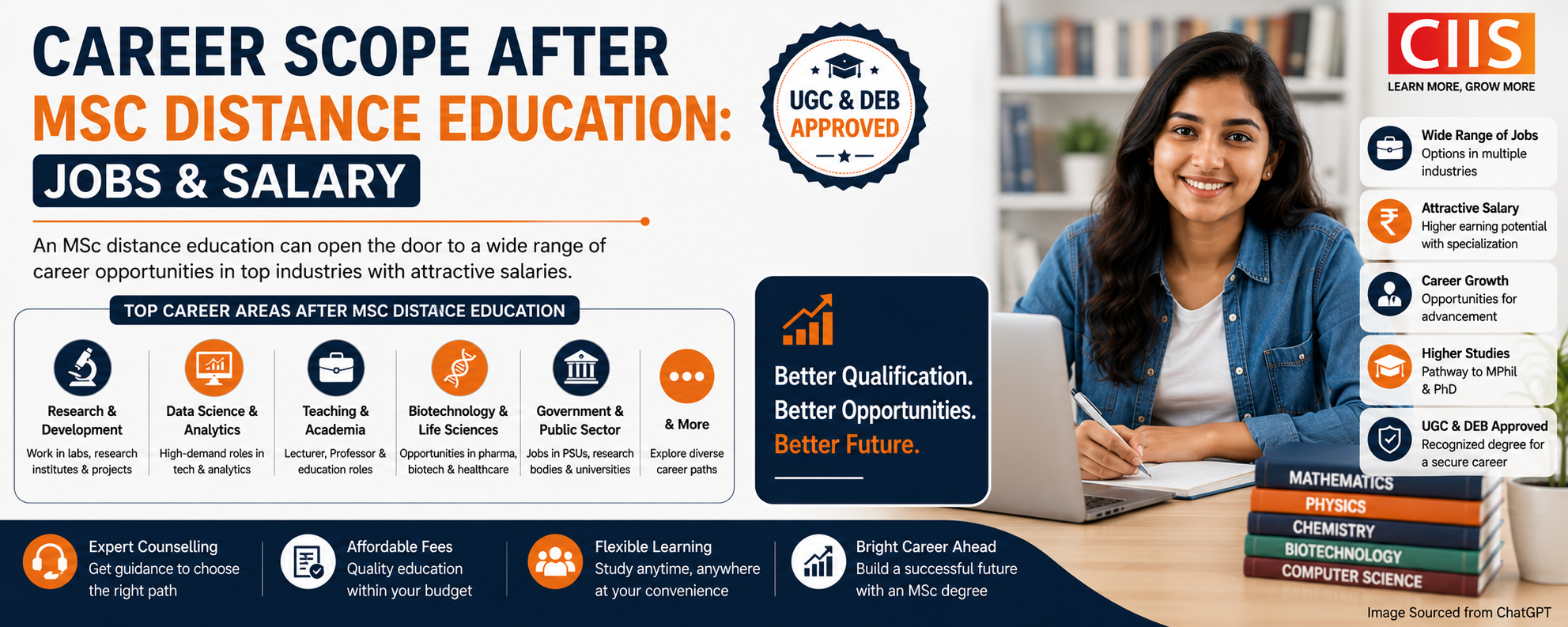
Career Scope After MSc Distance Education — Jobs & Salary
A distance MSc from an accredited university opens the same career doors as a regular MSc degree. Here is a comprehensive look at the career opportunities available to MSc graduates.
Top Career Roles After MSc Distance Education
| Job Role | Industry | Average Annual Salary (India) |
|---|---|---|
| Research Scientist | Pharmaceuticals, Biotechnology, Defense | ₹4,00,000 – ₹10,00,000 |
| Lecturer / Assistant Professor | Education (After NET/SET) | ₹3,00,000 – ₹8,00,000 |
| Data Analyst / Scientist | IT, Finance, Healthcare | ₹5,00,000 – ₹15,00,000 |
| Lab Analyst / Technician | Hospitals, Diagnostic Labs, R&D | ₹2,50,000 – ₹6,00,000 |
| Biotechnologist | Biotech Companies, FMCG, Agriculture | ₹3,50,000 – ₹9,00,000 |
| Environmental Consultant | Government, NGOs, Infrastructure | ₹3,00,000 – ₹7,00,000 |
| Quality Analyst | Manufacturing, Pharma, Food Industry | ₹3,00,000 – ₹7,50,000 |
| Scientific Writer / Content Expert | Edtech, Publishing, Research Journals | ₹3,50,000 – ₹8,00,000 |
| Pharmaceutical Researcher | Pharma Companies, CROs | ₹4,00,000 – ₹12,00,000 |
| Government Scientist (CSIR, DRDO, ISRO) | Central Government | ₹4,50,000 – ₹14,00,000 |
Key Insight: According to industry data, 52.3% of fresh MSc graduates were considered employable in 2024 — an improvement of 2% from the previous year. Distance MSc graduates with project work and practical dissertations are increasingly meeting employer expectations.
Post-MSc Academic Pathways
Your MSc distance degree also qualifies you for:
- PhD Program — Pursue doctoral research at any recognized Indian university
- UGC-NET / SET Exam — Qualify for college lecturer and assistant professor positions
- GATE Exam — Gate examination for engineering and science (Computer Science, Mathematics specializations)
- CSIR-NET — Council of Scientific and Industrial Research exam for research fellowships
- Government Job Exams — Many UPSC and State PSC exams accept MSc as a qualifying degree
MSc Distance Education vs Online MSc — What is the Difference?
Many students confuse distance MSc with online MSc. While both offer flexibility, there are important differences.
MSc Distance Education vs Online MSc: Head-to-Head
| Feature | MSc Distance Education | Online MSc |
|---|---|---|
| Primary Mode | Study materials + periodic online support | Fully internet-based with live classes |
| Internet Dependency | Moderate (materials accessible offline) | High (continuous internet required) |
| Regulatory Body | UGC-DEB (Distance Education Bureau) | UGC (Online Education Guidelines) |
| Live Sessions | Optional / recorded sessions | Live lectures + recorded backup |
| Study Materials | Physical + digital materials | Entirely digital |
| Campus Visits | Occasionally for exams | Rarely or never |
| Typical Fees | ₹14,500 – ₹76,000 per year | ₹30,000 – ₹1,50,000+ per year |
| Ideal For | Students in low-connectivity areas, self-paced learners | Tech-comfortable learners with stable internet |
| Degree Value | Same — both UGC recognized when from approved institutions | Same |
At CIIS India, we offer both modes across multiple universities, and our counselors help you choose the right one based on your location, internet access, and learning style.
Why Working Professionals Choose Distance MSc
MSc distance education was specifically designed with working professionals in mind. Here is why thousands of employed individuals across India are enrolling every year.
Top 7 Reasons Working Professionals Choose Distance MSc
1. No career break required
You never have to quit your job. Study in the evenings, on weekends, or during any free time without affecting your professional responsibilities.
2. Immediate application of learning
Apply what you study directly to your current job — making your MSc education practically relevant from day one.
3. Salary upgrade potential
In many organizations — especially government departments, educational institutions, and research companies — an MSc degree directly qualifies you for higher pay grades or promotion eligibility.
4. Affordable fees with EMI options
MSc distance programs cost significantly less than full-time programs. With 0% EMI options at CIIS India, you can pay from your monthly salary without financial strain.
5. No geographical barrier
Whether you are in Mumbai, a Tier-2 city, or a remote district, you can enroll in and complete your MSc from any UGC-approved university across India.
6. NET/SET eligibility for teaching careers
If your goal is to become a college lecturer, the distance MSc is your stepping stone to the UGC-NET or State SET exam — and eventually, a teaching position.
7. Access to government job opportunities
Several Union and State government positions — particularly in science departments, research organizations, and educational institutions — require an MSc degree. Distance mode is accepted for most of these.
Why Choose CIIS India for MSc Distance Education?
CIIS India is Mumbai’s most trusted education counseling center for distance and online degree programs. With over 9 years of experience and 27,000+ successful career placements, here is what makes us different from simply enrolling directly with a university.
CIIS India vs Self-Enrollment: Why Expert Guidance Matters
| Factor | CIIS India | Direct University Enrollment |
|---|---|---|
| University Matching | Personalized based on your background, budget & goals | You research and decide alone |
| Admission Support | End-to-end document guidance | Self-managed |
| Counselor Access | 50+ dedicated experts, free 1:1 sessions | University helpline only |
| Universities Available | 100+ UGC-DEB approved universities | One university |
| EMI / Finance Options | 7+ NBFC partners, 0% interest | Limited or none |
| Post-Admission Support | Ongoing mentoring throughout your program | Minimal |
| WES / International Recognition | Pre-verified programs | Must verify independently |
| Location | Mumbai-based (Malad West) + all-India service | University’s city |
What Our Students Say
“CIIS has the most dedicated staff — they were very patient enough to answer my never-ending queries. The most pleasant experience and journey.” — Cossmic Media Solutions
“My degree from CIIS helped me get promoted and win coveted assignments at work.” — Pranav Damania
“Fantastic enrollment experience. Khushi (counselor) guided me through each step, making everything seamless and stress-free.” — Murselin Khan
Talk to a CIIS India MSc Counselor — Free 1:1 Session →
Frequently Asked Questions (FAQs)
Yes, MSc obtained through distance education from a UGC-DEB approved university is valid for government job applications. Central and State government exams, including UPSC and State PSC, accept MSc distance degrees as a qualifying qualification.
Yes. A distance MSc from an accredited university makes you eligible to apply for PhD programs at any recognized Indian university. You will need to clear the university’s PhD entrance test or UGC-NET/JRF.
Most distance MSc programs in India do not require an entrance examination. Admission is based on merit in your graduation. However, some universities may have their own qualifying tests. CIIS India counselors can guide you to universities with the simplest admission process.
The general last date for MSc distance education admission for the 2026–27 session is around May 15–20, 2026, though this varies by university. Contact CIIS India immediately to check exact deadlines and avoid late fees.
Absolutely. This is the primary advantage of MSc distance education. Thousands of working professionals across India are currently completing their MSc through distance mode while being employed full-time.
Biotechnology, Computer Science, and Mathematics offer the highest demand in 2026. However, the best specialization is the one that aligns with your undergraduate background and career goals. Speak with a CIIS India counselor for personalized guidance.
You need your 10th, 12th, and graduation mark sheets and certificates, a valid government ID (Aadhaar/PAN/Passport), recent passport-size photographs, and (if applicable) work experience and caste certificates.
The total fee ranges from ₹14,500 to ₹76,000 per year, depending on the university and specialization. At CIIS India, we help you find the best program within your budget and offer 0% EMI options through 7+ NBFC partners.
No. The degree certificate issued by the university is the same for distance and regular students. There is no visible distinction that marks it as a “distance” degree.
Always verify on the official UGC-DEB approved institutions list at ugcdeb.gov.in. Alternatively, contact CIIS India – all programs we facilitate are pre-verified for UGC-DEB approval, AIU membership, and WES recognition. Conclusion MSc distance education in India is no longer a compromise – it is a smart, strategic choice for anyone who wants to advance their career in science without putting their life on hold. Whether you want to qualify for a university lectureship, crack government science exams, get promoted at your current company, or simply fulfil a long-held academic dream, a distance MSc from a UGC-approved university is your most practical path forward in 2026. With fees starting at ₹14,500 per year, flexible study schedules, 19+ specializations, and 0% EMI options — the only thing standing between you and your MSc degree is the right guidance. CIIS India has been that guidance for over 27,000 students and working professionals across India. Our team of 50+ counselors in Mumbai is ready to help you identify the right university, match your specialization, and support your admission process from start to finish — completely free.