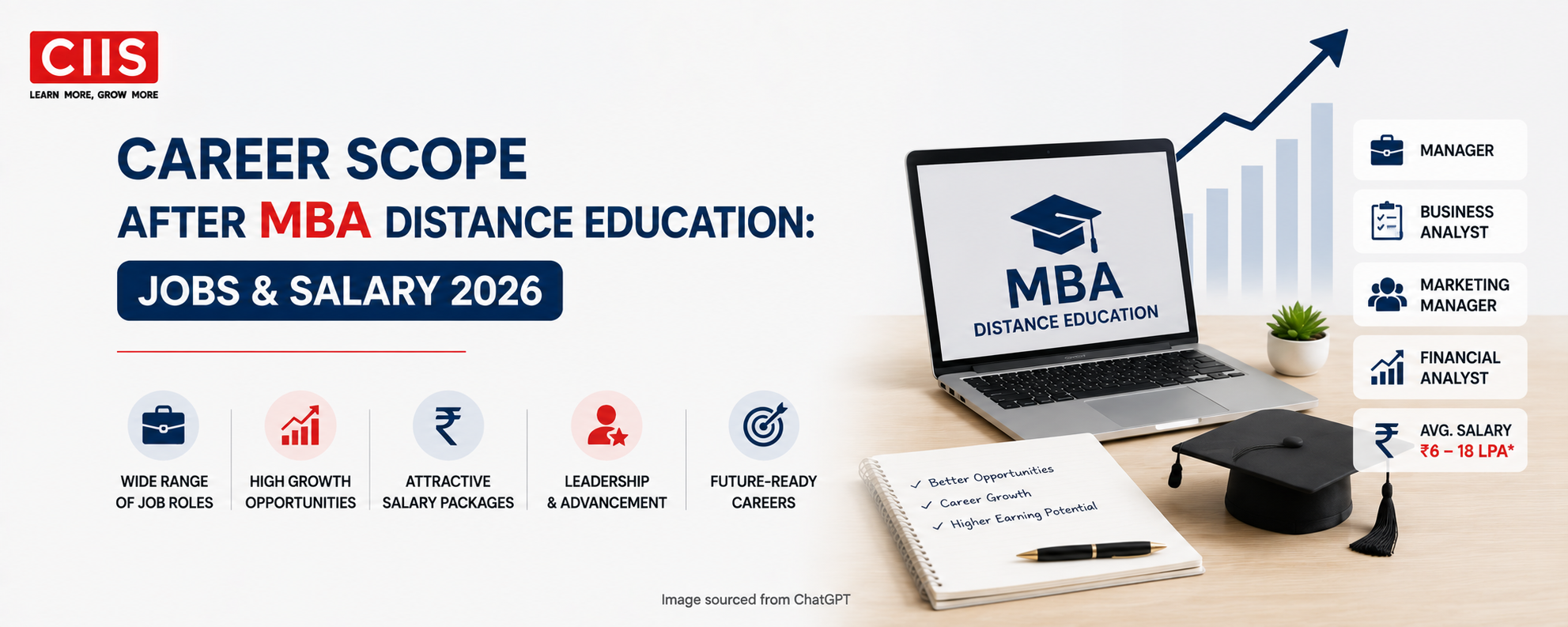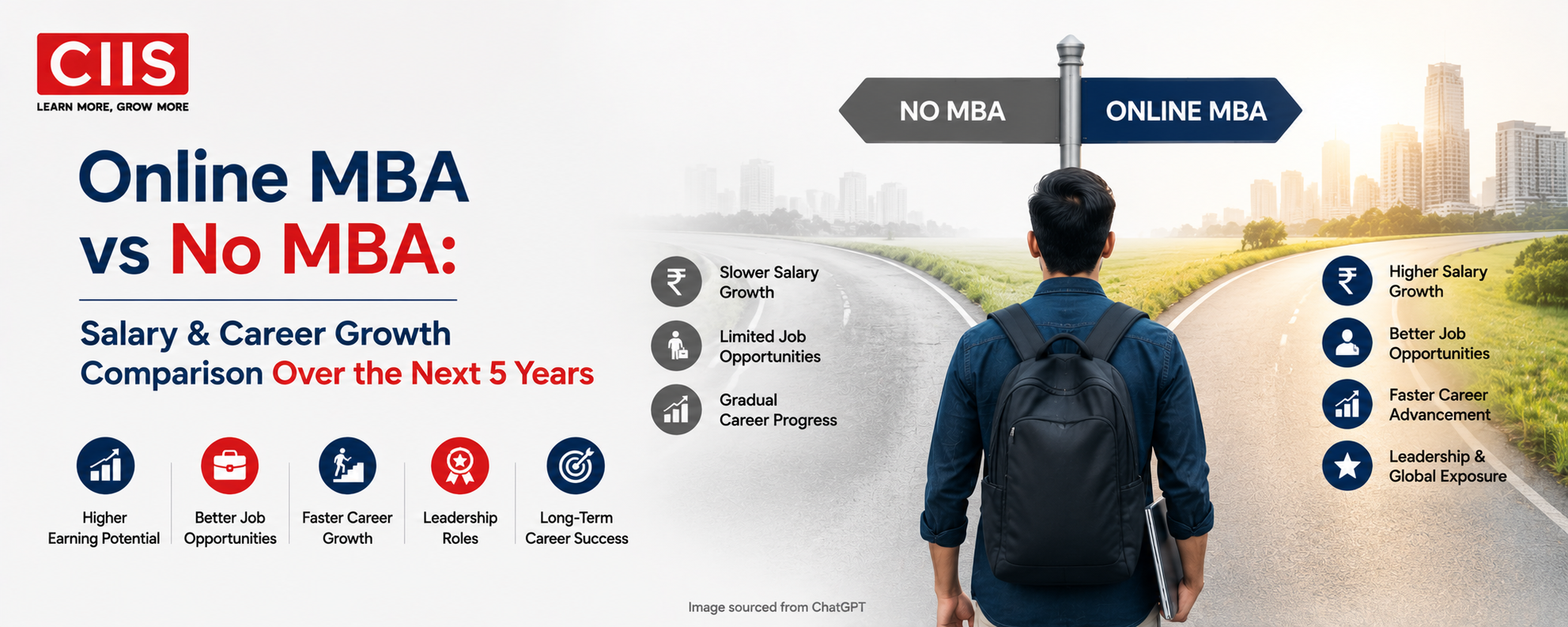
You have been working hard. Every year your experience grows, your responsibilities widen a little, and you handle things today that would have unsettled you three years ago. So here is a fair question to ask yourself: are your salary, your designation and your decision-making authority growing at the same speed as your experience?
For a lot of capable professionals in India, the honest answer is no not because they are doing anything wrong, but because experience alone tends to move a career sideways more often than upward. Now picture yourself five years from today. Will your CV show five more years of doing broadly what you do now? Or will it show that same experience combined with formal management knowledge finance, strategy, operations, people leadership and readiness for a role with a wider remit? This guide compares those two futures side by side, and shows exactly where an Online MBA fits in for someone who intends to keep working throughout.
Before diving in, explore our complete guide on the value of an Online MBA: Is an Online MBA Worth It in 2026? Salary, Career Growth & ROI Explained
Quick Answer — Online MBA vs No MBA Over 5 Years
- The real question: Not ‘will I earn more’ but ‘what will my profile look like in five years’
- What stays the same: Your job, your monthly income, your city. An Online MBA is studied alongside full-time work
- What can change: Management knowledge, business vocabulary, cross-functional understanding, leadership readiness
- Where the paths separate: Around the point you start being considered for roles with team, budget or business ownership
- What drives salary: Experience + role + industry + skills + performance + employer + the career decisions you make
- Duration: 2 years, 4 semesters, studied while working
- Weekly commitment: Roughly 10–12 hours, mostly weekends
- Specialisations: Finance, Marketing, Operations & Supply Chain, HR, Business Analytics, General Management
- Fees and EMI: EMI options are available — a counsellor can explain the current terms for each programme
- Always verify: ugc.ac.in for the university and deb.ugc.ac.in for the specific programme, before paying anything
Where Could Your Career Be 5 Years From Now?
Map it out properly with a CIIS India counsellor — your current role and experience on one side, the management roles that open up on the other, and the steps between them. Sessions can be arranged in person or over a call.
1. Is Your Career Growing as Fast as Your Experience?
Most professionals do not stall because they stop working hard. They stall because the thing that got them their first three promotions doing the work well is not the thing that gets them the next one. Somewhere between senior executive and manager, the question employers are asking quietly changes. It stops being ‘can you deliver this?’ and becomes ‘can you decide what should be delivered, cost it, defend it and lead a team through it?’
That is a different skill set, and very few roles hand it to you as part of the job. Which is why it is worth checking, honestly, which of these describes your last two years.
| Signal | What It Usually Points To |
|---|---|
| Your experience grew, your designation did not | Your growth may be limited by profile rather than performance |
| Your increments feel routine rather than reflective of your contribution | You may be nearing the top of your current salary band |
| You execute well but are not part of budget, pricing or planning discussions | Commercial exposure is the gap, not capability |
| You want to move into a different function and are not getting shortlisted | Your profile reads as a specialist rather than a generalist |
| You can do the manager’s job but have not been offered it | Employers may be looking for evidence of formal management readiness |
| Your career is already progressing | An Online MBA can help you prepare for broader management responsibilities as you move upward |
If any of these feel familiar, the rest of this guide is written for you. And if your career is already moving well, that is an even better starting point management education tends to compound fastest for professionals who are already on the way up.
2. The Five Year Question – Two Versions of the Same CV
Forget salary figures for a moment. Picture two versions of your own CV, five years from today. Same person, same intelligence, same work ethic. The only difference is whether management education sat alongside those five years of experience.
| On Your CV in 5 Years | Version A — Experience Only | Version B — Experience + Online MBA |
|---|---|---|
| Years of experience | 5 more years, mostly in the same function | 5 more years, in the same function |
| Qualification | Your graduation degree | Graduation degree + a recognised postgraduate management degree |
| Business knowledge | Whatever your role happened to expose you to | Finance, marketing, operations, strategy and organisational behaviour, studied formally |
| Cross-functional understanding | Strong in your own function | Able to read a P&L, a marketing plan and a supply chain problem |
| Evidence of management readiness | Your track record, which is real but harder to evidence on paper | Track record plus a formal credential that HR systems recognise |
| Range of roles you can apply for | Roles that resemble your current one | Those, plus management and business-facing roles that ask for a PG qualification |
| Confidence in senior rooms | Built through exposure, where exposure happened | Built through exposure and through vocabulary you were actually taught |
Notice that Version B does not claim a bigger salary. It claims a wider set of options — and options are what eventually produce salary. This is the honest version of the argument, and it is also the more useful one, because options are something you can actually build deliberately.
What difference does an Online MBA really make to a CV after five years?
The clearest difference is range. Two profiles with identical experience read very differently to a recruiter when one of them also carries a recognised postgraduate management qualification — not because the degree proves ability, but because it signals that the candidate has studied the commercial side of business formally and is likely to be comfortable in a role that requires it. As professionals move toward managerial and business-facing positions, employers increasingly look for that combination of hands-on experience and formal management knowledge. An Online MBA is one of the more practical ways to strengthen that part of a profile without stepping away from work.
3. Today → 1 Year → 3 Years → 5 Years: The Career Path Comparison
Here is the same comparison over time. Two professionals at the same starting point. One enrolls in a UGC-entitled Online MBA and keeps working; the other continues exactly as they are. These are the possibilities that open up along each route the pattern that plays out often enough to be worth planning around.
| Stage | Path A — Experience Only | Path B — Experience + Online MBA |
|---|---|---|
| Today | Solid performer. Deep in your function. Growth feels gradual | The same. Nothing about your job changes on the day you enroll |
| 1 year | One more year of experience. One normal increment | Two semesters of finance, marketing, operations and organisational behaviour — and you have already applied something from them at work |
| 3 years | Three more years of the same function. Possibly a team-lead role on seniority | Degree completed. Applying for roles with team or budget responsibility. Conversations with your manager have changed tone |
| 5 years | Five more years of experience. A strong specialist profile | Two years of post-degree management experience on top of a specialist foundation. Considered for wider roles |
| Range of options at Year 5 | Roles similar to your current one, in your industry | Management roles, cross-functional moves, and roles in other industries where the credential travels |
| Earning trajectory | Follows your current band and increment curve | Follows whichever role you actually move into which is the point |
Both paths are built on real professional growth. The difference is what each one is made of.
| Path | What It Is Built From |
|---|---|
| Path A — Experience Only | Career development primarily through workplace exposure and the responsibilities available within your current role |
| Path B — Experience + Online MBA | Work experience, plus management knowledge, business understanding, leadership development, cross-functional exposure, a postgraduate management qualification, and preparation for broader responsibility |
Read those two definitions side by side and the difference is not effort or ability. It is range. Salary follows role, role follows the breadth of what you are credible for, and Path B is simply the wider of the two.
4. What Actually Drives Salary Growth in India
There is no single salary figure that applies to every Online MBA graduate, because career growth depends on the role you hold, your industry, your experience, your skills and the responsibilities you take on. The bigger opportunity lies in strengthening your profile for roles with broader responsibility and those roles sit in wider salary bands. Here is how the factors actually work, and where management education has real influence.
| Factor | How Much It Moves Your Salary | Can an Online MBA Influence It? |
|---|---|---|
| The role you hold | The single largest factor bands are set by role, not by person | Indirectly, by widening the roles you can credibly apply for |
| Your industry | Large. The same role pays differently across BFSI, IT, manufacturing and retail | Yes — a portable credential makes an industry move more feasible |
| Years of experience | Significant early, flattens later | No — but it pairs with experience, which is the useful part |
| Depth of skills | High, especially in technical and analytical roles | Yes, for commercial and managerial skills specifically |
| Performance record | High within a band; limited across bands | No — this stays your responsibility |
| Employer and their pay philosophy | Large | Indirectly, by opening applications to employers who require a PG qualification |
| Career decisions you actively make | Very large, and most under-rated | Yes — the degree creates decisions worth making |
The practical takeaway is a useful one: look up what the specific role you want next commands — in your city, at your experience level — and set that as your target. That figure is real and it is yours. It is also the exact exercise a CIIS India counsellor will do with you, using live job listings, in a single session.
How can an Online MBA improve my long-term earning potential?
By widening the range of roles you can credibly pursue. Salary bands in India are set primarily by role, and roles that carry team, budget or business ownership sit in noticeably wider bands than individual-contributor roles at the same experience level. Management education strengthens exactly the part of your profile those roles are assessed on — commercial judgement, financial literacy, leadership and cross-functional understanding. So the productive question is which role you want next, what that role commands at your experience level in your city, and what your profile needs in order to be considered for it. Those three answers give you a target you can plan toward.
Where Could Your Salary & Career Be 5 Years From Now?
Salary follows role, and role follows profile. A CIIS India counsellor will look up the live market rate for the role you are targeting, compare it with where you are now, and show you exactly what your profile needs in order to get there.
5. What an Online MBA Actually Teaches You — and Where It Shows Up at Work
This is the part most people skip, and it is the part that decides whether the two years were worth it. An MBA is not a certificate you collect; it is a set of frameworks you can start using in your current job from the first semester. Here is what you learn and where it becomes visible.
| What You Study | What You Can Do With It At Work |
|---|---|
| Financial and management accounting | Read a P&L, build a cost breakdown of your own team or product, defend a budget request in numbers |
| Strategy and competitive analysis | Argue why a project matters rather than only how it should be executed |
| Marketing management | Understand pricing, positioning and how your company actually acquires customers |
| Operations and supply chain | Map a process, find the bottleneck, quantify what fixing it is worth |
| Organisational behaviour and leadership | Handle a difficult team situation with a framework instead of instinct |
| Business communication | Present a recommendation to senior stakeholders in the language they use |
| Team and performance management | Move from doing the work to getting work done through other people |
| Business decision-making and analytics | Make a case with data rather than opinion — which is how decisions get approved |
| Your chosen specialisation | Build depth in the specific function you want your next role to sit in |
Read the right-hand column again. Every one of those is something you could put in front of your manager during the programme not after it. Professionals who do exactly that consistently report that the conversation about their next role opened up long before they graduated. The degree gives you the material; using it at work is what makes it count.
6. Moving Toward Management — What Employers Look For
Before the table, take thirty seconds on these questions, because your answers decide how much of this article matters to you. Five years from today, what do you want your designation to read? Do you want to be managing people? Sitting in strategy discussions? Holding budget responsibility? Making commercial decisions rather than executing them? If the answer to any of those is yes, the path runs through management capability — and the table below shows where it starts to count.
Here is how the progression typically looks, and what is being assessed at each step:
EXECUTIVE → SENIOR EXECUTIVE → TEAM LEADER → ASSISTANT MANAGER → MANAGER → SENIOR MANAGER → BUSINESS OR FUNCTIONAL LEADERSHIP
| Level | What Is Mainly Assessed | Where a Management Qualification Helps |
|---|---|---|
| Executive / Engineer | Technical skill and reliable delivery | Little — do the work well and you progress |
| Senior Executive | Depth, independence, ownership of outcomes | Some — commercial awareness starts to get noticed |
| Team Lead / Assistant Manager | People coordination plus delivery | Moderate — leadership frameworks and communication matter |
| Manager | Budget ownership, cross-functional influence, commercial judgement | High — many roles at this level look for formal management knowledge |
| Senior Manager / Function Head | P&L thinking, strategy, resource allocation | High — and some organisations set a PG qualification as an eligibility criterion |
There is a simple principle running through that table, and it is worth remembering: the higher you want to move, the broader your business understanding needs to become. Technical excellence carries you to senior executive. Beyond that, employers increasingly look for the combination of hands-on experience, demonstrated leadership and formal management knowledge — and an Online MBA is one of the most practical ways to build the third of those while the first two continue to grow at work.
What capabilities matter most as I move toward management roles?
Five come up again and again: reading and defending numbers, thinking in terms of strategy rather than tasks, leading people you did not select, understanding how the other functions in your business actually work, and communicating a recommendation in the language senior stakeholders use. An Online MBA builds all five deliberately — finance and accounting, strategy, organisational behaviour and leadership, operations and marketing, and business communication. And because you are studying while working, you get to practise each one on live problems inside your own organisation, which is where capability actually becomes visible.
7. Career Directions an Online MBA Can Open — Industry-Wise
An Online MBA does not move everybody in the same direction. What it tends to do is open the commercial or managerial adjacent to whatever you already know well. Find your industry below — the third column is where most professionals from your background actually go.
| Your Background | Where Experience Alone Usually Leads | Directions That Commonly Open Up With Management Education |
|---|---|---|
| IT / Software | Senior Engineer, Technical Lead, Architect | Product Management, Delivery Management, Programme Management, Engineering Management |
| Banking, Financial Services, Insurance | Senior Relationship Manager, Senior Officer | Credit Management, Cluster and Regional roles, Product and Channel Management |
| Manufacturing / Operations | Senior Production or Quality Engineer | Production Management, Supply Chain Management, corporate procurement, business development |
| Sales / Retail | Senior Sales Executive, Store Manager | Area and Regional Sales Management, Category Management, Cluster Management |
| Healthcare / Pharma | Senior Medical Representative, Lab or Clinical roles | Area Business Management, Hospital and Healthcare Administration, Product Management |
| Accounts / Finance | Senior Accountant, Audit Executive | Finance Management, Financial Planning & Analysis, Credit and Risk roles |
| HR / Admin | Senior HR Executive, Recruiter | HR Business Partner, Talent Management, Compensation and Benefits |
| Government / PSU | Progression on seniority within your grade | Eligibility for grades where a PG management qualification forms part of the criteria |
| Engineers (any discipline) | Technical seniority within your specialisation | Project Management, Business Development, Operations Management, Product Management |
| Fresh graduates already working | Steady functional progression | A management profile built early, so you are ready when the first leadership opportunity appears |
| Family business owner or successor | Learning by running the business | Costing, pricing, marketing and operations applied directly to your own business from semester one |
| Planning a career switch | Difficult without transferable credentials | A recognised qualification that travels across industries and functions |
Two things are worth noticing. First, none of these are leaps into the unknown — they are all one step sideways and one step up from something you already understand. Second, the third column is where salary bands tend to be wider, because these roles carry ownership. That is the practical link between management education and earning potential.
8. Continue Working, Continue Earning — Why the Online Format Fits
For most working professionals in India, the barrier to an MBA was never desire. It was the arithmetic of a full-time programme: two years without a salary, relocation, and a gap on the CV. The online format removes that arithmetic entirely, and this is the single reason a management degree is reachable for you now when it may not have been five years ago.
| What Happens During the 2 Years | Online MBA | Full-Time MBA |
|---|---|---|
| Your job | Continues | Typically paused or given up |
| Your monthly income | Continues | Typically stops for the duration |
| Your work experience | Keeps accumulating | May pause for the duration of the programme |
| Your city and family life | Usually unchanged | May require relocation |
| Gap on your CV | Typically none, since you remain employed | May show a study period of around two years |
| Management knowledge | Built in parallel with live work experience | Built intensively, usually applied after graduation |
| Applying what you learn | Immediately, at work, from semester one | After graduation |
| What it asks of you | Roughly 10–12 hours a week, mostly weekends | A full-time commitment |
That combination is the whole proposition, and it is worth stating plainly: keep working, keep earning, keep building experience, and build management knowledge on top of all three. It is career development that does not require a career break. The investment is a structured weekly study routine — and in return you continue building your qualification, your experience and your income simultaneously.
Can I realistically manage an Online MBA alongside a full-time job?
Most people who complete one do exactly that, and three things make the difference between finishing and stalling. First, a fixed weekly study block — typically ten to twelve hours across the weekend — that you protect like a meeting you cannot move. Second, a programme that records its live sessions, so one demanding week at work does not leave you permanently behind. Third, an assessment calendar that allows a deferral if a project deadline collides with an examination. These vary considerably between universities, and they matter more to your completion than the brochure ever will. It is worth asking a counsellor about all three before you shortlist anything.
Ready to Prepare for the Next Management Level?
Three minutes, eight questions. Discover how an Online MBA could fit your current profile, which specialisation aligns with your career goal, and what management roles you can start preparing for.
9. Which Specialisation Fits Your Career Goal?
This is the decision that quietly determines what the degree does for you, and the rule is simple: choose backwards from the role you want, not forwards from what sounds impressive. Find your target role in the first column.
| If Your Next Role Is… | Choose | Why It Fits |
|---|---|---|
| Finance Manager, Credit Manager, FP&A, Corporate Finance | Finance | Directly builds the technical language these roles are assessed in |
| Marketing Manager, Brand Manager, Growth or Category Lead | Marketing | Pricing, positioning, channel strategy and customer economics |
| Supply Chain Manager, Production Manager, Procurement Lead | Operations & Supply Chain | Immediately applicable if you already work in manufacturing or logistics |
| HR Business Partner, Talent Lead, Compensation roles | Human Resources | Organisational design, employment frameworks, workforce planning |
| Business Analyst, Analytics Manager, Insights Lead | Business Analytics | Quantitative decision-making, which is increasingly what senior roles run on |
| Product Manager | General Management or Marketing | Product roles reward breadth and commercial judgement over narrow depth |
| General Manager, Business Head, family business | General Management | The broadest coverage, and the most role flexibility later |
| Not sure yet | General Management | Closes the fewest doors. You can specialise later through short courses |
If you genuinely cannot name a target role yet, that is common and it is fixable in a single conversation. Working out the role first, and the specialisation second, is the most valuable half-hour you will spend on this decision.
Which Online MBA Specialization Fits Your Career Goal?
Tell a counsellor the role you want next and they will work backwards to the specialisation that leads there, and the UGC-entitled programmes that offer it. You leave with a personalised Online MBA roadmap.
10. Where Can an Online MBA Take Your Career?
Different backgrounds lead to different opportunities. Find your profile below and see the direction an Online MBA most commonly opens up from where you already are.
| Your Profile | What an Online MBA Can Build For You |
|---|---|
| Professional with 3–12 years of experience aiming at management | The highest-leverage window enough experience to be credible, enough runway for it to compound |
| Engineer or IT professional wanting to move into product, delivery or operations management | Adds the commercial layer that a technical role rarely provides |
| BFSI professional targeting the next officer grade | Sectors with structured career frameworks tend to value formal qualifications |
| Sales professional aiming at regional or category leadership | Adds strategy and planning to strong field capability |
| Accounts or finance professional aiming at managerial finance roles | Broadens a technical finance background into business finance |
| Family business owner or successor | Every subject applies to a live business immediately — costing, pricing, operations, marketing |
| Graduate already working and wanting to build a management profile early | Gains experience and a postgraduate qualification simultaneously |
| Professional planning an industry switch | A recognised credential travels across sectors when domain experience does not |
Whichever of those you recognise yourself in, the next step is the same: work out your target role, then the specialisation that leads to it, then the programmes that offer it and are properly recognised. In that order.
11. Verify Before You Enroll – and Why Work With CIIS India
Everything in this guide depends on one thing: the qualification being recognised. Before paying fees anywhere, complete these four checks. They are free, they take minutes, and they are the difference between a degree that works for you and one that does not.
| Verification Step | Portal | What to Confirm |
|---|---|---|
| University recognition | ugc.ac.in | The university is listed as recognised, and does not appear on the fake university list |
| Programme approval for online / distance mode | ugcdeb.gov.in | This specific MBA is approved for online or distance delivery, for the current period |
| Accreditation | naac.gov.in | Valid NAAC accreditation, current grade and validity dates |
| International recognition, if relevant | aiuweb.org / wes.org | AIU membership and WES recognition, for credential evaluation abroad |
There is a fifth check almost nobody does, and it costs nothing: read your own organisation’s promotion policy and confirm how it treats online-mode qualifications. Find that out before you pay a fee, not after you graduate.
CIIS India works with graduates and working professionals across the city to plan exactly this kind of career move. Here is what a personalised counselling session gives you:
- Your own career comparison — mapped with your real details: current role, experience, target role, and what your profile needs in order to be considered for it
- UGC, UGC-DEB and NAAC verification — completed before you pay anything, with the listings shown to you
- Specialisation guidance — chosen backwards from your career goal, not forwards from whichever programme is easiest to sell
- The all-in fee for every option — including examination and material charges, not a per-semester figure that grows later
- EMI options explained clearly — including all charges, so you can plan your fees around your monthly cash flow
- Access to partner universities — offering UGC-entitled Online MBA programmes across every major specialisation
- A personalised Online MBA roadmap — based on your qualification, experience and career goal
Sessions can be arranged in person or over a call.
| In 5 Years You Could Have… | Version A | Version B |
|---|---|---|
| Experience | 5 more years | 5 more years |
| Management knowledge | Whatever your role happened to teach you | Finance, strategy, operations, leadership — studied formally |
| Qualification | Your graduation degree | Graduation degree + a recognised postgraduate management degree |
| Readiness for wider responsibility | Real, but harder to evidence | Real, and evidenced on paper |
| Range of roles open to you | Roles similar to today’s | Those, plus management and business-facing roles |
| Learning journey | Professional development primarily through workplace exposure | Workplace experience combined with structured management education |
| Professional development | Driven mainly by the opportunities available within your current role | Experience and management learning progressing together |
Version B is not a different person. It is the same person, with the same five years, who chose to spend them building two things at once — experience and management education — instead of one. Work experience, management knowledge, business understanding, leadership capability, cross-functional exposure and a postgraduate management qualification, all accumulated while continuing to earn.
WHICH VERSION OF YOUR PROFESSIONAL PROFILE WOULD YOU RATHER BE HOLDING FIVE YEARS FROM TODAY?
The five years are going to pass regardless. The opportunity is in what you use them to build.
Frequently Asked Questions (FAQs)
It builds the part of your profile experience alone does not finance, strategy, operations and people leadership. As roles turn managerial, employers tend to look for that combination. You build it while your experience keeps accumulating.
That is what it is designed for. You learn how to cost and defend a budget, decide with incomplete data, lead people and present a business case and you can practise all of it on live problems at your current job.
Yes. Recorded lectures, weekend live sessions and flexible assessments are built around working professionals. Most learners set aside ten to twelve hours a week. Your job, income and experience all continue.
It strengthens both the capability you can demonstrate and the qualification on record. Many larger organisations consider formal qualifications when assessing eligibility for senior grades worth checking your own promotion criteria.
Often more useful, not less. With five or ten years behind you, every framework connects to a problem you have already faced, so you absorb and apply it faster. Experienced professionals form a large part of most cohorts.
Indirectly, and that matters. Salary follows the role you hold. A management qualification widens the roles you can credibly pursue including those with team, budget or business ownership, where bands tend to be wider.
Work backwards from the role you want. Finance for finance and credit roles, Marketing for brand and growth, Operations if you come from manufacturing or logistics, HR for people functions, Business Analytics for data-led roles. Undecided? General Management keeps the most options open.
Start by checking your eligibility and identifying the specialisation that matches your experience and career goals. Once you know the direction, you can explore suitable options and plan your next step.
Every query is essential.
Schedule a free video consult or Tele counseling with our team of experts.