If you hold a BSc or BCA degree and are deciding between an MSc Computer Science and an MCA for your postgraduate qualification in 2026, the decision comes down to three things: your undergraduate background, your target career, and whether you want a science-route degree or an applications-route degree. Both are UGC-recognised postgraduate programs available through distance mode; both are valid for government jobs and private sector employment, and both are available at affordable fees without any entrance exam at most distance universities.
This complete comparison covers eligibility, curriculum, career scope, salary, government job access, and which one to choose based on your specific situation.
⚡ Quick Answer – MSc vs MCA: Which Is Better?
- Choose MSc CS: If you have a BSc CS / IT / Maths background and want a science-track postgraduate degree for research, teaching (UGC NET), or technical specialisation
- Choose MCA: If you have a BCA / BSc / BA / BCom background and want an applications-oriented computing degree for software development, IT management, or industry roles
- Salary comparison: Roughly equal at entry level; MSc CS has a slight edge in research and teaching; MCA has a slight edge in software industry roles
- Government jobs: Both valid for computer science government posts; MSc CS also qualifies for science department posts
- Duration: MSc CS 2 years; MCA 2 years (was 3 years until UGC revised norms in 2020)
- Entrance exam: Not required at most distance universities for either program
MSc or MCA Not Sure Which Is Right for Your Background? Get Free Guidance at CIIS India
CIIS India verifies UGC-DEB approval for both programs, checks your eligibility, and helps you choose the right course for your career goal — free, before you pay any fees. 9+ years. 50,000+ students enrolled.
1. MSc vs MCA – Head-to-Head Comparison
| Parameter | MSc Computer Science | MCA (Master of Computer Applications) |
|---|---|---|
| Degree type | Master of Science science-track postgraduate degree | Master of Computer Applications applied computing postgraduate degree |
| Duration | 2 years (4 semesters) | 2 years (4 semesters) revised from 3 years by UGC in 2020 |
| Minimum eligibility | BSc CS / IT / Mathematics / Physics (with CS elective) 45%–50% aggregate | BCA / BSc CS / BSc IT or any graduation with Mathematics as a subject in Class 12 or graduation 45%–50% aggregate |
| Who can apply | BSc graduates with CS / Maths / IT background | BCA, BSc CS / IT, BSc Maths with Class 12 Maths broader eligibility |
| Curriculum focus | Theory-heavy: algorithms, data structures, computer theory, research methodology, software engineering at depth | Applications-oriented: programming, system development, enterprise software, project management, industry-ready skills |
| Postgraduate next step | PhD in Computer Science; M.Tech via GATE; research fellowship (CSIR NET / UGC NET) | MCA is a terminal degree for most; M.Tech via GATE also available; PhD route less common |
| UGC NET eligibility | Yes qualifies for UGC NET Computer Science & Applications (Paper 87) | Yes MCA also qualifies for UGC NET Computer Science & Applications (Paper 87) |
| GATE eligibility | Yes MSc CS qualifies for GATE CS paper | Yes MCA qualifies for GATE CS paper |
| Government job scope | NIC Scientist / Technical Officer, DRDO / ISRO Scientist, govt. teaching (UGC NET), SSC general graduation posts | NIC Scientist / Technical Officer, DRDO / ISRO Scientist (CS), SSC CGL, bank IT officer, state IT department posts |
| Private sector scope | Software Engineer, Research Scientist, ML Engineer, Data Scientist, Systems Analyst | Software Developer, System Analyst, IT Manager, Application Developer, Project Lead |
| Average starting salary | ₹4 – ₹10 LPA | ₹4 – ₹10 LPA |
| Distance mode available? | Yes IGNOU, YCMOU, Annamalai, Manipal Online, JAIN Online and others | Yes IGNOU, YCMOU, Manipal Online, Jain Online, Chandigarh University Online and others |
2. MCA vs MSc Computer Science – Eligibility Compared
MSc Computer Science Eligibility
| Eligibility Parameter | Requirement |
|---|---|
| Minimum qualification | BSc CS, BSc IT, BSc Mathematics (with CS/Statistics elective), BSc Physics (with CS) from a UGC-recognised university |
| Minimum marks | 45%–50% aggregate in BSc (SC/ST: 5% relaxation; IGNOU: no minimum for some programs) |
| Subject alignment | BSc subject must have a computing or mathematics component BSc Arts or BCom graduates generally not eligible for MSc CS directly |
| Entrance exam | Not required at most distance MSc CS universities; IGNOU requires its own OPENMAT equivalent for management; MSc CS is usually direct admission |
| Work experience | Not required |
MCA Eligibility Criteria
| Eligibility Parameter | Requirement |
|---|---|
| Minimum qualification | BCA, BSc CS, BSc IT, BSc Mathematics with CS or Statistics OR any graduation with Mathematics as a subject in Class 12 or at undergraduate level (at select universities) |
| Minimum marks | 45%–50% aggregate (SC/ST: 5% relaxation) |
| Mathematics requirement | Most MCA programs require Mathematics either at Class 12 or at graduation level this is the key eligibility differentiator vs MSc CS |
| Entrance exam | Not required at most distance MCA universities merit-based on graduation percentage |
| Broader eligibility than MSc CS | BSc with any subject can apply for MCA at many universities if they had Mathematics in Class 12 this makes MCA accessible to a wider pool than MSc CS |
Long-tail note: “Can a BSc Mathematics student do MCA or MSc CS?” Yes to both. A BSc Mathematics graduate with 45%+ is eligible for MSc CS at most distance universities (Mathematics is a core foundation for CS at postgraduate level) and is also eligible for MCA (Mathematics background satisfies the Maths requirement). CIIS India advises BSc Maths students on which of the two programs better fits their target career before enrollment.
3. Curriculum – What You Study in MSc CS vs MCA
| Year / Semester | MSc CS Curriculum Focus | MCA Curriculum Focus |
|---|---|---|
| Year 1 (Semesters 1–2) | Theory of Computation, Algorithms & Data Structures, Computer Architecture, Discrete Mathematics, Research Methodology, Software Engineering | Programming Languages (Python, Java), DBMS, Operating Systems, Computer Networks, Software Engineering, Web Technologies |
| Year 2 (Semesters 3–4) | Advanced algorithms, AI / Machine Learning, Compiler Design, Cryptography, Dissertation / Research Project | Advanced DBMS, Cloud Computing, Mobile App Development, Project Management, Industry Project / Dissertation |
| Outcome | Deep theoretical foundation; strong for research, teaching, and systems-level roles | Practical application skills; strong for software development, enterprise IT, and project delivery |
4. Career Options After MSc Computer Science
| Job Role | Industry | Avg. Salary (2–4 Yrs Exp.) |
|---|---|---|
| Software Engineer / Systems Analyst | IT product and services companies | ₹5 – ₹12 LPA |
| Data Scientist / ML Engineer | Technology, BFSI, analytics firms | ₹8 – ₹20 LPA |
| Research Scientist | DRDO, ISRO, CSIR, academic institutions | ₹6 – ₹14 LPA |
| Assistant Professor (after UGC NET) | Engineering colleges, science colleges | ₹57,700 – ₹1,82,400 per month (7th Pay) |
| NIC Scientist / Technical Officer | Government IT NIC, MeitY, state IT departments | ₹47,600 – ₹1,51,100 per month |
| Database Administrator | Banking, enterprise IT, government systems | ₹5 – ₹11 LPA |
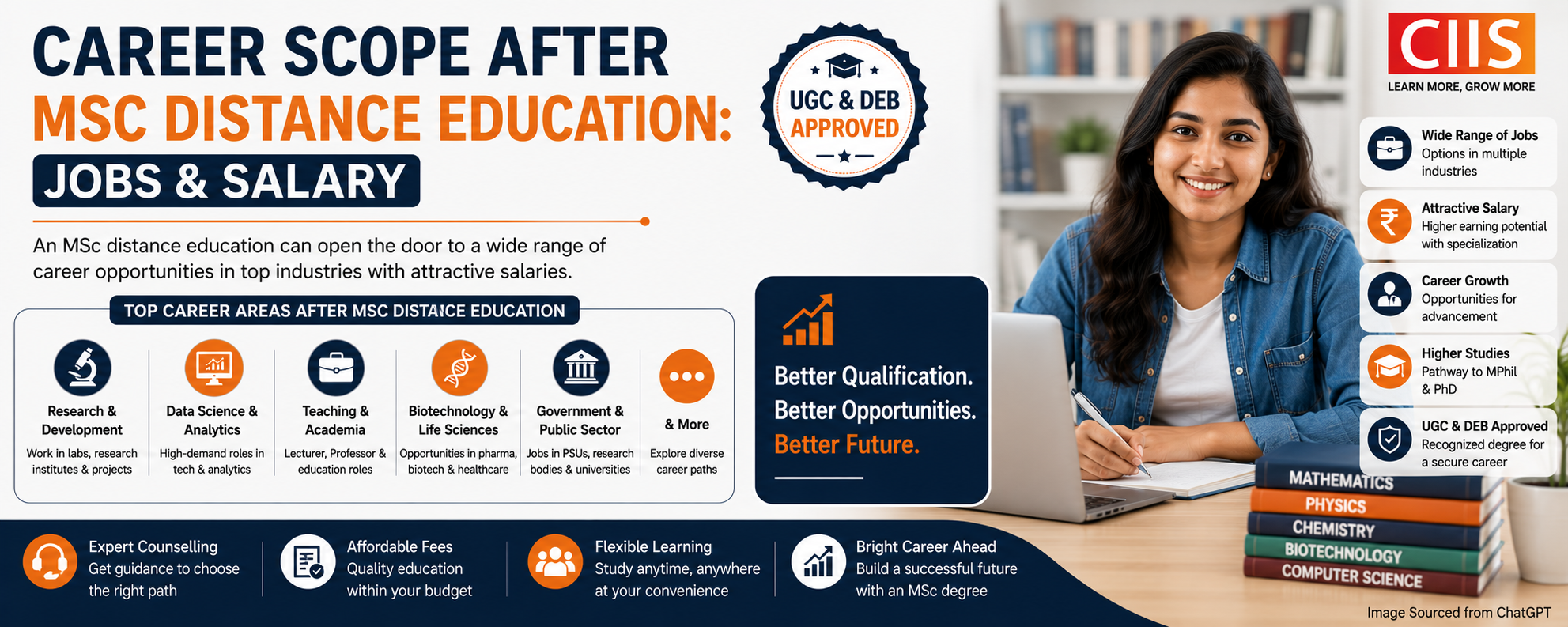
For the complete career scope and salary analysis after MSc distance education, read: Career Scope After MSc Distance Education: Jobs & Salary
5. Career Options After MCA – Job Opportunities Explained
| Job Role | Industry | Avg. Salary (2–4 Yrs Exp.) |
|---|---|---|
| Software Developer / Full Stack Engineer | IT product, startup, services companies | ₹5 – ₹12 LPA |
| Application Developer (Mobile / Web) | Digital agencies, product companies, BFSI | ₹5 – ₹11 LPA |
| System Analyst | Enterprise IT, manufacturing, logistics | ₹5 – ₹10 LPA |
| IBPS SO IT Officer | Banking IBPS, SBI technology cadre | ₹36,000 – ₹63,840 per month + allowances |
| NIC Scientist / Technical Officer | Government IT | ₹47,600 – ₹1,51,100 per month |
| IT Project Manager | IT services, consulting, corporate IT | ₹9 – ₹20 LPA |
6. Jobs After MSc CS vs MCA – Government Sector Comparison
| Government Post | MSc CS Valid? | MCA Valid? | Notes |
|---|---|---|---|
| UGC NET Computer Science (college teaching) | ✅ Yes | ✅ Yes | Both qualify for UGC NET CS & Applications Paper 87 |
| NIC Scientist / Engineer | ✅ Yes | ✅ Yes | Both accepted; B.Tech/M.Tech preferred at senior levels |
| DRDO / ISRO Scientist (CS) | ✅ Yes | ✅ Yes at most roles; check specific notification | Some DRDO units prefer M.Tech or MSc; MCA accepted at many posts |
| IBPS SO IT Officer | ✅ Yes (CS degree) | ✅ Yes (MCA specifically mentioned) | IBPS SO IT notification explicitly lists MCA and MSc CS as qualifying |
| SSC CGL (general graduation posts) | ✅ Yes | ✅ Yes | Both are postgraduate degrees from UGC-recognised universities |
| Drug Inspector / Science Dept. posts | ✅ Yes (science degree) | ❌ No MCA is applications degree, not a science degree for regulatory posts | MSc CS qualifies as a science postgraduate degree for regulatory roles; MCA does not |
For the complete government job validity analysis for MSc distance education, read: Is MSc Distance Education Valid for Government Jobs?
7. After MCA Salary vs After MSc CS Salary – 5-Year Projection
| Career Stage | After MSc CS (Avg.) | After MCA (Avg.) |
|---|---|---|
| Entry level (0–2 years) | ₹4 – ₹8 LPA | ₹4 – ₹8 LPA |
| Mid-level (3–5 years) | ₹8 – ₹15 LPA (higher in research, AI/ML) | ₹7 – ₹14 LPA (higher in senior developer, IT lead roles) |
| Senior level (6–10 years) | ₹15 – ₹35 LPA (research, ML, specialised systems) | ₹12 – ₹28 LPA (architect, manager, senior dev) |
| Government career ceiling | Professor / Associate Professor + NET qualification opens academic track | IBPS SO Officer scale → Manager; NIC Senior Technical Officer |
8. MSc Distance Education – Top Universities Offering MSc CS
| University | UGC-DEB Listed (MSc CS)? | Total Fees | Exam Mode |
|---|---|---|---|
| IGNOU | ✅ Yes | ₹10,000 – ₹20,000 | Physical centres pan-India |
| YCMOU (Maharashtra) | ✅ Yes | ₹12,000 – ₹25,000 | Mumbai study centres |
| Annamalai University | ✅ Yes | ₹18,000 – ₹35,000 | Partner centres |
| JAIN Online | ✅ Yes | ₹80,000 – ₹1,60,000 | Online proctored |
| Manipal University Online | ✅ Yes | ₹90,000 – ₹1,80,000 | Online proctored |
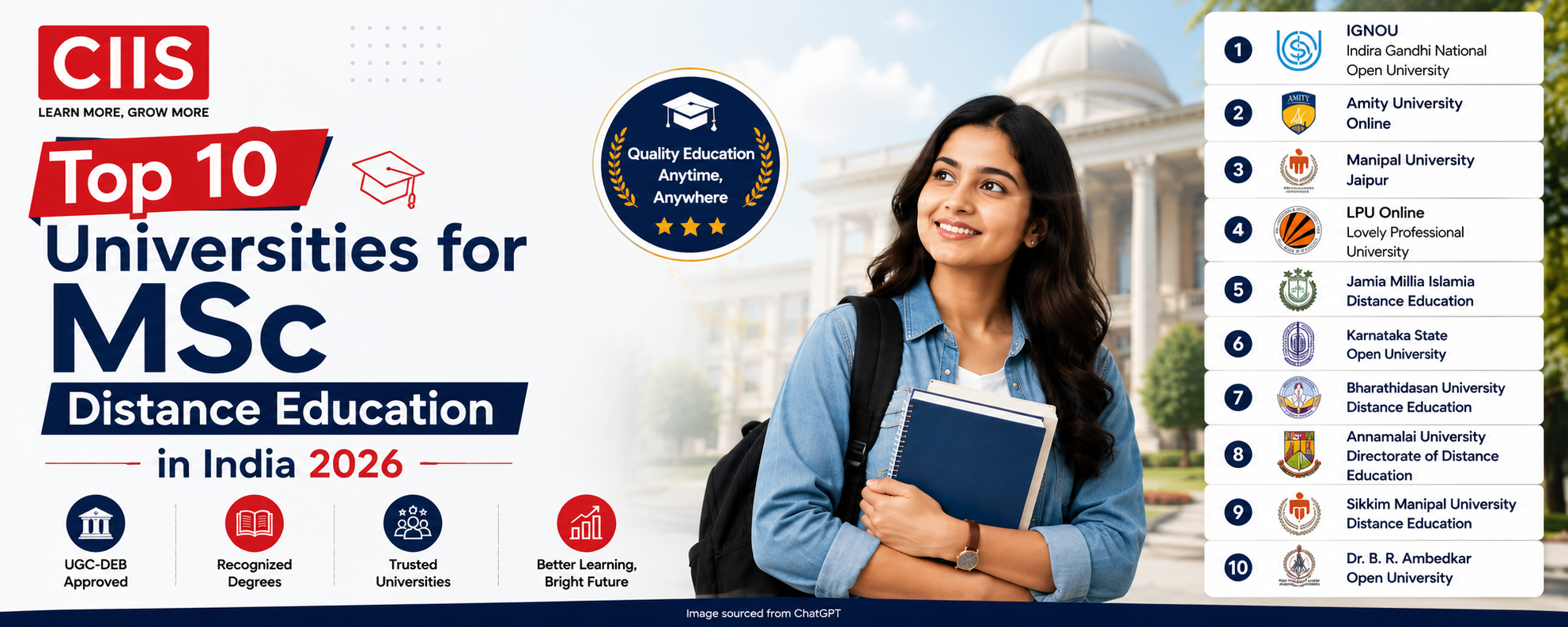
For the complete ranked university list with specialisation availability and NAAC grades, read: Top 10 Universities for MSc Distance Education in India 2026
For the complete MSc distance education program guide, read: MSc Distance Education: Everything You Need to Know in 2026
9. MCA Distance Education – Key Universities
| University | UGC-DEB Listed (MCA)? | Total Fees | Exam Mode |
|---|---|---|---|
| IGNOU | ✅ Yes | ₹25,000 – ₹42,000 | Physical centres pan-India |
| YCMOU | ✅ Yes | ₹20,000 – ₹35,000 | Mumbai centres |
| Manipal University Online | ✅ Yes | ₹90,000 – ₹1,60,000 | Online proctored |
| JAIN Online | ✅ Yes | ₹75,000 – ₹1,40,000 | Online proctored |
| Chandigarh University Online | ✅ Yes | ₹65,000 – ₹1,20,000 | Online proctored |
10. MSc Distance Education Fees vs MCA Fees – Cost Comparison
| University Category | MSc CS Total Fees (2 Years) | MCA Total Fees (2 Years) |
|---|---|---|
| Government open university (IGNOU, YCMOU) | ₹10,000 – ₹25,000 | ₹20,000 – ₹42,000 (MCA slightly higher due to program complexity) |
| Traditional private distance university (Annamalai) | ₹18,000 – ₹35,000 | ₹22,000 – ₹40,000 |
| Private online university (JAIN, Manipal, Chandigarh) | ₹80,000 – ₹1,80,000 | ₹65,000 – ₹1,60,000 |
For the complete MSc fee analysis by university, read: MSc Distance Education Fees 2026 – University-wise Comparison
11. MSc CS or MCA – Which Should You Choose?
| Choose MSc CS If | Choose MCA If |
|---|---|
| You have a BSc CS / IT / Mathematics background | You have a BCA background (MCA is the natural progression from BCA) |
| You want to pursue research, PhD, or CSIR / UGC NET | You want industry-ready application development skills |
| You want to teach in a science or engineering college (NET + MSc CS) | You want IBPS SO IT Officer eligibility (MCA is explicitly listed in the notification) |
| You are targeting AI/ML, Data Science, or research-track roles | You want software development, system analysis, or IT management roles |
| Your undergraduate was non-CS but had Maths (BSc Maths) | You had BCA or any graduation with Maths in Class 12 MCA has broader eligibility |
| You want the lowest possible fees for a top government job (IGNOU MSc CS: ₹10,000–₹20,000 total) | You want quick job placement in IT companies where MCA is a known hiring target |
12. MSc vs MCA vs MBA – Three-Way Comparison for Working Professionals
| Parameter | MSc CS | MCA | MBA (for reference) |
|---|---|---|---|
| Best background | BSc CS / Maths / IT | BCA / BSc CS / any with Maths | Any graduation |
| Career track | Technical / Research | Software / Applications | Management / Business |
| UGC NET eligible? | Yes (CS paper) | Yes (CS paper) | Yes (Management paper) |
| Average fees (distance) | ₹10,000 – ₹1,80,000 | ₹20,000 – ₹1,60,000 | ₹20,000 – ₹1,80,000 |
For the MSc vs MBA comparison for working professionals, read: MSc vs MBA: Which Is Better for Working Professionals?
13. MSc Admission 2026 – How to Enroll
For the complete MSc admission guide with eligibility matrix, intake dates, and step-by-step process, read: MSc Admission 2026: Eligibility, Process & Last Dates
14. Is MSc CS UGC Approved? What to Verify
For both MSc CS and MCA through distance mode, the same two-condition UGC-DEB approval framework applies. For the complete UGC approval verification guide, read: Is MSc Distance Education UGC Approved? Validity Explained
15. MSc Specialisations – Beyond CS: Other Options to Consider
If MSc CS and MCA both seem similar in terms of career outcomes, consider whether a specialised MSc in Data Science, Statistics, or Mathematics might give you a stronger differentiated profile. For the complete specialisation guide, read: MSc Specialisations List: Which Should You Choose?
16. MSc Distance Education in Mumbai – Free Guidance at CIIS India
For Mumbai students choosing between MSc CS and MCA through distance mode, read: MSc Distance Education in Mumbai: Top Colleges & Fees at CIIS India
CIIS India at Sej Plaza, Marve Road, Malad (West), Mumbai provides:
- Free course guidance – we map your BCA / BSc background and career goal to the right program (MSc CS vs MCA vs other options) before you apply
- UGC-DEB verification for both MSc CS and MCA programs before recommendation
- Eligibility check for both programs against your graduation subject and marks
- Complete admission support – application, documents, fee payment, enrollment tracking at no charge
- Zero-interest EMI through Eduvanz, Jodo, and Early Salary
- Walk-in at Sej Plaza, Marve Road, Malad (West), Mumbai
Frequently Asked Questions (FAQs)
For a software development career specifically, MCA has a slight practical edge the curriculum is more applications-oriented, covering web technologies, mobile development, enterprise software, and project management alongside core CS subjects. MSc CS is more theory-heavy and better suited for roles that require deep technical knowledge (algorithms, systems programming, research). Both are equally valued by most IT employers at the hiring stage, and the salary difference at entry level is minimal. If your goal is to become a software developer, application developer, or full-stack engineer, MCA is the more direct path. If you want AI/ML, research, or data science roles, MSc CS or MSc Data Science is stronger.
MCA distance education eligibility requires a bachelor’s degree BCA, BSc CS, BSc IT, or BSc Mathematics with a minimum of 45%–50% aggregate. The key condition is Mathematics: most MCA programs require Mathematics either at Class 12 level or as a subject in your undergraduate degree. At some open universities (IGNOU, YCMOU), the Mathematics requirement is more flexible BCA graduates are directly eligible without this additional check. No entrance exam is required at most distance MCA universities. Work experience is not needed. CIIS India confirms which specific university’s MCA your graduation background qualifies for.
A BCA graduate can do both MSc CS and MCA both are open to BCA backgrounds with the required marks. The traditional progression from BCA is MCA (it was originally designed as the postgraduate equivalent of BCA). However, MSc CS is equally available and may be preferred if you want research, teaching, or specialised technical roles. For most working BCA graduates in IT companies, MCA adds the most direct value in terms of employer recognition and matching the degree type to the work. For those targeting UGC NET, government research posts, or AI/ML roles, MSc CS or MSc Data Science is equally strong or stronger.
Starting salaries after MCA in India in 2026 range from ₹4–₹8 LPA at entry level for software developer and system analyst roles. With 3–5 years of experience, MCA graduates typically earn ₹7–₹14 LPA at mid-level positions including senior developer, tech lead, and IT manager. In government roles, IBPS SO IT Officers earn ₹36,000–₹63,840 per month plus allowances; NIC Scientist / Technical Officers earn ₹47,600–₹1,51,100 per month at the base scale. MCA graduates at product companies with specialisation in cloud, mobile, or enterprise platforms can earn ₹12–₹25 LPA at 5+ years experience.
Both MSc CS and MCA are equally valid for most government IT posts UGC NET Computer Science (Paper 87), NIC Scientist/Technical Officer, DRDO/ISRO CS positions, IBPS SO IT Officer, and SSC CGL. The one area where MSc CS has an advantage over MCA is in science-department government posts (Drug Inspector, Lab Analyst, CSIR research) that require a science postgraduate degree MCA is not classified as a science degree and does not qualify for these. For college teaching through UGC NET, both qualify for the same CS paper. CIIS India advises on which degree better suits your specific government target post before enrollment.
MCA distance education now takes 2 years (4 semesters) UGC revised the duration from 3 years to 2 years in 2020 as part of the National Education Policy alignment. All distance and regular MCA programs from 2020 onwards are 2-year programs. Most open universities allow up to 4 years for completion, giving working professionals flexibility to take one semester at a time. The minimum duration of 2 years is fixed and cannot be shortened any program claiming to offer MCA in less than 2 years is not following current UGC norms.
Yes MSc CS from a UGC-DEB listed university (whether earned through distance or regular mode) is valid for PhD admission at UGC-recognised universities. PhD admission criteria require a master’s degree from a recognised university with minimum 55% marks (50% for reserved categories). The UGC regulations explicitly state that distance and regular master’s degrees have equal eligibility for all purposes including research admission. Many IGNOU and YCMOU MSc CS graduates have proceeded to PhD programs at regular universities. UGC NET qualification alongside the MSc CS makes the research profile stronger for funded PhD positions.
For someone already working in IT, the choice depends on what you want the degree to do for you. If you want a designation upgrade, qualification for IBPS SO IT Officer, or enhanced credibility as a developer MCA from IGNOU or a private online university is the most cost-effective and directly relevant option. If you want to move into data science, AI/ML, or research-oriented roles, MSc CS or MSc Data Science from JAIN Online or Manipal Online is a stronger choice. If your budget is limited and you primarily want a qualification that clears HR background checks, IGNOU MCA (₹25,000–₹42,000 total) is the most accessible and widely accepted option in India. CIIS India recommends the specific program based on your current role, target role, and budget.